





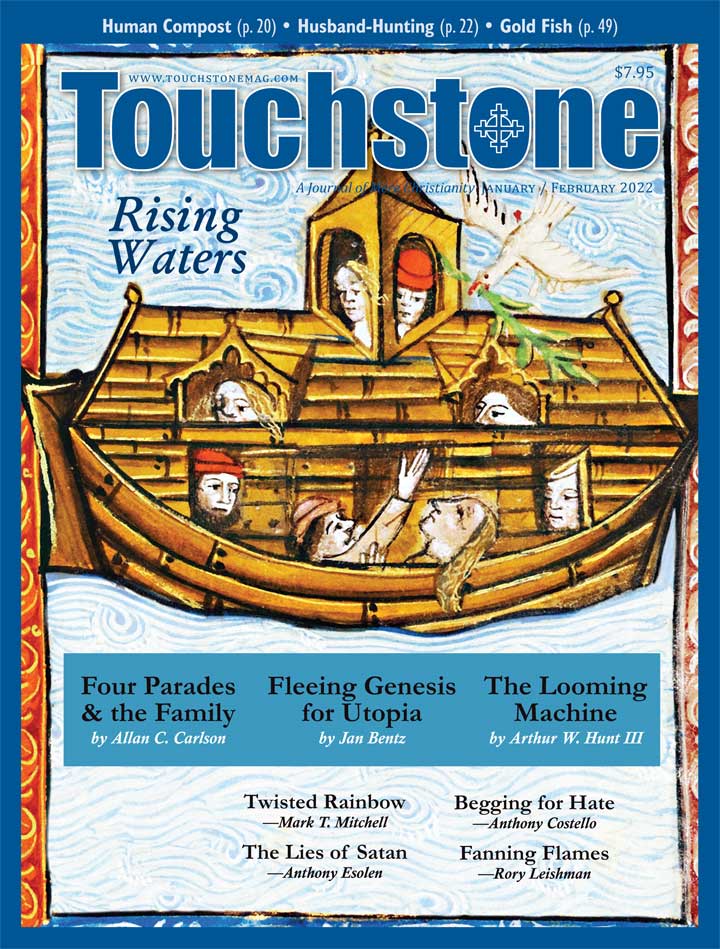
Twisted Rainbow
Mark T. Mitchell on the Subversive Tyranny of a Month of Pride
Last June we completed yet another month dedicated to Pride, one of the seven deadly sins. But this is not just a generic and amorphous pride that would suggest a general disorder of souls. Instead, the United States, and indeed much of the world, has set aside June as a month to celebrate LGBT practices and ideas. Thus, we are enthusiastically celebrating the fact that we are proud of our national proclivity to sexual antinomianism.
But why pride and why sex? There is a curious dynamic at work here, and it behooves us to press a bit. The LGBT movement has, if nothing else, experienced unprecedented success in the last two decades, and Pride Month is a key indicator of that success. It is as if the world decided to celebrate origami or extroversion and, to commemorate the enthusiasm, designed symbols, organized parades, and compelled schools, businesses, and governments to join in the celebration. Hurray for Origami!
But what is being celebrated in June is not simply a morally indifferent practice or inclination. Sex has always been seen as deeply and unavoidably moral, and a movement aggressively celebrating what were once seen as abhorrent sexual practices represents a remarkable social transformation, the effects of which we have only begun to realize.
A Tight, Self-Referential Circle
Everyone seems to agree that sex matters, and that a society's view of sex tells us significant things about that society. Not long ago, sex was understood as ideally existing between a man and a woman within the bonds of marriage and ordered toward the procreation and nurture of children. Such a view of sex seems, in this brave innovative world, both quaint and confining. Why foist artificial limits upon sexual desire? Why place children at the center, rather than individuals' pleasure and, of course, love?
Love obviously isn't what it used to be, but the word still has tremendous social and psychological power even if the metaphysical orientation has changed. For the Christian, love is ultimately found in God, and a creature's love is necessarily ordered toward its Creator. Love and the divine order are inseparable; thus, to love is to participate in that divine order as a creature submitting to the Creator.
However, in an effort to wrench free from the constraints implied in submitting to a given order, the focus of love has been redirected from God to the privatized human subject. My love is my business. I can love whomever I desire. In the process, love and sex are conflated in a dramatic diminishment whereby love is reduced to the comingling of body parts. Love and desire have been cut loose from any normative direction or order. They have, instead, been reconceived as the twin aspects of a sexuality liberated from teleology or theology. I love what I desire and I desire what I love. It is a tight circle of self-referential eros, unmoored, free-floating, and infinitely malleable.
Removing Impediments
Once this conception of love is widely accepted, the next task is political: remove all impediments to the free and unhampered expression of erotic desire. But even after legal impediments are removed, the work is not complete, for to achieve the maximum latitude of desire, social impediments must also be dissolved. We called this phase "tolerance."
And even after that, there is work to be done, for tolerance still implies disapproval even if there is no overt move to forbid, because one only tolerates what one disapproves of. Thus, the final step in the process had to be the shift from tolerance to celebration. And the best way to solidify this final move is to cloak it in the self-affirming language of pride.
Mark T. Mitchell teaches political theory at Patrick Henry College in Virginia. He is the co-founder of Front Porch Republic.
A Journal of Mere Christianity—Delivered to Your Door
- Essays on theology, culture, and the Church
- Contributors from across the Christian traditions

Six print issues (one year) of Touchstone, plus full online access and PDF downloads for only $39.95.

Get a one-year full-access subscription to the Touchstone online archives for only $19.95.
bulk subscriptions
Order Touchstone subscriptions in bulk and save $10 per sub! Each subscription includes 6 issues of Touchstone plus full online access to touchstonemag.com—including archives, videos, and pdf downloads of recent issues for only $29.95 each! Great for churches or study groups.
Transactions will be processed on a secure server.
more on sex from the online archives

31.6—November/December 2018
on the Church's Response to the Anti-marriage Tide by Diane Woerner
23.5—September/October 2010
The Loss of a Christian Understanding of Virginity Is Pure Tragedy by Eleanor Bourg Donlon

27.6—Nov/Dec 2014
Tales of Forbidden Stereotypes
Real-Life Men & Women & the Tragic Loss of Human Comedy by Anthony Esolen
more from the online archives

26.1—Jan/Feb 2013
The Alternate & Alternative Worlds of H. P. Lovecraft & C. S. Lewis by C. R. Wiley

33.3—May/June 2020
Maternal Body: A Theology of Incarnation from the Christian East by Carrie Frederick Frost
Fertile Ground: A Pilgrimage Through Pregnancy by Laura S. Jansson by Agnes R. Howard
19.8—October 2006
on the Good Father’s Quiet Desperation by Russell D. Moore
calling all readers
Please Donate
"There are magazines worth reading but few worth saving . . . Touchstone is just such a magazine."
—Alice von Hildebrand
"Here we do not concede one square millimeter of territory to falsehood, folly, contemporary sentimentality, or fashion. We speak the truth, and let God be our judge. . . . Touchstone is the one committedly Christian conservative journal."
—Anthony Esolen, Touchstone senior editor
