Henri Matisse's Chapel of the Rosary
Night nurse needed—Should be young and pretty." So ran the advertisement placed in 1941 by the 71-year-old artist Henri Matisse while he recovered from cancer surgery. Nursing student Monique Bourgeois answered the ad and not only nursed the convalescent painter but also became his model, studio assistant, and close friend. At this point Matisse was experimenting with the cutouts that eventually became the series known as Jazz: essentially drawing with his scissors, he cut brightly painted paper into shapes that his assistants pinned to the wall at his direction. An amateur artist herself, Monique helped to paint the colored paper and position the shapes, and, according to his biographers, Matisse found her to be "stimulating, funny, and touching."
Shortly thereafter, though, Bourgeois contracted tuberculosis and went to a convalescent home run by Dominican nuns in Vence. In 1943, refusing to leave France in spite of the war, Matisse moved to Vence, and the two resumed their friendship. But a stronger friendship called to Monique Bourgeois. She entered the Dominican novitiate and in 1946 took her permanent vows as Sister Jacques-Marie. Matisse had strongly objected to her vocation in his letters to her ("I do not need any lectures about religious calling. I've not needed the sacraments to glorify the name of God throughout my life"), but nevertheless they remained friends.
The Design of the Oratory
The nuns were in need of an oratory, as the room they were using was little more than a leaky shed. Sister Jacques-Marie enlisted the aid of her old friend. Soon he was drawn into a project that consumed his next five years, shaped his art and the end of his life, and produced one of the few masterpieces of modern liturgical art.
The road to completion was not a smooth one. A mass of Matisse's preparatory material—many, many charcoal drawings, pen sketches, brush drawings, models, mock-ups, and full-scale designs—still exists, and from it we can reconstruct his artistic processes and learn much about the ultimate intent and meaning of the Chapel of the Rosary.
In order to adapt an essentially non-figurative, abstract Modernist style to the needs of the Dominican nuns, their work, and their liturgy, Matisse had to immerse himself in all aspects of Dominican life, and to collaborate with the community at Vence and the Dominicans at large. The nuns at Vence were a cloistered order, and nearly their only contact with the outside world was with the tubercular girls in their school. Apart from nursing and educating the girls, the main work of the order was the chanting of the Office, the liturgical Hours in simple Gregorian chant, which the Dominicans felt they had preserved in its purest form. So their oratory required two distinct spaces, one for lay people attending Mass, and another for the nuns to attend Mass, chant the Office, and have room for private prayer, all out of sight of the laity.
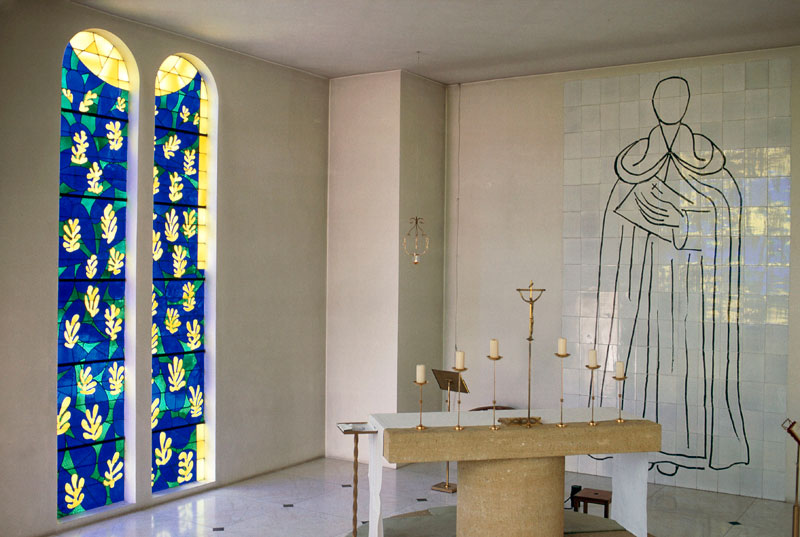
To this end Matisse designed an L-shaped space, with the nuns' choir in the short leg and the lay people in the larger part of the L. Drawing on the example of early Dominican monastic churches in the Haut-Rhin, he called for rather high lateral walls, pierced with tall lancet windows. The two arms of the chapel converge at the altar, behind which is a broader window visible from both parts of the building. The walls, the floor, and all the mural decorations are executed in ascetical white tile and marble with black accents, while the windows are of stained glass in pure, deep tones of blue, green, and gold, so that the brilliant Mediterranean sun, falling from the south and west, sets the whole chapel awash with color. Otherwise, the only other color in the chapel is provided by the priest's vestments, which Matisse also designed with a brilliance and exuberance that one critic describes as "totally mad." (Matisse enlisted the major fashion houses of Paris to donate silks, brocades, and velvets for his designs; the first set, when executed, was too heavy for the chaplain to stand up in, and had to be redone in much lighter materials.)
The St. Dominic Mural
The first of the murals, St. Dominic, sits opposite the nuns' choir, so that it is always in their line of sight. To construct the image, Matisse began with drawings of his two Dominican consultants, Brother Rayssiguier and Father Couturier, spare line drawings without shading or perspective and the barest indications of facial features and the shape of the Dominican habit. For Matisse, line drawing demanded the strictest discipline. Before setting charcoal to paper, he would rehearse his hand's motion over and over until he felt he had it exactly right. From the first sketches, Matisse reworked the design in a long series of re-drawings, simplifying and refining his design even further. The end result presents us with a visionary St. Dominic, transparent, faceless, levitating in space and holding up the book of his Rule as a perpetual example to his followers.
The Dominican Couturier was a Neo-Platonist, who maintained that abstract form was the clearest expression of the mystical and supernatural, and that plastic, three--dimensional representation was an impediment to the life of prayer. For him, Matisse's fluid linear style was the modern equivalent of the Byzantine icon (which the artist studied during the course of his work at Vence), dematerialized, transparent, a window onto the supernatural world.
This St. Dominic, minimal as he may seem, is an embodiment of the life to which his followers were called. Faceless, he reminds us of the self-abnegation of the Dominican way of life, and the book he holds is the Rule which shapes that life. Additionally, Dominic was the initiator of the devotion of the rosary, to which the chapel is dedicated. At least since the years of the Black Death, the rosary has been associated with powers of healing; the nuns at Vence devoted their days to the healing of that latter-day plague, tuberculosis.
Mary Elizabeth Podles is the retired curator of Renaissance and Baroque art at the Walters Art Museum in Baltimore, Maryland. She is the author of A Thousand Words: Reflections on Art and Christianity (St. James Press, 2023). She and her husband Leon, a Touchstone senior editor, have six children and live in Baltimore, Maryland. She is a contributing editor for Touchstone.
A Journal of Mere Christianity—Delivered to Your Door
- Essays on theology, culture, and the Church
- Contributors from across the Christian traditions

Six print issues (one year) of Touchstone, plus full online access and PDF downloads for only $39.95.

Get a one-year full-access subscription to the Touchstone online archives for only $19.95.
bulk subscriptions
Order Touchstone subscriptions in bulk and save $10 per sub! Each subscription includes 6 issues of Touchstone plus full online access to touchstonemag.com—including archives, videos, and pdf downloads of recent issues for only $29.95 each! Great for churches or study groups.
Transactions will be processed on a secure server.
more on art from the online archives
more from the online archives
calling all readers
Please Donate
"There are magazines worth reading but few worth saving . . . Touchstone is just such a magazine."
—Alice von Hildebrand
"Here we do not concede one square millimeter of territory to falsehood, folly, contemporary sentimentality, or fashion. We speak the truth, and let God be our judge. . . . Touchstone is the one committedly Christian conservative journal."
—Anthony Esolen, Touchstone senior editor