John Paul the Scribe
An Appreciation of Centesimus Annus on Its 30th Anniversary
"When a society is perishing, the wholesome advice to give to those who would restore it is to call it to the principles from which it sprang."—Pope Leo XIII
"Christianity conceals within its womb a much greater treasure for a renewal of life than one suspects."—Johann Gottlieb Fichte
"The present Encyclical has looked at the past, but above all it is directed to the future . . . and its intention, with God's help, is to prepare for that moment."—Pope John Paul II
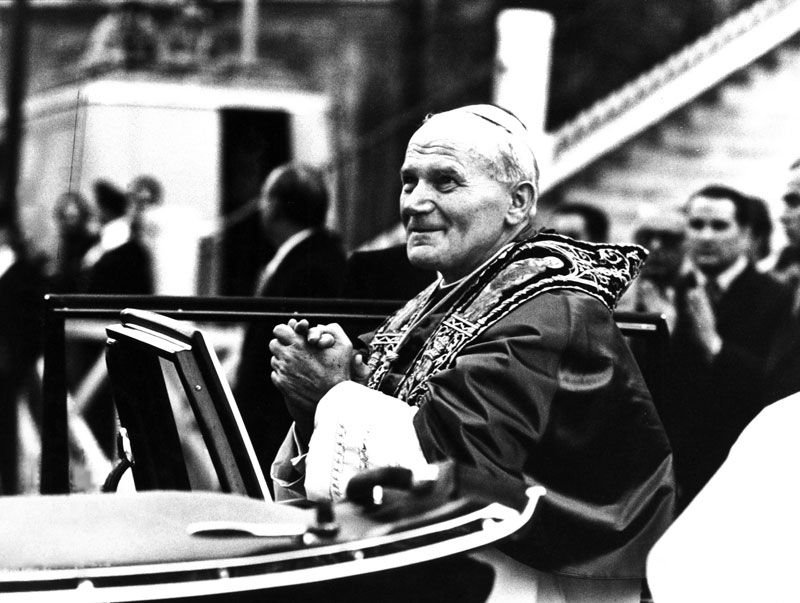
It is easy to overlook the sheer productivity that characterized the 27-year pontificate of John Paul II. A remarkable fourteen major encyclicals—which is to say, one every two years—accompanied numerous Apostolic Letters, Apostolic Exhortations, and other papal documents that issued from his pen. Virtually all of these writings of the former cardinal from Poland, Karol Wojtyla, and first non-Italian pope in 455 years, who acceded to the Roman Catholic pontificate in 1978, touched on themes that concerned the intersection of faith and culture. John Paul, of course, was strategically placed. As noted by the United States Conference of Catholic Bishops, he served as the "spiritual protagonist" in two momentous global transitions: the fall of European communism and passage into the third millennium of Christianity.
Papal encyclicals, if we may be honest, do not make for the easiest of reading. They tend to be written in a style that is formal, stiff, and plodding, at times laborious, and without illustrations or personal "connections." It goes without saying that they do not make for common bedtime reading; most of us do not engage in serious cultural critique before we turn out the lights each night and fall asleep.
Nevertheless, the particular pronouncements that came from John Paul demonstrated extraordinary insight into both the assumptions that drive modern and ultra-modern culture and the response needed by the Christian Church, given the cultural challenges that confront us. No pope in recent memory was so prolific; his pen was as active as his mind. And none has demonstrated greater ability to speak to the present cultural context from the standpoint of historic Christian faith.
Things Old & New
Published on May 1, 1991, Centesimus annus (hereafter CA) was intended to celebrate and honor the encyclical Rerum novarum (hereafter RN), published a century before by Pope Leo XIII. In John Paul's words, RN constituted what would come to be called "the Church's 'social teaching,' even its 'social magisterium'" (CA 2). For this reason, John Paul invited a "re-reading" of RN in order to assess the present and "look to the future"—a context, he well understood, that was "filled with uncertainties." The inspiration for CA was said to derive from the Gospel image of "the scribe who has been trained for the kingdom of heaven," whose calling is to "bring out of his treasure what is new and what is old" (CA 3; cf. Matt. 13:52). "What is old" is that tradition of truth passed on by the Church that enables us to interpret "new things" in the midst of contemporary life in the world.
But what was it precisely that was inspiring in RN, which, by 1991, lay a century in the past? What was it in that "old" treasure that might inform the "new"?
The end of the nineteenth century witnessed social, economic, and political developments whose roots even then were well established yet whose outworking among the nations was shortly to become "revolutionary," resulting in "a new conception of society and State" (CA 4). In response to the socio-economic and political realities of that time, in particular, "the danger of a revolution fanned by the ideals which were then called 'socialist,'" Pope Leo reasserted the bond between human freedom and enduring truth. At the heart of this response was "the defense of the human person and the safeguarding of human dignity" (CA 3) in the face of, inter alia, evolving social conditions, the changing relationship between employers and workers, the growing distinction between wealth and poverty, and a notable decline in morality.
J. Daryl Charles is the Acton Institute Affiliated Scholar in Theology & Ethics. He is the author or editor of twenty books, including Retrieving the Natural Law (2008), Natural Law and Religious Freedom (2018), and, most recently, Just War and Christian Traditions (forthcoming). He is also co-editor of Abraham Kuyper, Common Grace: God's Gifts for a Fallen World, Volume 3 (2020). He is a contributing editor to Touchstone.
A Journal of Mere Christianity—Delivered to Your Door
- Essays on theology, culture, and the Church
- Contributors from across the Christian traditions

Six print issues (one year) of Touchstone, plus full online access and PDF downloads for only $39.95.

Get a one-year full-access subscription to the Touchstone online archives for only $19.95.
bulk subscriptions
Order Touchstone subscriptions in bulk and save $10 per sub! Each subscription includes 6 issues of Touchstone plus full online access to touchstonemag.com—including archives, videos, and pdf downloads of recent issues for only $29.95 each! Great for churches or study groups.
Transactions will be processed on a secure server.
more on Catholic from the online archives
35.4—Jul/Aug 2022
The Death Rattle of a Tradition
Contemporary Catholic Thinking on the Question of War by Andrew Latham
more from the online archives
calling all readers
Please Donate
"There are magazines worth reading but few worth saving . . . Touchstone is just such a magazine."
—Alice von Hildebrand
"Here we do not concede one square millimeter of territory to falsehood, folly, contemporary sentimentality, or fashion. We speak the truth, and let God be our judge. . . . Touchstone is the one committedly Christian conservative journal."
—Anthony Esolen, Touchstone senior editor