




Fair to Middle Earth
Even the token conservative Catholic among the extensive stable of editorial writers employed by the New York Times enjoys only limited latitude in the opinions he is permitted to express in the pages of America's most influential organ of progressive piety. Although what Ross Douthat writes is more likely to be thoughtful, coherent, and prudent than most of what is on offer in the Times, it appears that he must still make concessions. Much as Christians in pagan Rome were permitted to worship Jesus so long as they were willing to burn an occasional pinch of incense to the divinity of the emperor; just so, writing for our nation's paper of record evidently requires everyone, even the man paid to be a conservative anomaly, to offer occasional obeisance to the gods of imperial progressivism.
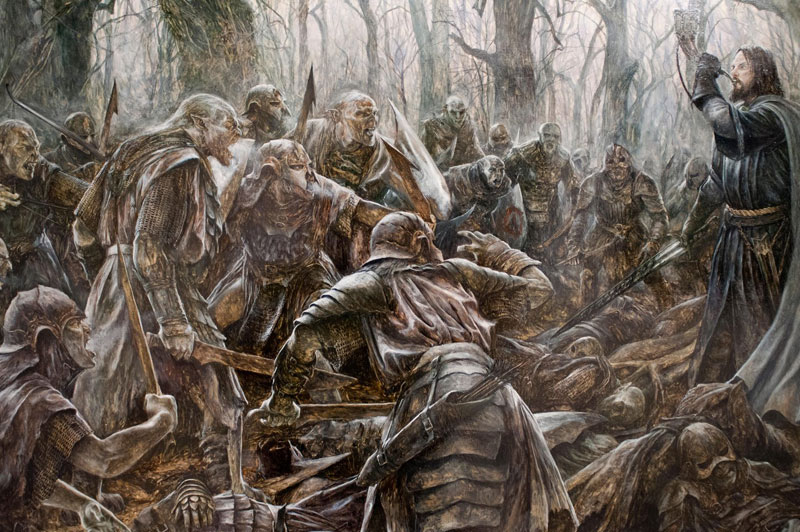
A piece by Douthat in the New York Times of March 7, 2021, "Do Liberals Care If Books Disappear?", deplores the decision by the custodians of the copyright to the "Dr. Seuss" books, so popular among children, to withdraw from publication six of the books, deemed by a "panel of experts" to "portray people in ways that are hateful and wrong." Even as he inveighs against this example of "cancel culture," Douthat concedes, however, that "Western children's literature really has been influenced by imperialism and racism. The Babar books have obvious colonialist undertones." Then there is The Lord of the Rings, "with its Greco-Roman Gondorians besieged by darker races from the south and east": although it is "a work of genius," still, "Tolkien's chauvinism is a real moral and artistic flaw."
These problematic assertions seem to be Douthat's bit of incense in the sacrificial fire.
THIS ARTICLE ONLY AVAILABLE TO SUBSCRIBERS.
FOR QUICK ACCESS:
R. V. Young is Professor of English Emeritus at North Carolina State University, a former editor of Modern Age: A Quarterly Review, and the author of Shakespeare and the Idea of Western Civilization (Catholic University of America Press, 2022). He and his wife are parishioners at St. Ignatius of Antioch Church in Tarpon Springs, Florida. They have five grown children, fifteen grandchildren, and three great-grandchildren. He is a senior editor of Touchstone.
A Journal of Mere Christianity—Delivered to Your Door
- Essays on theology, culture, and the Church
- Contributors from across the Christian traditions

Six print issues (one year) of Touchstone, plus full online access and PDF downloads for only $39.95.

Get a one-year full-access subscription to the Touchstone online archives for only $19.95.
bulk subscriptions
Order Touchstone subscriptions in bulk and save $10 per sub! Each subscription includes 6 issues of Touchstone plus full online access to touchstonemag.com—including archives, videos, and pdf downloads of recent issues for only $29.95 each! Great for churches or study groups.
Transactions will be processed on a secure server.
more on J. R. R. Tolkien from the online archives
more from the online archives

22.6—July/August 2009
on a Noble Defense Doomed by Darwinian Materialism by John G. West

31.2—March/April 2018
How Best to Face the Total War of the Anti-Culture by R. J. Snell
32.1—January/February 2019
Sex, Women's Ordination & the Rejection of Hierarchy & Equality by James A. Altena
calling all readers
Please Donate
"There are magazines worth reading but few worth saving . . . Touchstone is just such a magazine."
—Alice von Hildebrand
"Here we do not concede one square millimeter of territory to falsehood, folly, contemporary sentimentality, or fashion. We speak the truth, and let God be our judge. . . . Touchstone is the one committedly Christian conservative journal."
—Anthony Esolen, Touchstone senior editor
