





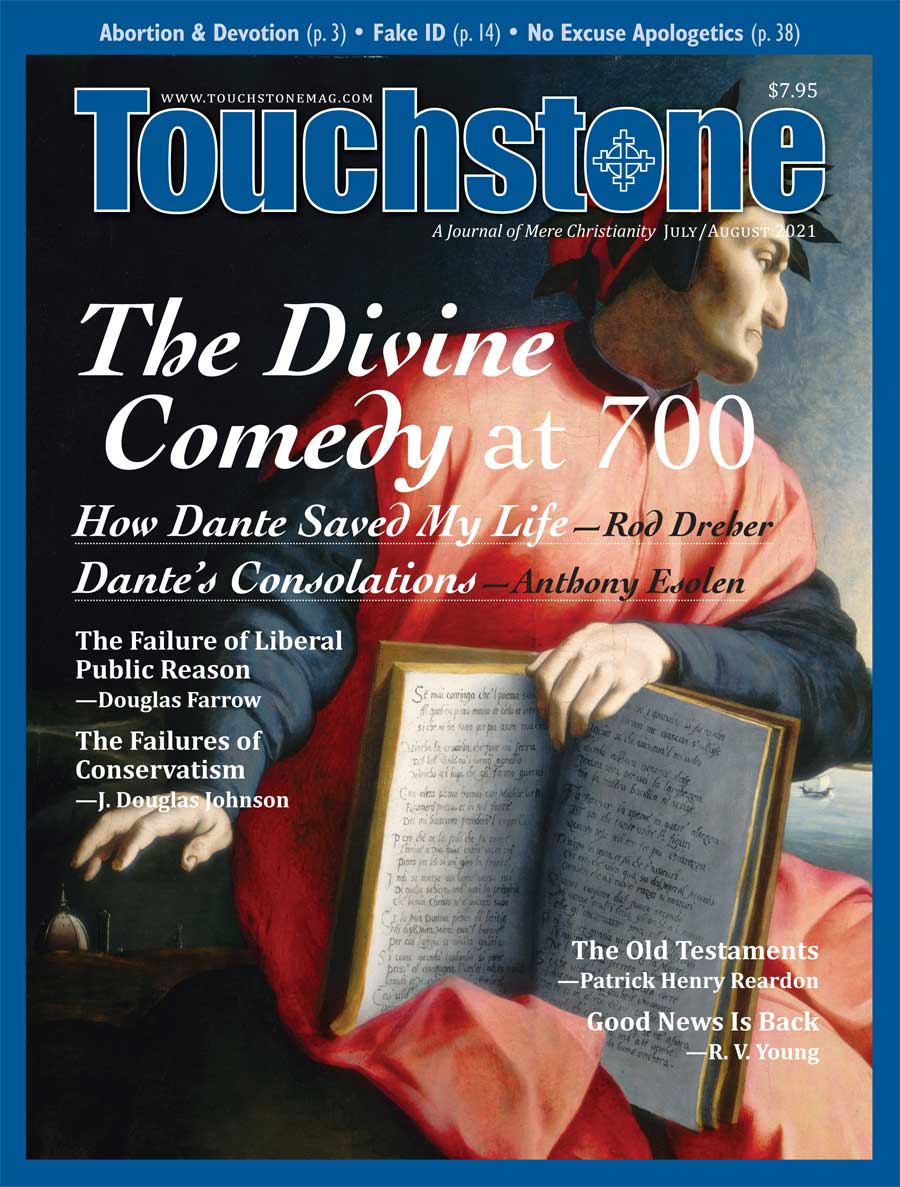
Grateful for Dante
How the Great-Souled Tuscan Saved My Life
On a warm October day in Ravenna, the ancient Roman imperial capital on the Adriatic, I walked down a street that runs by the Franciscan basilica and dead-ends at a small neoclassical monument topped with a dome. This is the Tomb of Dante, erected in the city where the fourteenth-century poet spent the final years of his life, and died. I entered the shaded portico quietly and stood to the side, waiting for German tourists to finish their inspection of the sarcophagus. Then, alone at the grave of the man whom God had used to deliver me from my own dark wood, I fell to my knees and prostrated myself in gratitude.
This is not the kind of place a middle-aged man from a small Louisiana town finds himself, nor is making a full prostration the normal thing that Dante admirers do at his tomb. But I needed to do this as an act of pietas. The wandering Tuscan had saved my life. He saved me from what the Welsh call hiraeth, defined as "homesickness for a home to which you cannot return; the nostalgia, the years, the grief for the lost places of your past."
Shattered Illusions
I was born in St. Francisville, a little Mississippi River town, the only son of my father. He named me after himself—I am Ray Oliver Dreher, Jr.—because he wanted me to be just like him. What a man he was! My father, who died in 2015, was one of the most intelligent, brave, and accomplished men I have ever known. With the exception of a few years serving in the U.S. Coast Guard, he spent his entire life in West Feliciana Parish, our home. He was the master of everything there. He was an accomplished athlete in his youth, a skilled hunter all his life, the kind of man who could repair anything, and a model of physical courage. Local men looked to him for wisdom and leadership. In an earlier age, he would have been a chieftain.
I was . . . not him. Daddy sired a son who was intensely bookish and a terrible athlete. I was so tenderhearted towards animals that I forced myself to shoot them because I was so desperate not to fail my father's expectations. He was mostly kind and nurturing towards my younger sister and me, but it was clear that I was a disappointment to him. (My country-girl sister Ruthie, though, was the son he never had.) My teenage years were quite turbulent between us, and made it clear to me that I would have to live away from his disapproving gaze if I wanted to flourish.
Flourish I did. My journalism career took me to Washington, New York, and other big cities. I did well. With distance between us, my dad and I got along fine. My sister married, started a family, built a house across the gravel road from my folks, and taught in the local school system. I married, started a family, and migrated from city to city, like many people of my generation do. Then, in 2011, Ruthie died of cancer. My wife and I felt called to return to St. Francisville to serve the family. I was at the point in my career where I could live anywhere and write. We left Philadelphia in early winter, and were at home in St. Francisville in time for Christmas.
Days into the new year, I landed a big book deal to tell the story of my sister and my decision to move back to my roots. I looked forward to paying tribute to her memory and my family. I had come home in honor, and was now in a position to bring honor and glory through my writing. I was on top of the world.
Then, as I was finishing the manuscript for the book, my sister's oldest child, Hannah—whose gift and whose curse is an inability to keep her mouth shut and stay on script—explained to me why her younger sisters were keeping my wife and me at bay. They had all been raised by their sainted mother to reject us as fake, unreliable "city people"—and my father had encouraged them in this. Hannah said that there was no way any of them would accept me and my family, and that it broke her heart to watch us keep trying, not knowing the back story.
Hannah and I were standing on the Boulevard Saint-Germain in Paris when she revealed the truth to me. It was from that spot that I entered exile. Yet I had to go back home and keep living there, where we were not wanted. I confronted my father about this. His denials were weak and unconvincing. My illusions about family were shattered. I fell into a deep depression, and became ill with chronic mononucleosis, brought on by the stress. My rheumatologist said that I would never recover unless I left Louisiana. I told him I couldn't do that, because as the only child of my parents still alive, I had a duty to take care of them.
"Well," he said, "you had better find some way to get inner peace, or you're not going to make it."
Rod Dreher is a contributing editor to Touchstone. He is a writer and blogger and the author of several books, including The Benedict Option (2017) and Live Not by Lies: A Manual for Christian Dissidents (2020).
A Journal of Mere Christianity—Delivered to Your Door
- Essays on theology, culture, and the Church
- Contributors from across the Christian traditions

Six print issues (one year) of Touchstone, plus full online access and PDF downloads for only $39.95.

Get a one-year full-access subscription to the Touchstone online archives for only $19.95.
bulk subscriptions
Order Touchstone subscriptions in bulk and save $10 per sub! Each subscription includes 6 issues of Touchstone plus full online access to touchstonemag.com—including archives, videos, and pdf downloads of recent issues for only $29.95 each! Great for churches or study groups.
Transactions will be processed on a secure server.
more on literature from the online archives
30.5—Sept/Oct 2017
on Costly Grace in Breece D'J Pancake's Flyover Country by Casey Chalk
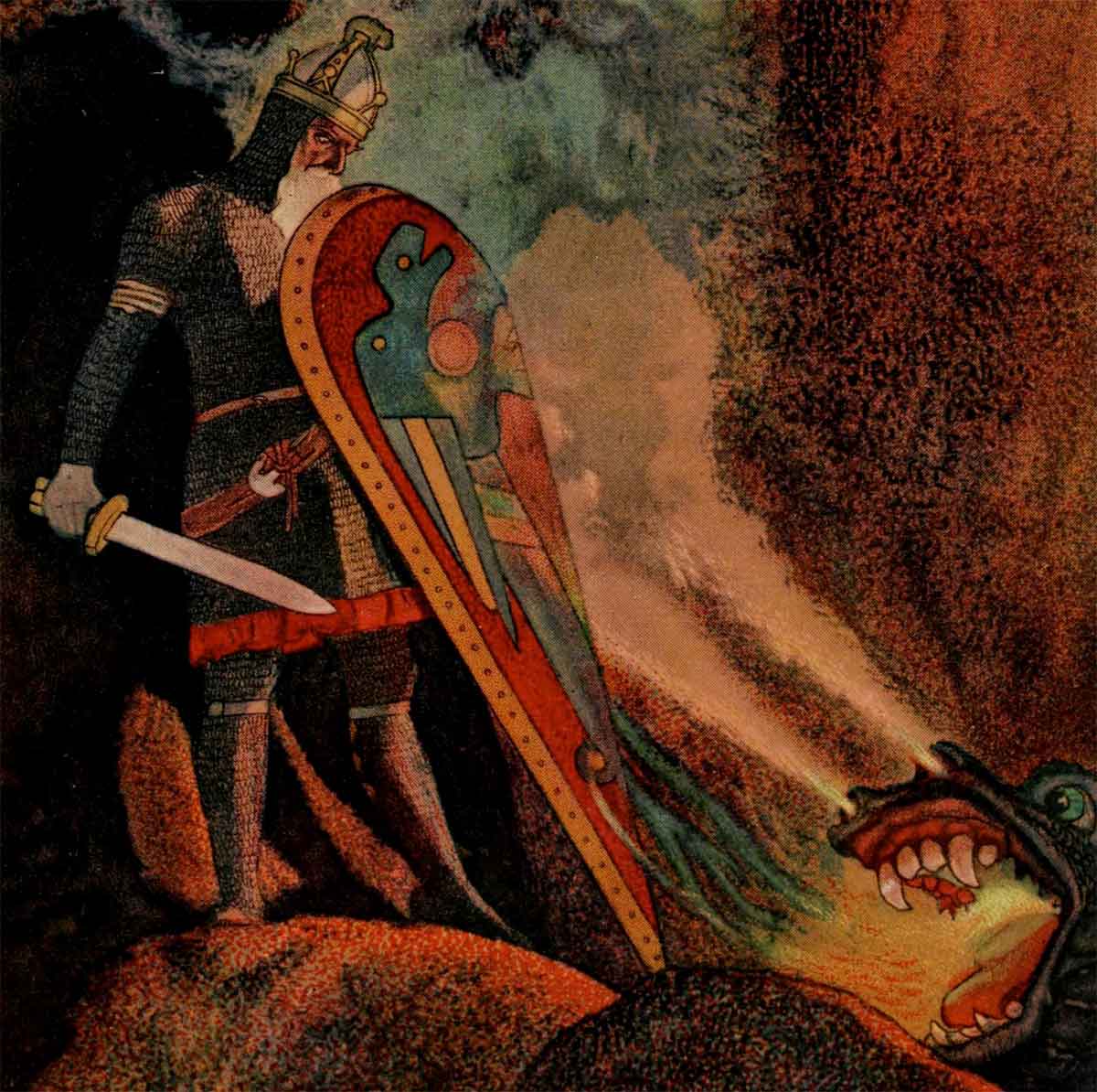
20.6—July/August 2007
The Beowulf Poet Was a Shrewd Christian Apologist by Douglas Wilson
more from the online archives
27.4—July/August 2014
The Bible, Sacred Theology & the Mind of Christ by Patrick Henry Reardon


calling all readers
Please Donate
"There are magazines worth reading but few worth saving . . . Touchstone is just such a magazine."
—Alice von Hildebrand
"Here we do not concede one square millimeter of territory to falsehood, folly, contemporary sentimentality, or fashion. We speak the truth, and let God be our judge. . . . Touchstone is the one committedly Christian conservative journal."
—Anthony Esolen, Touchstone senior editor
