




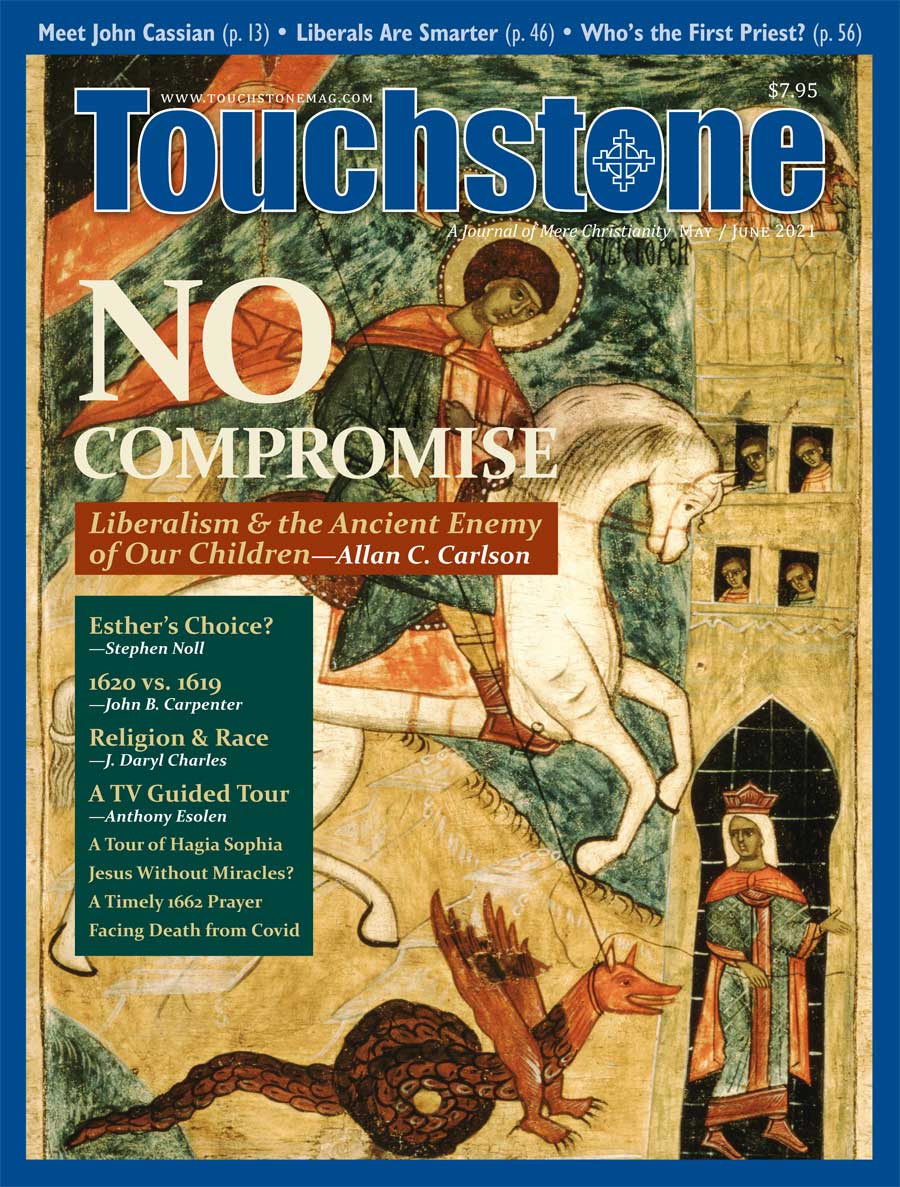
A Hymn for His Courts
by Anthony Esolen
I've often said that beauty is not just for museums, or the parlors of rich people, or professors browsing among books of poetry, but for everyone. There was a time when every peasant in Europe need only turn to his village church to find himself amidst beautiful art in stone and paint and wood and glass. In particular, the art of poetry—song, and story told in song—is universal to man, or was so until our place and time, when no songs are passed from the memory of one generation to another, and most college graduates have never heard of Tennyson and would be hard put to read something like The Idylls of the King, once enjoyed by young and old regardless of their schooling.
And I have seen this collapse in the hymns that Christians sing. In our time, a church service may be the only chance for an ordinary person to encounter a real poem in his own language; a poem he can get by heart, set to a memorable melody, so that it may work in his imagination forever. All he needs is a mind and a voice—and a real hymn, rather than what is clumsy, sloppy, foolish, or destructive of the faith.
So I would like to present here a model of what a sacred poem is, in English. I don't imply that it is the only model or the finest model. I do imply that its virtues are necessary for any decent hymn. The melody should be singable by both men and women in great numbers all at once; it must not be for a soloist with a guitar, or a choir. The text must not be piety-salad. The hymn should make grammatical sense. It should be clear. It should have a beginning, a middle, and an end. The parts should have to do with one another. It should make a point, tell a story, make an appeal, or meditate upon some image in Scripture.
A Meditation on Psalm 84
Here, then, is "Pleasant Are Thy Courts Above," by Henry Francis Lyte (1834). The hymn is a meditation on Psalm 84, "How lovely is your dwelling place, O Lord of hosts!" The Psalmist was thinking of the Temple in Jerusalem. Lyte is thinking of the new Temple, the Church. The Psalmist has at most a vague sense of eternity: "A day in your courts is better than a thousand elsewhere." Lyte longs to enter that Temple not built by human hands, which is eternal. The Psalmist says that the Temple is to him as her nest is to the sparrow, "where she may lay her young, at your altars, O Lord of hosts, my King and my God." Lyte thinks also of the angels, and of us who wander about on the earth, like the dove that Noah sent from the ark, the saving vessel that is itself an image of the Church (cf. 1 Pet. 3:20).
The first stanza does something that many of our bad songsters refuse to do. It speaks honestly about our life on earth:
Pleasant are thy courts above
In the land of light and love;
Pleasant are thy courts below
In this land of sin and woe.
Oh, my spirit longs and faints
For the converse of thy saints,
For the brightness of thy face,
For thy fullness, God of grace.
The melody to which it is usually set, Maidstone, is in a lilting 3/4 time, as befits a poem beginning with the word "pleasant." I might label the lines of music thus: A A* A A* for the first four lines (* marking a variation on the theme), followed by a different motif for the next three lines, B B* B**, returning to A* for the final line. The structure thus binds the eight lines together, which otherwise might unravel.
Notice also how the grammar works for coherence. The third line, as it begins, seems exactly to correspond with the first, as the courts of God are pleasant above in heaven and pleasant below on earth, when suddenly we sing, but without worry, without pain, that this is a land of "sin and woe." Of course it is! Hence, we long for heaven, in a series of objects ascending in beauty: "the converse of thy saints," "the brightness of thy face," "thy fullness, God of grace." Beyond fullness, we cannot go. "Grace" is here not just to provide a rhyme. The fullness of God can be experienced by man only by grace: it is a pure gift.
The second stanza is remarkable for the ease with which Lyte moves from angels to the soul-sparrow to the dove in Genesis:
Anthony Esolen is Distinguished Professor of Humanities at Thales College and the author of over 30 books, including Real Music: A Guide to the Timeless Hymns of the Church (Tan, with a CD), Out of the Ashes: Rebuilding American Culture (Regnery), and The Hundredfold: Songs for the Lord (Ignatius). He has also translated Dante’s Divine Comedy (Random House) and, with his wife Debra, publishes the web magazine Word and Song (anthonyesolen.substack.com). He is a senior editor of Touchstone.
A Journal of Mere Christianity—Delivered to Your Door
- Essays on theology, culture, and the Church
- Contributors from across the Christian traditions
Subscribe (Print + Online) 
Six print issues (one year) of Touchstone, plus full online access and PDF downloads for only $39.95.
Subscribe (Online Only) 
Get a one-year full-access subscription to the Touchstone online archives for only $19.95.
bulk subscriptions
Order Touchstone subscriptions in bulk and save $10 per sub! Each subscription includes 6 issues of Touchstone plus full online access to touchstonemag.com—including archives, videos, and pdf downloads of recent issues for only $29.95 each! Great for churches or study groups.
Transactions will be processed on a secure server.
more on music from the online archives

33.3—May/June 2020
Bach's Cantata BWV 106, Gottes Zeit ist die allerbesteZeit (God's time is the very best time) by Ken Myers
more from the online archives

31.5—September/October 2018
The Secular State Without the Decalogue by James M. Kushiner

27.2—March/April 2014
on C. S. Lewis & the New State Paganism by W. E. Knickerbocker
calling all readers
Please Donate
"There are magazines worth reading but few worth saving . . . Touchstone is just such a magazine."
—Alice von Hildebrand"Here we do not concede one square millimeter of territory to falsehood, folly, contemporary sentimentality, or fashion. We speak the truth, and let God be our judge. . . . Touchstone is the one committedly Christian conservative journal."
Support Touchstone
—Anthony Esolen, Touchstone senior editor
