




Shadow of the Valley
Clara Sarrocco on Facing Imminent Death from Covid-19
Then they cried to the Lord in their need, and he rescued them from their distress. He sent forth his word to heal them and saved their life from the grave. (Psalm 107)
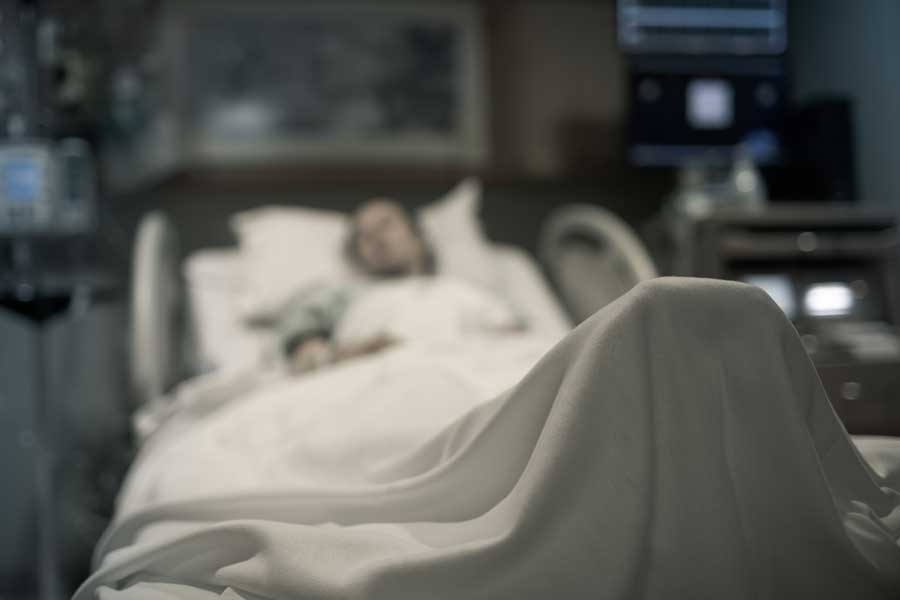
Science can record what happens to your body during an illness, but not what happens to your soul. When I first heard of Covid-19, I wondered why such a fuss was being made over a virus. That was before it became a pandemic. Mask-wearing was only suggested, so I went to the customer service department of a local bank without one. The transactions took about thirty minutes. A few days later, I had a cold, slight fever, and sore throat. Much later, I was to learn via a special-delivery letter from the bank that the clerk who had assisted me was ill with the coronavirus.
I began to feel sicker with each passing day. By week's end I knew I was headed for the hospital. Fortunately, my niece is a nurse in a large university hospital in New York City, where I live, and her brother is an officer in the fire department. The NYFD First Responders came immediately after I called and got me to the hospital. By that evening, my condition had turned critical. The diagnosis was "double pneumonia and sepsis with acute hypoxic respiratory failure."
Birthday Death Wish
My hospital stay began two days before my birthday. On my birthday, two nurses came to my room and sang "Happy Birthday." They offered to buy me a birthday cake. Their thoughtfulness was comforting. Despite this, the wish to die flashed through my mind, perhaps because of what I had been advised regarding my condition.
Because my illness occurred at the very beginning of the pandemic, the doctors had no arrows in their quiver. I recall saying to the attending physician: "Doctor, please make me better." He shrugged his shoulders and did not reply. It was a heavy burden to place on a physician. His calling is just that—to make people better—but he knew of no way to do it. The doctors' advice to me was to be resigned: death was inevitable and coming soon.
Everything in us goes to support life from our very start in the womb, but sometimes the fight is too severe and the body starts to give up. This aspect of the illness is not subject to scientific investigation but is just as real—possibly more so. My desire to die superseded the desire to live. Would I have to reconsider my long-standing objections to physician-assisted suicide and how one could go about taking one's own life? These were horrifying thoughts, but Covid-19 is the devil's playground.
It was surprising that the illness produced no pain. Our bodies are so wonderfully designed that a foreign invader is immediately recognized and the battle to remove the invader begins at once. The body's immune system may fight the coronavirus with such force that it uses up all the oxygen that the cells can take in. When deprived of oxygen, the organs begin to fail, and death ensues in a very short time. While the administration of oxygen eases one's breathing, the actual fight is on the molecular level. You feel horrible.
My niece would not give up. As a member of the diagnostic team, she repeatedly begged her colleagues to try anything they thought might work. Finally, she gave them my background to increase their motivation to preserve a "life worth saving." I had not foreseen that all those courses, term papers, and final exams would be used to motivate doctors to try to save my life. But if I were someone's grandmother known for baking cookies, and with no "friend at court," would my life have been any less worth saving?
The medical team decided to try an experiment. It was just an educated guess. Permission papers were signed, and an immune-suppressant drug was administered intravenously to force my immune system to calm down and thereby to release more oxygen to feed my cells and my vital organs. After twenty-four hours, there was a turnaround. More oxygen was reaching the right places. I was past the crisis, but full recuperation took four months.
Clara Sarrocco is the longtime secretary of The New York C. S. Lewis Society. She has taught classes on C. S. Lewis at the Institute for Religious Studies at St. Joseph's Seminary and is the president of the Long Island Chapter of University Faculty for Life. Her articles and reviews have appeared in numerous publications, including Touchstone, New Oxford Review, Gilbert, The Chesterton Review, St. Austin's Review, and The International Philosophical Quarterly.
A Journal of Mere Christianity—Delivered to Your Door
- Essays on theology, culture, and the Church
- Contributors from across the Christian traditions

Six print issues (one year) of Touchstone, plus full online access and PDF downloads for only $39.95.

Get a one-year full-access subscription to the Touchstone online archives for only $19.95.
bulk subscriptions
Order Touchstone subscriptions in bulk and save $10 per sub! Each subscription includes 6 issues of Touchstone plus full online access to touchstonemag.com—including archives, videos, and pdf downloads of recent issues for only $29.95 each! Great for churches or study groups.
Transactions will be processed on a secure server.
more from the online archives
23.1—January/February 2010
It’s Bent on Bringing Down the House on the Family & the Church by Douglas Farrow
33.1—January/February 2020
on a Saint's Charism That Cures Toxic Perfectionism by Colleen Carroll Campbell
29.5—Sept/Oct 2016
on the Loss of True Community & Rising Political Desperation by Karl D. Stephan
calling all readers
Please Donate
"There are magazines worth reading but few worth saving . . . Touchstone is just such a magazine."
—Alice von Hildebrand
"Here we do not concede one square millimeter of territory to falsehood, folly, contemporary sentimentality, or fashion. We speak the truth, and let God be our judge. . . . Touchstone is the one committedly Christian conservative journal."
—Anthony Esolen, Touchstone senior editor
