




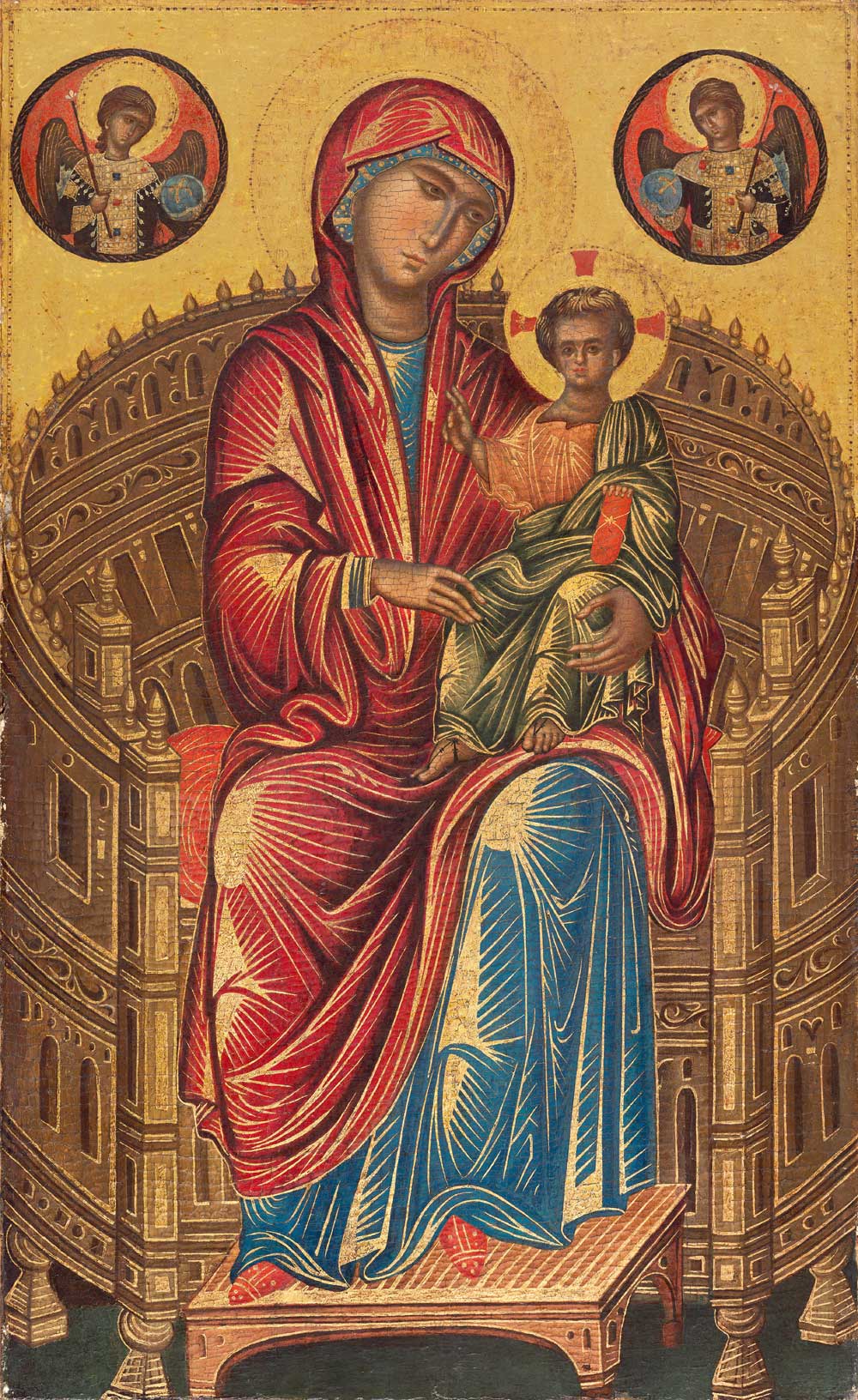
Madonna and Child on a Curved Throne
This panel is probably the oldest painting in the National Gallery in Washington; it is called the "Mellon Madonna" after its donor. The painting is the type of Madonna known as the Virgin Hodegetria (She who points the way), of which there are almost countless versions in Byzantine art. The original prototype was a miracle-working icon of the Virgin in Constantinople, and its prototype in turn traced its heritage to a portrait of the Virgin supposedly painted from life by St. Luke. Thus it was considered to be a true image, to be copied as precisely as possible, and, as such, it conferred apostolic sanction on the making of holy images.
While the type allowed for certain variations, it was generally a half- or full-length depiction of the Madonna with the Child on her left arm, pointing to him with her right, as if to indicate the way to salvation. In these images, the Child looks like a miniature adult in the pose of a philosopher, holding a book or scroll (he is the Word). He raises his right hand in blessing or possibly proclamation. Usually the Virgin is dressed in dark reds and blues picked out with gold. Her Son wears brighter colors, and, since gold represents the uncreated light breaking through, with considerably more gilding.
By the tenth century, the conventional representation of the Virgin's face had crystallized: long oval face, large almond eyes, thin arching nose, small mouth, and dark shading along the right cheek and upper eye sockets. To her right and left often appeared sceptered angels in roundels.
THIS ARTICLE ONLY AVAILABLE TO SUBSCRIBERS.
FOR QUICK ACCESS:
Mary Elizabeth Podles is the retired curator of Renaissance and Baroque art at the Walters Art Museum in Baltimore, Maryland. She is the author of A Thousand Words: Reflections on Art and Christianity (St. James Press, 2023). She and her husband Leon, a Touchstone senior editor, have six children and live in Baltimore, Maryland. She is a contributing editor for Touchstone.
A Journal of Mere Christianity—Delivered to Your Door
- Essays on theology, culture, and the Church
- Contributors from across the Christian traditions

Six print issues (one year) of Touchstone, plus full online access and PDF downloads for only $39.95.

Get a one-year full-access subscription to the Touchstone online archives for only $19.95.
bulk subscriptions
Order Touchstone subscriptions in bulk and save $10 per sub! Each subscription includes 6 issues of Touchstone plus full online access to touchstonemag.com—including archives, videos, and pdf downloads of recent issues for only $29.95 each! Great for churches or study groups.
Transactions will be processed on a secure server.
more on art from the online archives
33.2—March/April 2020
An Architectural Sign of Mere Christianity by Michael Ward
32.4—July/August 2019
on Single-Mindedness in Durer's Ritter, Tod, und Teufel by Anthony Costello
more from the online archives


28.2—March/April 2015
Why Scientism's Cherished Progress Narrative Fails by Jonathan Witt
24.2—March/April 2011
Certain Death & the Last Lectures of Socrates & Jesus by Randall B. Smith
calling all readers
Please Donate
"There are magazines worth reading but few worth saving . . . Touchstone is just such a magazine."
—Alice von Hildebrand
"Here we do not concede one square millimeter of territory to falsehood, folly, contemporary sentimentality, or fashion. We speak the truth, and let God be our judge. . . . Touchstone is the one committedly Christian conservative journal."
—Anthony Esolen, Touchstone senior editor
