The First-Wave Bible
on the Gospel According to Elizabeth Cady Stanton
If you want to get confused in the Bible, the end is a great place to start. First-wave feminist Matilda Joslyn Gage (1826–1898) said of the troublesome book of Revelation:
A literal devil is to be bound for a thousand years, during which time the saints are to dwell on earth, "every man to have a farm," as I once heard a devout Methodist declare. "But there will not be land enough for that," objected a brother. "O, well, the earth is now two-thirds water, and that will be dried up," was the reply.
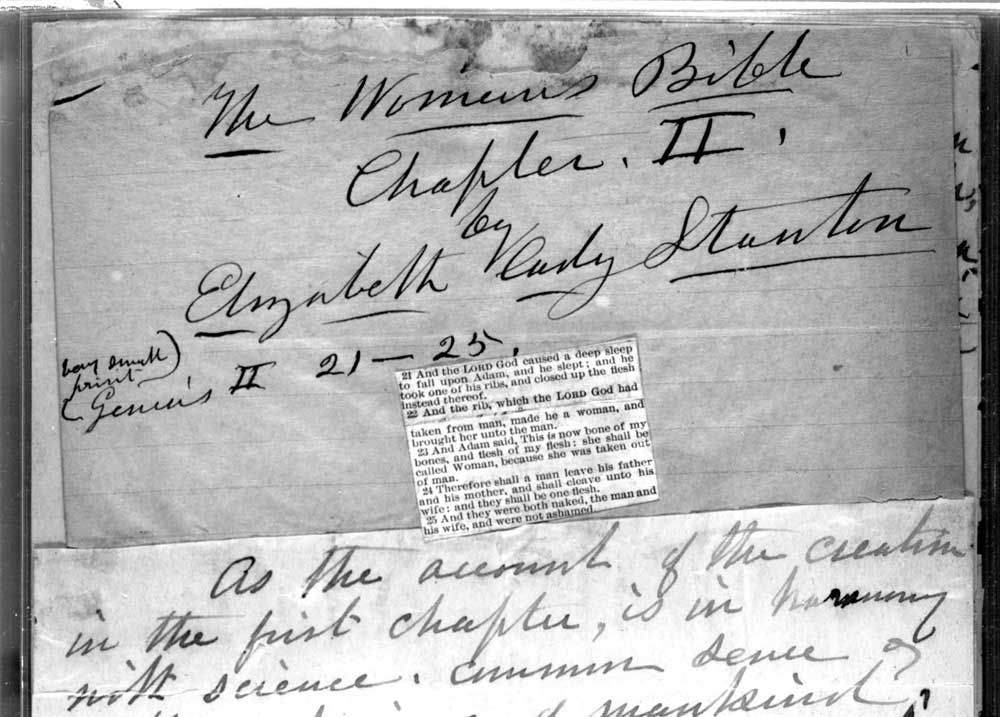
Mrs. Gage supplied her comment to Elizabeth Cady Stanton's The Women's Bible, a text nearly as worthy of infamy as Revelation. Stanton (1815–1902) found not only Revelation, but the whole of Christian Scripture intellectually incoherent. Her reworked edition, published in 1895, reproduced every instance in which the biblical text had particular bearing upon women. Each selection was then criticized by Stanton, or by one of a number of women who shared her perspective.
The Women's Bible was not a hit within Stanton's political cohort. First-wave feminism was as subject to tension between its elites and its base as any subset of society. Stanton, her bosom buddy Susan B. Anthony (1820–1906), and many other leaders of the women's movement held personal beliefs well outside Christian orthodoxy. But open denial of traditional Christian norms was too risky for a cause that was serious about transforming its radical ideas into public policy. Even Anthony, a barely-Quaker, believed that Stanton's outsized heterodoxy would hurt the formal goals of the suffragettes. The Women's Bible was formally denounced by the National American Women's Suffrage Association, which was headed by Anthony.
The Postmillennial Factor
The significance of The Women's Bible to the women's suffrage movement reveals much about American feminism's early reckoning with religion. Murray Rothbard identifies Christian eschatology as a critical factor in the transformation of the franchise:
One of the [postmillennial pietist]s' favorite reforms was to bring about women's suffrage, which was accomplished in various states and localities long before a constitutional amendment imposed it on the entire country. One major reason: it was obvious to everyone that, given the chance to vote, most Yankee women would be quick to troop to the ballot-box, whereas Catholic women believed their place to be at home and with the family, and would not bother about political considerations. Hence, women's suffrage was a way of weighting the total vote toward the postmillennialists and away from the Catholics and High Church Lutherans. (Origins of the Welfare State in America)
In the "Yankee" North, Rothbard explains, the Second Great Awakening had electrified the heirs of the Puritans. The newly revived were eager to establish an ideal society fit to welcome Jesus at his Second Coming. This is born out in the religious pedigrees of many first-wave feminists, particularly among Stanton's Women's Bible participants. Stanton's team of commentators included Free Will Baptists, Congregationalists, Universalists, Wesleyans or Methodists, Christian Scientists, and Spiritualists.
This survey corresponds strikingly with observations from anti-suffragist Helen Kendrick Johnson. In her 1897 Women and the Republic, Johnson itemized denominations with women preachers. Her list included Hicksite Quakers, Free-Will Baptists, some Methodists, and Universalists. Johnson also noted that although Congregationalist doctrine did not admit the practice, Congregationalist polity did (this was the situation of Antoinette Brown Blackwell, a Women's Bible contributor who was ordained in her own congregation). The overlap of Johnson's list with Stanton's exegetical team is significant, and several of these traditions bear out Rothbard's claim about postmillennialism. Other more or less formal dogmas shared among them also align with their adherents' readiness to embrace the early feminist cause.
Two Foundational Beliefs
Rebekah Curtis is the co-author of LadyLike (Concordia, 2015), and her essays have appeared in Touchstone, Chronicles, Salvo, Modern Reformation, and Lutheran Forum, among other publications. She attends a congregation of the LCMS.
A Journal of Mere Christianity—Delivered to Your Door
- Essays on theology, culture, and the Church
- Contributors from across the Christian traditions

Six print issues (one year) of Touchstone, plus full online access and PDF downloads for only $39.95.

Get a one-year full-access subscription to the Touchstone online archives for only $19.95.
bulk subscriptions
Order Touchstone subscriptions in bulk and save $10 per sub! Each subscription includes 6 issues of Touchstone plus full online access to touchstonemag.com—including archives, videos, and pdf downloads of recent issues for only $29.95 each! Great for churches or study groups.
Transactions will be processed on a secure server.
more on bible from the online archives
more from the online archives
calling all readers
Please Donate
"There are magazines worth reading but few worth saving . . . Touchstone is just such a magazine."
—Alice von Hildebrand
"Here we do not concede one square millimeter of territory to falsehood, folly, contemporary sentimentality, or fashion. We speak the truth, and let God be our judge. . . . Touchstone is the one committedly Christian conservative journal."
—Anthony Esolen, Touchstone senior editor