






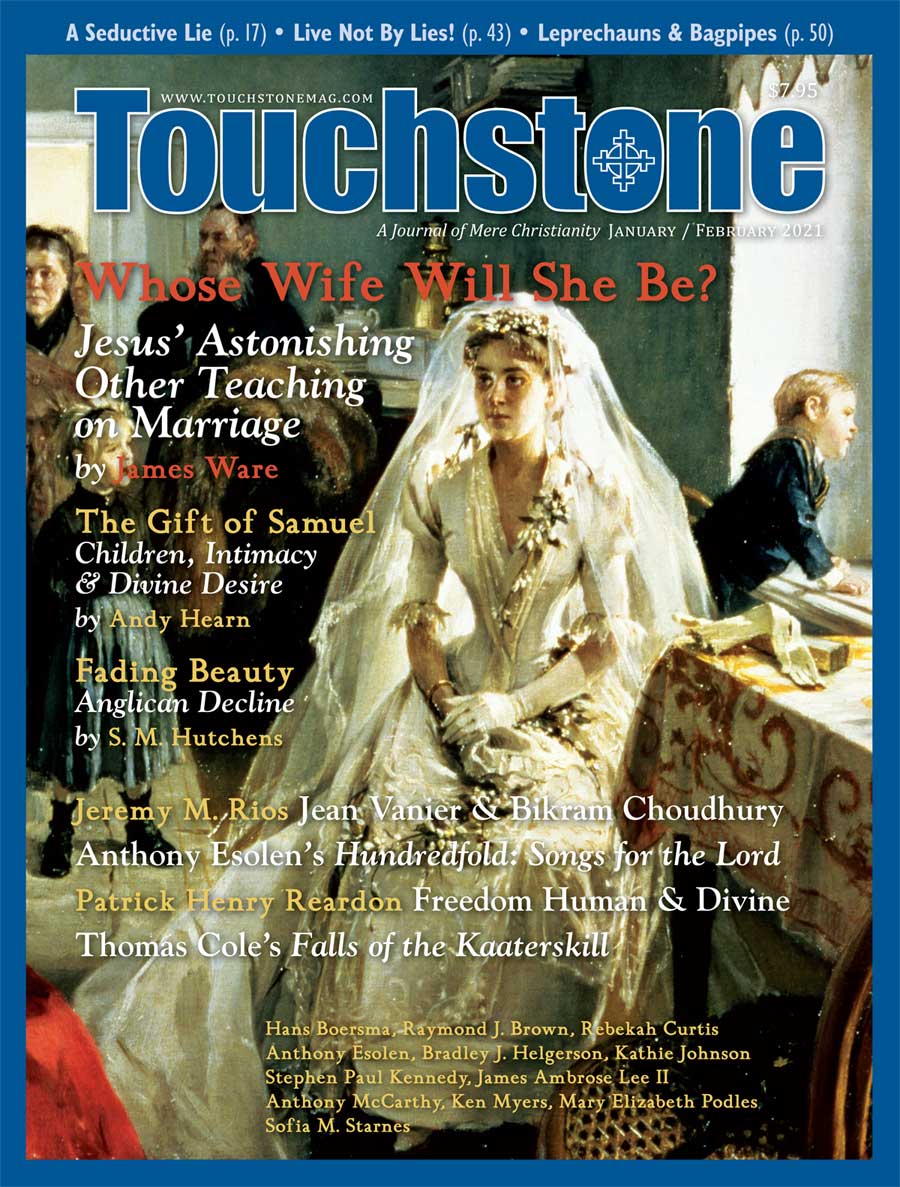
A Call to Virtues
on the Promiscuous Use of the Word "Values"
Many political prognosticators now pondering the health of our republic pronounce its moribundity. If its lifeblood is reasoned debate, then its health can be judged by the lively precision, intelligence, and civility of its public discourse. On these grounds, the pessimists may have the better diagnosis.
The lack of precision in our use of language is a primary source of toxins. One malignancy is the ubiquitous and promiscuous use of the word values. In order to resuscitate reasoned discourse, we need to limit this word's use to its proper range of meanings for at least three reasons: first, its misuse obscures its legitimate meanings; second, illegitimate meanings obscure the need for other words, like doctrines, principles, precepts, and virtues; and third, the obscuring of important words makes us more susceptible to propaganda.
THIS ARTICLE ONLY AVAILABLE TO SUBSCRIBERS.
FOR QUICK ACCESS:
Stephen Paul Kennedy is Adjunct Professor and Senior Research Fellow at the Center for Human Rights, Trinity Law School, in Santa Ana, California. He and his wife Michele have four children and eight grandchildren. He is a member of St. Matthew's Parish, an Anglican Catholic Church in Newport Beach, California.
A Journal of Mere Christianity—Delivered to Your Door
- Essays on theology, culture, and the Church
- Contributors from across the Christian traditions

Six print issues (one year) of Touchstone, plus full online access and PDF downloads for only $39.95.

Get a one-year full-access subscription to the Touchstone online archives for only $19.95.
bulk subscriptions
Order Touchstone subscriptions in bulk and save $10 per sub! Each subscription includes 6 issues of Touchstone plus full online access to touchstonemag.com—including archives, videos, and pdf downloads of recent issues for only $29.95 each! Great for churches or study groups.
Transactions will be processed on a secure server.
more on culture from the online archives
34.1—January/February 2021
Live Not by Lies: A Manual for Christian Dissidents by Rod Dreher by Hans Boersma
35.2—Mar/Apr 2022
on Fatigued Christians Deciding to Engage the Culture by Keith Lowery

34.1—January/February 2021
What the World Needs Now It Hardly Knows by Anthony Esolen
more from the online archives

33.1—January/February 2020
Speaking Truth About the Sexes Is Not Optional by Anthony Esolen
32.6—November/December 2019
on Taking Heed of the Parallels Between the Crises of Yesterday & Today by Korey D. Maas
calling all readers
Please Donate
"There are magazines worth reading but few worth saving . . . Touchstone is just such a magazine."
—Alice von Hildebrand
"Here we do not concede one square millimeter of territory to falsehood, folly, contemporary sentimentality, or fashion. We speak the truth, and let God be our judge. . . . Touchstone is the one committedly Christian conservative journal."
—Anthony Esolen, Touchstone senior editor
