John the Baptist by Anton Raphael Mengs by Mary Elizabeth Podles

A Thousand Words

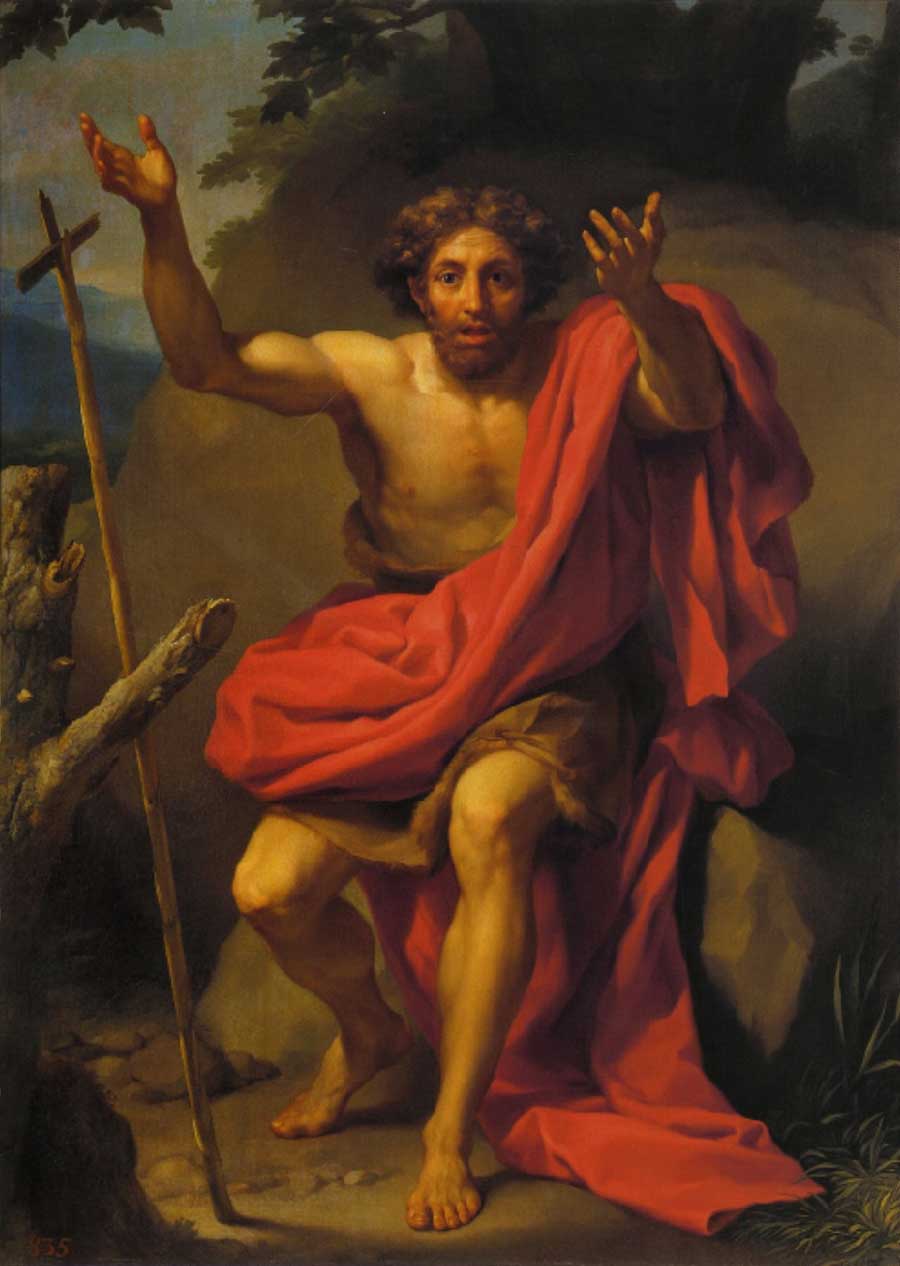
John the Baptist by Anton Raphael Mengs

"Behold, I send my prophet before your face." This is not a conventional, benevolent, smiling St. John the Baptist, pointing benignly upward in gentle reminder. This is a full-blown wild man, up close to the picture plane and in your face, as befits a prophet. His message is clear, urgent, and compelling: Repent! This John sits on a rock, and behind him a cliff face signifying the wilderness pushes him further forward into our faces.

At the lower right, a reed, shaken by the wind, makes reference to Jesus' gently ironic, "What did you come out to see?" At the left, John's staff, a foreshadowing of Christ's cross, leans against the remains of a dead tree. This is the Stump of Jesse, "from which shall come a shoot" that is Jesus. And while John is wearing his customary camel's hair clothing, a billowing red cloak foretells his own martyrdom at the hands of Herod.

The Artist

What, apart from a close reading of Scripture, might have inspired such an unconventional image? The artist, Anton Raphael Mengs, was a somewhat unconventional figure. Born in 1728 to the illicit second family of a Danish painter in Dresden, the young Anton showed precocious talent and was trained by his father. The whole nontraditional household moved to Rome in 1741, and Anton and two of his sisters, one of them legitimate, continued their painting studies. Anton converted to Catholicism, married one of his models, and in 1754 accepted the post of director of the Vatican school of painting.

His reputation in the modern day has fallen on hard times, but in his lifetime he was anything but obscure. Twice King Charles III of Spain brought him to Madrid to paint major commissions, including the ceiling of the Banqueting Hall of the Royal Palace. Mengs was popular, too, as far away as Britain, and travellers on the Grand Tour often brought home his Classical subjects or, alternatively, their own likenesses by Mengs. In addition, two Oxford colleges commissioned altarpieces from him.

But despite his sojourns elsewhere, Mengs's heart belonged to Rome. During his time there, he became close friends with Johann Joachim Winckelmann, the Classical scholar and archaeologist credited with the eighteenth-century revival of enthusiasm for the ancient, especially Greek, ideal of beauty. Winckelmann exerted a strong influence on Mengs, who occupies a peculiar niche in the history of art. Certainly he turned his back on the roiling playfulness of the Rococo style of his contemporaries. That said, it is not altogether clear whether he was the last dying gasp of the operatic Italian Baroque or else the pioneering first Neoclassicist.

The Painting

His John the Baptist contains elements of both. The dramatic gesture and lighting, the billowing drapery, and the powerful expression of the gospel message show a debt to the seventeenth-century Counter-Reformation paintings that surrounded him in Rome. On the other hand, the firm sculptural rendering of the figure of John points to Neoclassicism: Mengs shared Winckelmann's passion for Classical sculpture and would have been on intimate terms with the Vatican collection of Antique marbles.

John's counterbalanced posture and slightly twisted pose recall the famous Belvedere Torso, and his face seems to be a composite of several well-known heads. The tousled curls and full beard resemble those of the Vatican's Jupiter (Figure 1), suggesting John's greatness ("I tell you, among men born of woman, there is none greater than John"), but they are combined with a more surprising source. The staring eyes and shouting mouth are very like those of the long-standing tourist attraction, La Bocca della Verita (Figure 2). This mask, now thought to have been originally a drain covering (the eyes, nose, and mouth are pierced through and the face flattened), has a legendary power to speak truth to power, as did John.

Academic training for painters, begun in the eighteenth century and fully systematized in the nineteenth, was a rigorous process, which Mengs would no doubt have implemented as head of the Vatican school. Students began their training by drawing from Classical sculptures in order to learn ideal proportions, anatomy, and the expressive potential of the (Classical) human body. They then moved on to specialized studies of both the head and the torso, working out their own solutions to such assignments as "a male torso expressing anguish," or "a female head conveying joy." Only then, after several years of such drawing and painting exercises, were they permitted to try their hands at full compositions of their own.


Mary Elizabeth Podles is the retired curator of Renaissance and Baroque art at the Walters Art Museum in Baltimore, Maryland. She is the author of A Thousand Words: Reflections on Art and Christianity (St. James Press, 2023). She and her husband Leon, a Touchstone senior editor, have six children and live in Baltimore, Maryland. She is a contributing editor for Touchstone.

A Journal of Mere Christianity—Delivered to Your Door

  • Essays on theology, culture, and the Church
  • Contributors from across the Christian traditions

Subscribe (Print + Online)

Six print issues (one year) of Touchstone, plus full online access and PDF downloads for only $39.95.

Subscribe (Online Only)

Get a one-year full-access subscription to the Touchstone online archives for only $19.95.


bulk subscriptions

Order Touchstone subscriptions in bulk and save $10 per sub! Each subscription includes 6 issues of Touchstone plus full online access to touchstonemag.com—including archives, videos, and pdf downloads of recent issues for only $29.95 each! Great for churches or study groups.

Transactions will be processed on a secure server.


more on art from the online archives
33.2—March/April 2020

Christ Chapel at Hillsdale

An Architectural Sign of Mere Christianity by Michael Ward

32.4—July/August 2019

Sojourner Knight

on Single-Mindedness in Durer's Ritter, Tod, und Teufel by Anthony Costello
30.3—May/June 2017

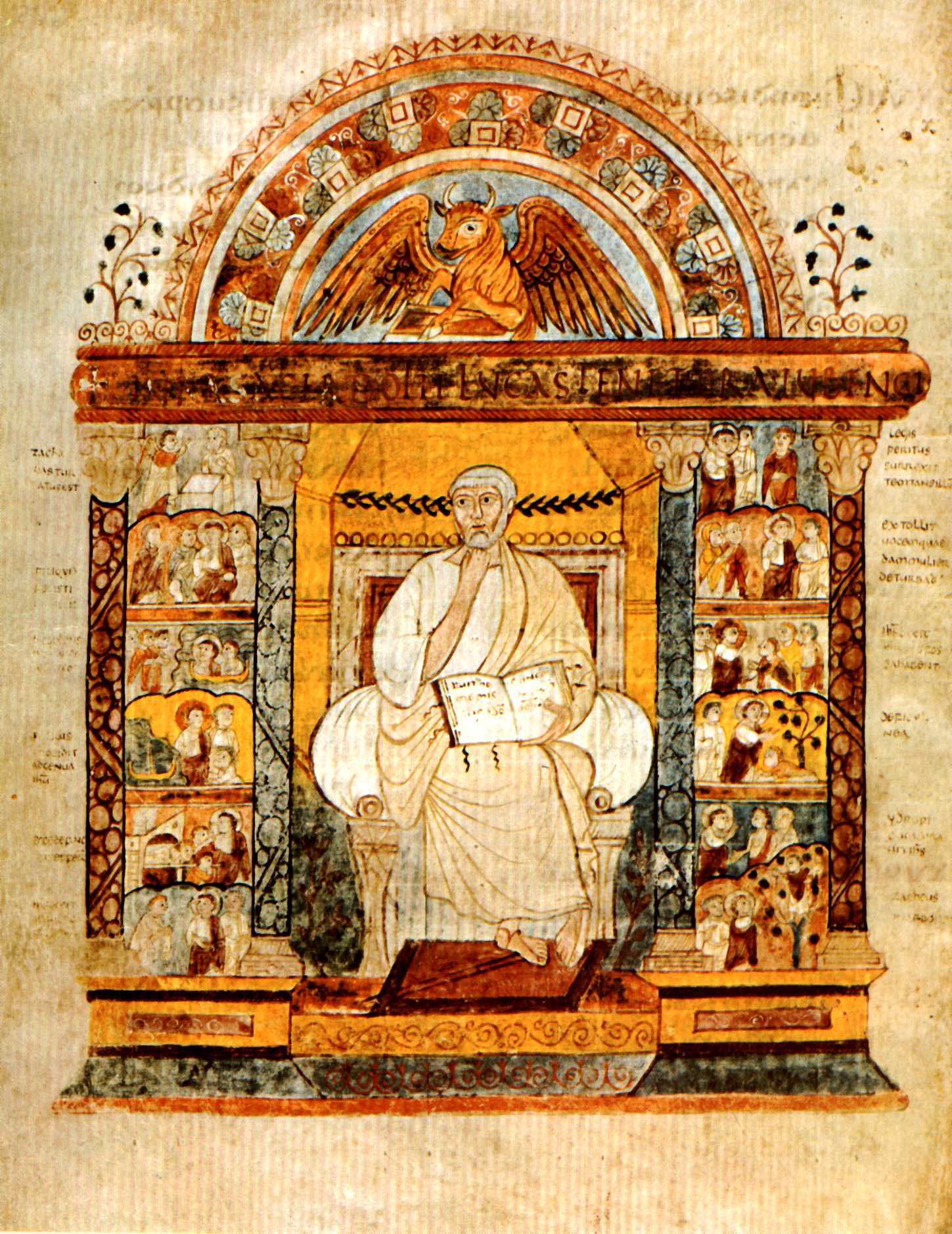
St. Luke the Evangelist

by Mary Elizabeth Podles


more from the online archives

22.8—November/December 2009

Looking for Wenceslaus

on the Real Men Behind the Christmas Carol by Michael Baum
28.1—January/February 2015

Altered Matrimony

on State Impositions & Church Acquiescence by Stephen Baskerville

29.5—Sept/Oct 2016

Dying of Despair

on the Loss of True Community & Rising Political Desperation by Karl D. Stephan

calling all readers

Please Donate

"There are magazines worth reading but few worth saving . . . Touchstone is just such a magazine."
—Alice von Hildebrand

"Here we do not concede one square millimeter of territory to falsehood, folly, contemporary sentimentality, or fashion. We speak the truth, and let God be our judge. . . . Touchstone is the one committedly Christian conservative journal."
—Anthony Esolen, Touchstone senior editor

Support Touchstone

00