


Memoir
A Methodist Youth
Christian Faith & Formation in Rural Alabama by Maclin Horton
Casting about for a way to open this recollection of the church of my youth, I found myself reaching for the words that might be used by a wealthy or famous person giving tribute to his roots. Phrases such as "what (or who) I am today" and "my present position" rattled around in my mind. Since I'm neither wealthy nor famous, this struck me as strange until I realized that it must mean that I have, as the jargon goes, internalized the knowledge of my position as a possible heir to the kingdom. I do in fact feel that to have reached old age as a reasonably faithful Christian constitutes a considerable distinction.
Moreover, and in contradiction to the literal meaning of the word "distinction," it can be had by anyone for the asking, and so does not, or at least should not, produce any personal pride in the holder. It is the perfect answer to that desire we all have (born of the inner certainty of our fundamental weakness and emptiness) to pass through life with the knowledge that we have accomplished something.
We Christians often say this sort of thing, but the attractions of the world being what they are, we don't always altogether mean it. And so I am pleased to find that, at the moment anyway, I do mean it. I have accomplished, I am accomplishing, something, and it is hard to imagine having done it without the help of the Methodist Church—more specifically, Belle Mina Methodist Church in Belle Mina, Alabama.
Belle Mina & Its Church
"Belle Mina" seems to be a corruption of "Belle Manor," the name of a nearby plantation. No one knows who chose the spelling, and whether it was the product of poor learning or a poor ear. Belle Mina is a small—very small—community in north Alabama, owing its existence to its namesake plantation and to the railroad station that served that thinly populated area. When I was growing up in the 1950s and early 1960s, Belle Mina had, in spite of its smallness, a self-sufficiency which now seems surprising: it had two general stores, a post office, a garage, a physician, a school, the railroad station, and several churches. Some of its residents farmed the land around it, and it was "town" to a number of others who farmed nearby. The town has, of course, been somewhat emptied out by the urbanization of the economy over the past fifty years; it no longer has the local economic life that it once did.
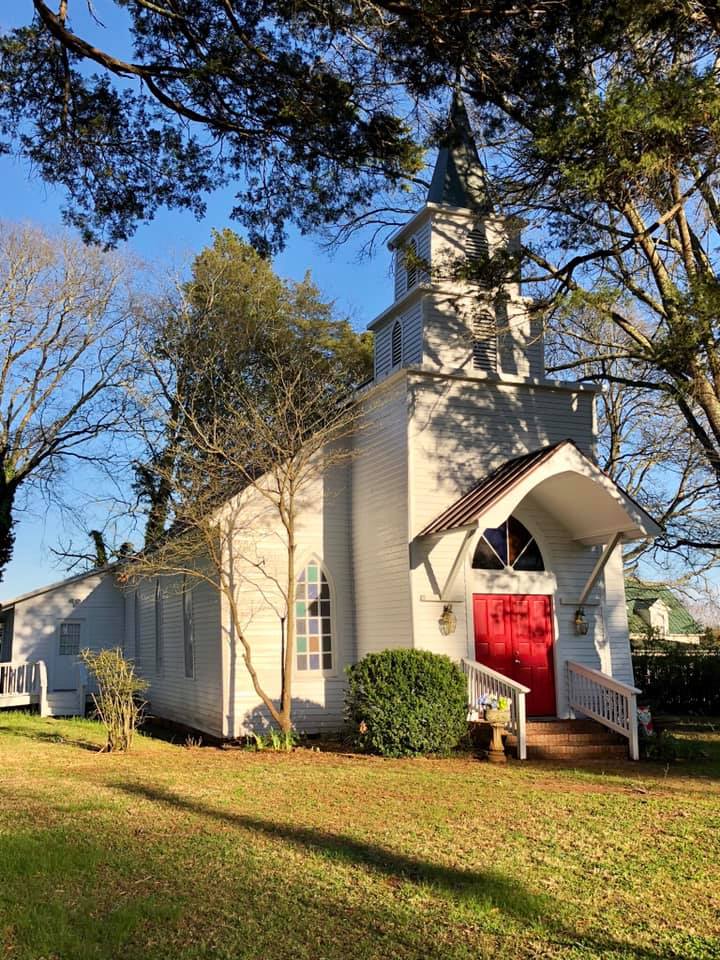
My family lived six or seven miles away in an even smaller community called Greenbrier, not really even a town, but a crossroads among the farms, where there were a couple of stores and the cotton gin that served the surrounding farms. Greenbrier had a Baptist Church and a Church of Christ, but we were Methodists, by family tradition if not especially by theology, and so every Sunday we drove past those other churches to the one in Belle Mina. It still exists and still has an active though small congregation. I am now a Catholic and I live several hundred miles away, so I don't worship there, but I do visit from time to time.
The church building itself is what many Americans may still picture to themselves when they think of a rural Protestant church: a white clapboard building with a steeple, set among trees. It is one of those images that Americans hallow nostalgically yet that have not been a living reality for most people for a couple of generations; even when I was a child in the 1950s, new churches were of brick, deliberately "modern" in style for the more moneyed congregations, plain utilitarian boxes for the less. The use of brick is understandable as being a more durable construction, but what is less understandable is the abandonment of the old steepled architecture. Plain though it was in its heritage of reaction to Catholic splendor, its silhouette nevertheless recalled the ancient pattern of Christian Europe; it had a simple grace and humanity and, in its steeple, a clear mark of transcendent purpose, as recognizable a symbol, even now when it has passed out of everyday use, as the corporate logos that fill our lives.
Many of the church buildings of the past few decades already look dated; one regards them, as one does most faded fashions, with a dismissive smile: Oh yeah, I remember when that was popular. If anyone ever stops, as people sometimes do at Belle Mina Methodist, to photograph them, it will probably be as period pieces, not as things pleasing in themselves.
A Memory of Baptism?
For many years I was not sure whether my earliest memory associated with that church was genuine. I have long carried in my mind a fragment of what seems to be memory, unattached to any other: I am very young, younger than six, as I somehow feel that I am not yet in school. I'm dressed up. I'm not sure where I am—I feel that it somehow involves the Belle Mina church, yet the only visual clues in the picture seem to be from the home of my paternal grandparents; I have a vague impression that I'm in the entrance hall of their home. I have a sense that there are green plants and maybe flowers nearby. Something involving water has happened—that is the aspect of the memory that seems associated with the church—and I feel cool and clean. People are looking at me. They're happy and I'm happy.
A Journal of Mere Christianity—Delivered to Your Door
- Essays on theology, culture, and the Church
- Contributors from across the Christian traditions
Six print issues (one year) of Touchstone, plus full online access and PDF downloads for only $39.95.

Get a one-year full-access subscription to the Touchstone online archives for only $19.95.
bulk subscriptions
Order Touchstone subscriptions in bulk and save $10 per sub! Each subscription includes 6 issues of Touchstone plus full online access to touchstonemag.com—including archives, videos, and pdf downloads of recent issues for only $29.95 each! Great for churches or study groups.
Transactions will be processed on a secure server.
more on ministry from the online archives

32.1—January/February 2019
Sex, Women's Ordination & the Rejection of Hierarchy & Equality by James A. Altena
more from the online archives
29.1—Jan/Feb 2016
on Marriage, Moral Corruption & the Christian Duty of Witness by Regis Nicoll
30.5—Sept/Oct 2017
on Costly Grace in Breece D'J Pancake's Flyover Country by Casey Chalk

31.6—November/December 2018
Victimhood Culture Scapegoats Its Very Source by Michael P. Foley
calling all readers
Please Donate
"There are magazines worth reading but few worth saving . . . Touchstone is just such a magazine."
—Alice von Hildebrand
"Here we do not concede one square millimeter of territory to falsehood, folly, contemporary sentimentality, or fashion. We speak the truth, and let God be our judge. . . . Touchstone is the one committedly Christian conservative journal."
—Anthony Esolen, Touchstone senior editor