





Feature
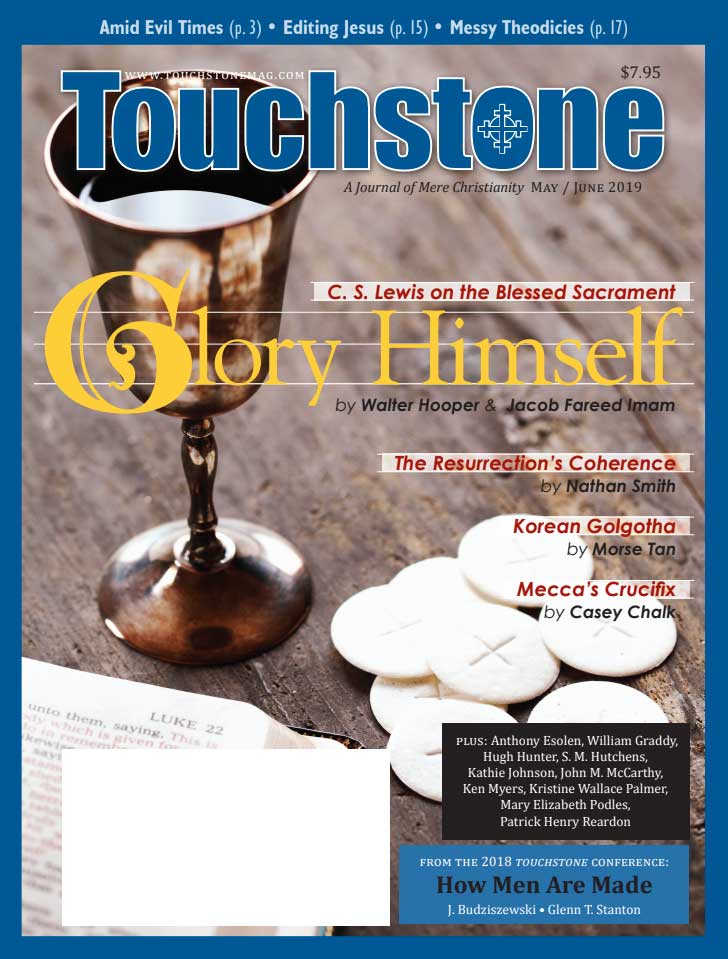
The Grand Coherence
The Compelling "Bayesian" Case for Christ
by Nathan Smith
To what extent, and on what grounds, are we justified in claiming to know the truth of the Christian faith?
This old question is perennially in need of fresh answers. The content of Christianity is constant, but the reasons for believing in it vary from person to person and age to age. There are interwoven into the life story of every Christian certain confirmations of so intimate a nature that they can hardly be expressed, and must be far less persuasive as reports than they were as experiences. In addition to such private evidence, there has always been a public case for Christianity, consisting of arguments that appeal to the common experiences and innate rational faculties of mankind. Yet this public case must keep adapting as the assumptions that prevail in the culture, and the alternatives against which Christianity competes, shift. The parts of Christianity that are commonsensical in one century become controversial in the next, and vice versa.
To make this public case is the perennial task of the Christian apologist. Apologetics alone probably makes few converts, but it can disrupt the complacency of unbelief, remove intellectual stumbling blocks to conversion, dispel gnawing doubts in half-made Christians, and strengthen and edify devout believers. I doubt I would be a Christian today but for the writings of C. S. Lewis.
A little while ago, Tyler Cowen, my former professor and one of America's leading public intellectuals, wrote a blog post entitled "Why I Don't Believe in God," to which this article is a rebuttal. Cowen is aware of the evidence that the universe is fine-tuned for life. He does not "rule out" theism, and explicitly rejects "the view of many non-believers that [theism] is somehow absurd, mystical, Santa Claus-like, and so on." Yet he still feels he has a deep epistemic warrant for a kind of tentative yet stubborn unbelief, the heart of which lies in this cryptic passage:
I am frustrated by the lack of Bayesianism in most of the religious belief I observe. I've never met a believer who asserted: "I'm not really sure here. But I think Lutheranism is true with p = .018, and the next strongest contender comes in at only .014, so call me a Lutheran." The religious people I've known rebel against that manner of framing. . . . That . . . inclines me to think they are using belief for psychological, self-support, and social functions [which] won't get me to belief.
Few readers will find the arguments offered here easy to master. But if understood, they might help breach the walls of unbelief, and let the forces of faith break into human minds.
The Bayesian Theory of Belief
What is "Bayesianism"? The closest thing to a popular translation of the word "Bayesian" is "evidence-based," but that loses a good deal. Bayesianism is a school of thought in statistics, and beyond that, a philosophy of probability and belief. An introduction to Bayesianism is a great way to help us think clearly about the sufficiency of evidence for all sorts of things, including the truth of Christianity.
I like to teach epistemology with murder mysteries, so let's say a wealthy old man is found murdered, and much cash and valuables hastily stolen. Stevens, the victim's butler, is a suspect. At first, you think there's a 5 percent chance that he's guilty. Then you hear that, right after the murder, he bought a luxury car. You conclude that he's probably guilty. Finally, it becomes known that, on the morning after the murder, Stevens unexpectedly inherited a fortune from a childless uncle. Since the car now has an innocent explanation, you rate the probability of his guilt at 5 percent again.
A Journal of Mere Christianity—Delivered to Your Door
- Essays on theology, culture, and the Church
- Contributors from across the Christian traditions

Six print issues (one year) of Touchstone, plus full online access and PDF downloads for only $39.95.

Get a one-year full-access subscription to the Touchstone online archives for only $19.95.
bulk subscriptions
Order Touchstone subscriptions in bulk and save $10 per sub! Each subscription includes 6 issues of Touchstone plus full online access to touchstonemag.com—including archives, videos, and pdf downloads of recent issues for only $29.95 each! Great for churches or study groups.
Transactions will be processed on a secure server.
more on apologetics from the online archives
31.4—July/August 2018
The Difficulty of Apologetics for Dead Souls in the Real World by R. J. Snell

31.2—March/April 2018
How Best to Face the Total War of the Anti-Culture by R. J. Snell

33.3—May/June 2020
On Flight & Fight in the Present Tribulation by Douglas Farrow
more from the online archives

30.6—Nov/Dec 2017
on C. S. Lewis, Brideshead Revisited & the Middle Things by Ben Reinhard
31.4—July/August 2018
Labels & the Ecumenism of Discipleship by James M. Kushiner
calling all readers
Please Donate
"There are magazines worth reading but few worth saving . . . Touchstone is just such a magazine."
—Alice von Hildebrand
"Here we do not concede one square millimeter of territory to falsehood, folly, contemporary sentimentality, or fashion. We speak the truth, and let God be our judge. . . . Touchstone is the one committedly Christian conservative journal."
—Anthony Esolen, Touchstone senior editor
