




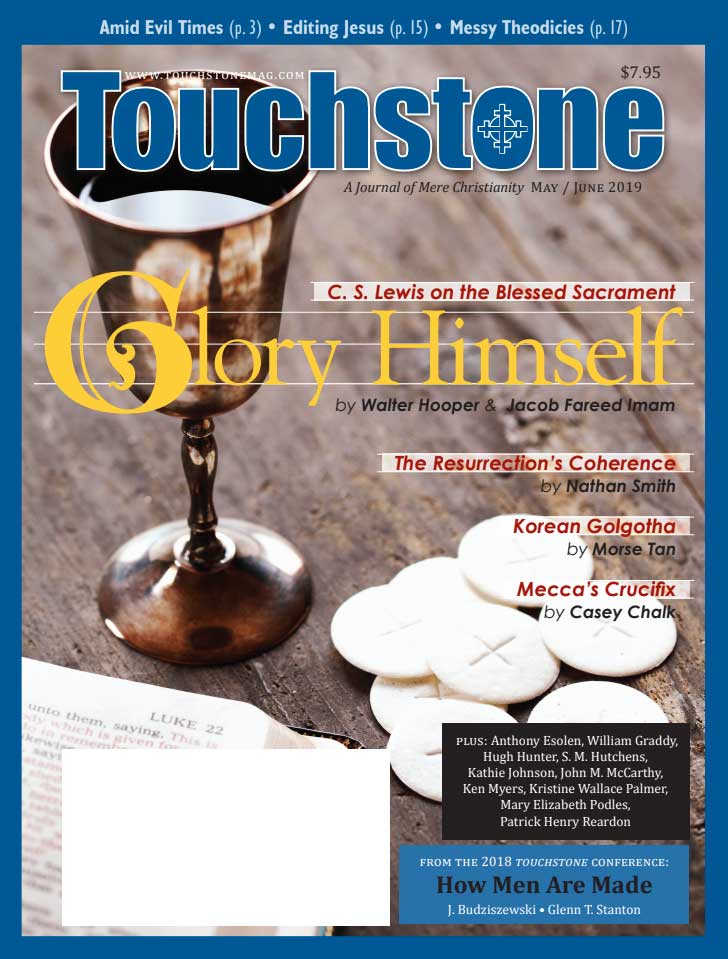
Mortal Remains
Still At It, with Good Help
I regard James Altena's "Role Reversals: Sex, Women's Ordination & the Rejection of Hierarchy & Equality" (January/February 2019) as the finest piece Touchstone has published on this subject—a significant admission from the person who has himself done most of that publishing. The issue will not go away for the same reason that mistakes about homosexuality will not: all of these are fundamental, "constitutional" matters, responses to which define the Church. When we received Richard Mason's letter, to which James responds in this issue, I was moved, without consulting him, by my own somewhat proprietary interest to write what follows. The similarity of our responses is striking.
Lewis's Example
A great many people are fond of C. S. Lewis's writings and are attracted by the notion of mere Christianity as he explained it, but find it convenient to forget that he, at least, did not think the ordination of women to be a Christian practice at all, but rather an expression of some other religion. Lewis said this gently in his essay "Priestesses in the Church?", his most explicit treatment of the subject, and I hope we at Touchstone have followed his example of realism and gentility by giving what praise we can to women who profess the Creed, are full of good works, and with genuine sincerity think they have been called and ordained to the presbyter's or the bishop's office.
Through all my years of writing on the subject I have been acutely concerned about whether I am among those who, like the frustrated Jewish authorities of old, with whom I feel deep affinity, could not see that God was doing a New Thing I could not recognize because of the morbid attachment to tradition characteristic of mere conservatism. Mr. Mason drives home the personal with his allusion to the Pharisees, suggesting that among them is just where we belong.
It has been a good discipline to bear this possibility continually in mind, for it has often moderated my tone—but not my conclusions. I will note here in my defense that it would have been profitable in several ways if I had been able to find convincing reasons to come to the "right" opinions on such matters and decided, as many have, that mere Christianity included ordained women. Instead, however, my opposition to women's ordination has only become stronger as I have over the years become more acutely aware of the symbolic life of the Church.
A Deadness to Non-verbal Symbols
In Protestantism this life centers around the written word of (sola!) Scriptura and confession (Symbolics is the study of creeds and confessions), which does little to discourage iconoclasm outside the verbal sphere, but in general supports the denial of meaning and significance to other Christian symbols. In its most radical expression, houses of worship are stripped of them all, including simple crosses, and are called "meeting houses," rid of any decorations that might distract from the Word written, taught, and preached. There is a cultivated deadness to the meaning of non-verbal symbols among a great many Christians, which I believe lies close to the bottom of large tracts of Protestantism's resistance to (the Protestant) Lewis's principal argument against women's ordination.
I'll give an example that readers of Touchstone have heard from me before: Vis-à-vis the Roman Church I -remain a Protestant, and every Protestant church of which I have been a member has a chancel arrangement in which the American flag is given the place of honor on the preacher's right. A flag representing the Christian Church is always placed on the left, this arrangement ineluctably symbolizing the precedence of the United States of America over God's kingdom. My protests have always fallen on deaf ears. If this does not represent "cultivated deadness to the meaning of non-verbal symbols," I don't know what does.
In his essay against priestesses, Lewis's basic criticism of those who favor women's ordination—among whom are those we recognize as having orthodox intentions, but just don't seem to "get it"—is likewise their deadness to the Christ-symbol of maleness in the ministry of Word and Sacrament. To them this means nothing more than does the essential arbitrariness of Jesus' sex—a deadness that devitalizes their religion right into un-Christianity, however intense their piety. They cannot conceive of an involvement of maleness in the gospel that one could "get wrong" by regarding the sexes as equal and fungible in re-presenting Christ to God and his people. And, like -mistakes in chancel vexillology, the error unavoidably teaches by training the unconscious mind and its intuitions in the essential arbitrariness of the language of Scripture and creed, whereas the male-only tradition reinforces it.
Vital & Decisive
The sum of Mr. Mason's letter may lie in his assertion that "the question should not be, who is doing the preaching, but rather, what is the content of that preaching and leadership." As what I have written above indicates, this is wrong because "who is doing the preaching" is a vital and decisive part of the preaching itself, as is who is leading the flock. One cannot separate the Word and its ministers in this way. That is why the Pastoral Epistles have requirements for them that assume their maleness. To say, "Who are we judge?" and let the error prevail is in such cases not an expression of humility, but dereliction of duty.
S. M. Hutchens is a senior editor and longtime writer for Touchstone.
A Journal of Mere Christianity—Delivered to Your Door
- Essays on theology, culture, and the Church
- Contributors from across the Christian traditions

Six print issues (one year) of Touchstone, plus full online access and PDF downloads for only $39.95.

Get a one-year full-access subscription to the Touchstone online archives for only $19.95.
bulk subscriptions
Order Touchstone subscriptions in bulk and save $10 per sub! Each subscription includes 6 issues of Touchstone plus full online access to touchstonemag.com—including archives, videos, and pdf downloads of recent issues for only $29.95 each! Great for churches or study groups.
Transactions will be processed on a secure server.
more on liberalism from the online archives
29.1—Jan/Feb 2016
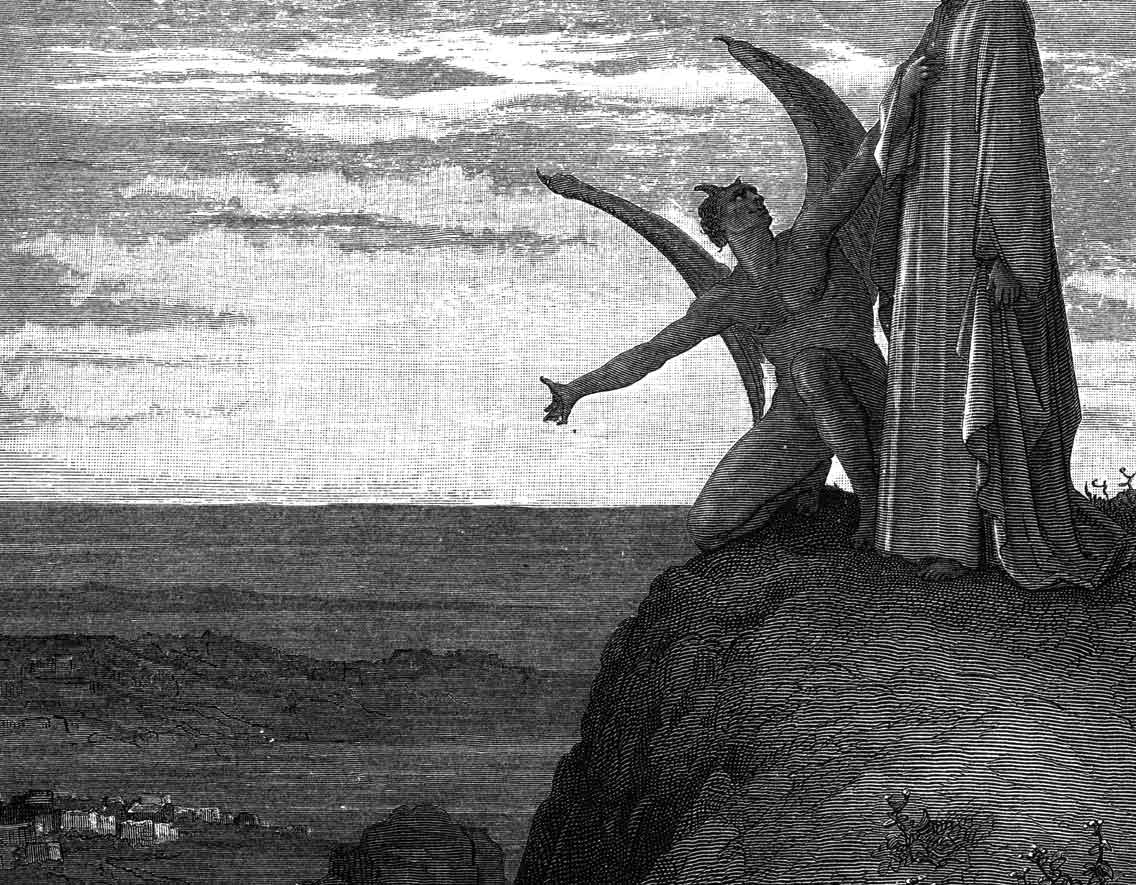
Secular Credibility Is a Devilish Temptation by James Hitchcock
17.4—May 2004
The Unhappy & Abusive Marriage of Liberalism & Modernism by James Hitchcock
more from the online archives

30.3—May/June 2017
C. S. Lewis Assesses the Religion of Mohammed by Jacob Fareed Imam

19.4—May 2006
The Culture War Is Between Religious Believers on Both Sides by Howard P. Kainz
calling all readers
Please Donate
"There are magazines worth reading but few worth saving . . . Touchstone is just such a magazine."
—Alice von Hildebrand
"Here we do not concede one square millimeter of territory to falsehood, folly, contemporary sentimentality, or fashion. We speak the truth, and let God be our judge. . . . Touchstone is the one committedly Christian conservative journal."
—Anthony Esolen, Touchstone senior editor
