





From Heavenly Harmony
Ancient Maranatha Music
by Ken Myers
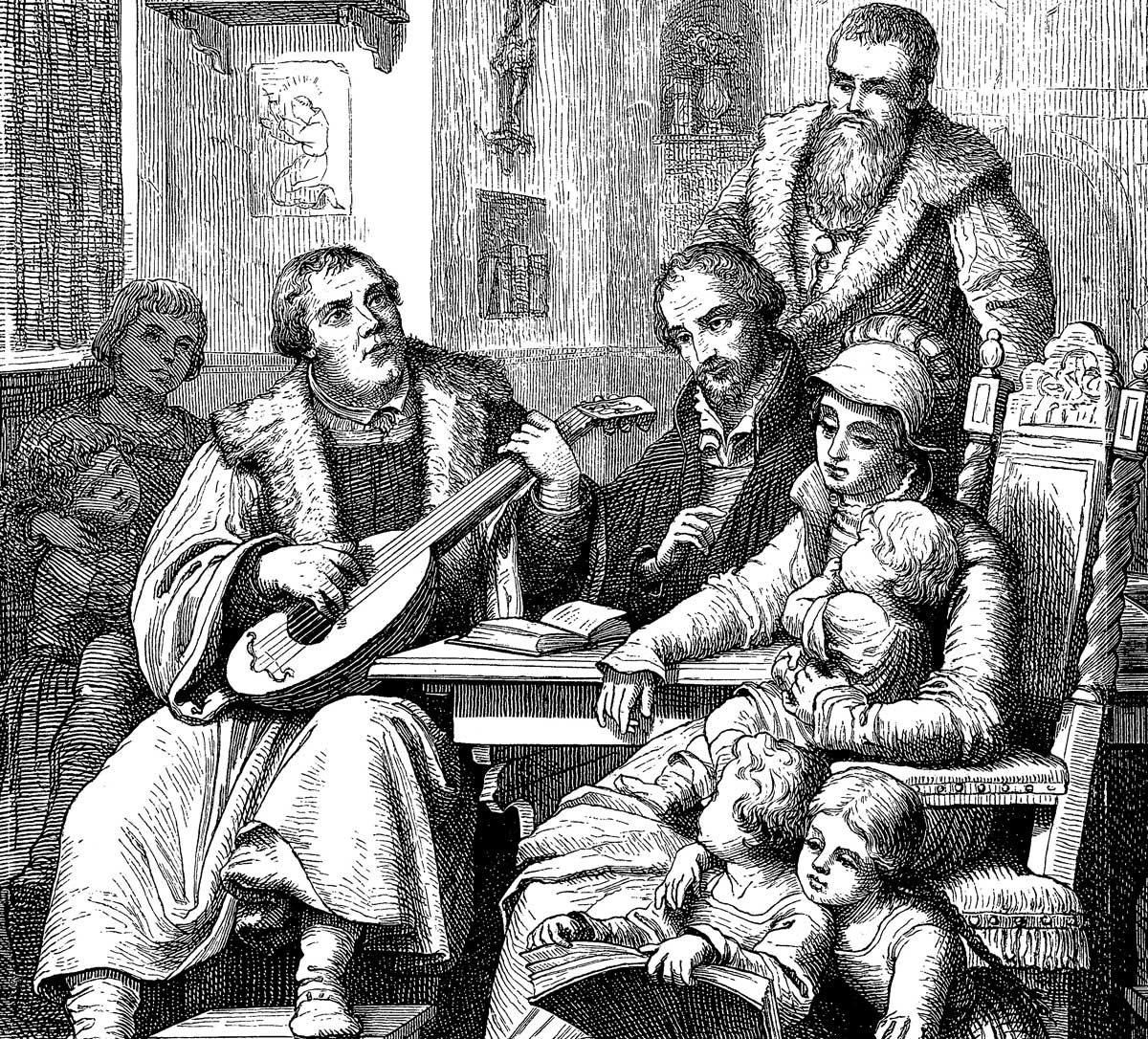
In 1524, two influential Protestant hymnals were published in Germany. The first, edited by Luther and fellow Lutheran pastor Paul Speratus and published in Wittenberg, was a 12-page booklet with only eight hymns. The second larger and more influential volume, the Erfurt Enchiridion, contained 26 hymns, 18 of them by Luther. One of the most enduring of these, the Advent hymn "Nun komm, der Heiden Heiland," evidences Luther's genius of reforming rather than disposing of the liturgical tradition of the Church. If you've sung "Savior of the Nations, Come" on one of the Sundays in Advent, you, too, have been a conveyance of a particular treasure within that inheritance, sharing an experience with St. Ambrose, medieval monks, Luther, J. S. Bach, and countless others.
The fourth-century bishop of Milan, St. Ambrose, may be best known to contemporary Western Christians as the man who baptized Augustine. Less well-known is his role in enriching the music of the Church. Ambrose recognized the power of hymnody to shape the hearts and minds of faithful believers, as well as to challenge theological errors (his nickname "Hammer of the Arians" was not for naught). He is credited with having promoted antiphonal chant within the liturgy, and a number of hymns are believed to have come from his hand. The best-known of these is "Veni, redemptor gentium," "Come, Redeemer of the nations." By the twelfth century, Ambrose's text was set to a chant melody, to which it was sung for centuries.
THIS ARTICLE ONLY AVAILABLE TO SUBSCRIBERS.
FOR QUICK ACCESS:
Ken Myers is the host and producer of the Mars Hill Audio Journal. Formerly an arts editor with National Public Radio, he also serves as music director at All Saints Anglican Church in Ivy, Virginia. He is a contributing editor for Touchstone.
subscription options
Order
Print/Online Subscription

Get six issues (one year) of Touchstone PLUS full online access including pdf downloads for only $39.95. That's only $3.34 per month!
Order
Online Only
Subscription

Get a one-year full-access subscription to the Touchstone online archives for only $19.95. That's only $1.66 per month!
bulk subscriptions
Order Touchstone subscriptions in bulk and save $10 per sub! Each subscription includes 6 issues of Touchstone plus full online access to touchstonemag.com—including archives, videos, and pdf downloads of recent issues for only $29.95 each! Great for churches or study groups.
Transactions will be processed on a secure server.
more on music from the online archives
33.3—May/June 2020
Bach's Cantata BWV 106, Gottes Zeit ist die allerbesteZeit (God's time is the very best time) by Ken Myers
more from the online archives

24.5—Sept/Oct 2011
A Critical Memoir of Thomas Merton at Gethsemani Abbey by Patrick Henry Reardon
28.5—Sept/Oct 2015
on Our Sacred Duty to Teach the Devil to Death by Marcus Johnson

22.5—June 2009
C. S. Lewis on Civilization & the Natural Order by Timothy L. Hall
calling all readers
Please Donate
"There are magazines worth reading but few worth saving . . . Touchstone is just such a magazine."
—Alice von Hildebrand
"Here we do not concede one square millimeter of territory to falsehood, folly, contemporary sentimentality, or fashion. We speak the truth, and let God be our judge. . . . Touchstone is the one committedly Christian conservative journal."
—Anthony Esolen, Touchstone senior editor
