





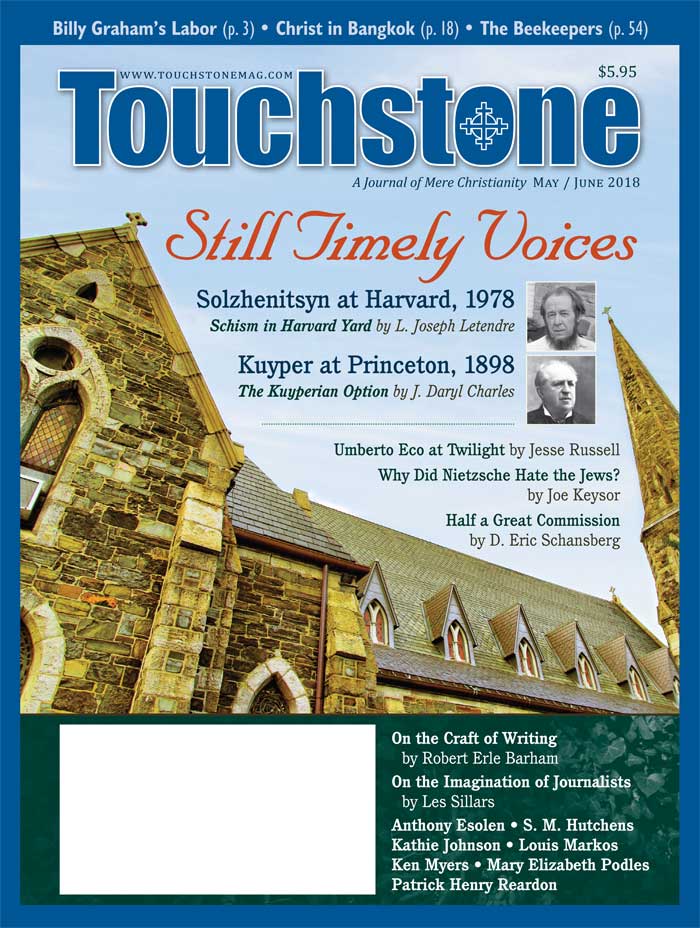
Feature
A Fading Voice at Twilight
The Last Will & Testament of Umberto Eco
On February 19, 2016, Umberto Eco, one of the most influential modern European intellectuals, died in Milan, Italy, his body laid to rest in a simple wooden coffin during a "nonreligious funeral" in Sforza Castle. The sprawling and gloomy castle, once home to Ludovico Sforza, one of the greatest podestas of the Milanese Renaissance, is now a museum of Italian art and culture. It was a fitting place for the funeral of Eco, who spent his life lovingly guarding the crumbling treasures of Europe.
Eco was famous for his novels, his semiotic writings, and, seemingly contradictorily, his leftist politics—the sight of the portly and aged Eco pontificating on political corruption while surrounded by (usually very good-looking) Italian undergraduates was not uncommon during the Berlusconi years. The trajectory of Eco's intellectual path from belief to unbelief parallels that of Europe in the twentieth and twenty-first centuries. Underneath the beautiful facade of his aesthetic Catholicism there was always a creeping yet ultimately shallow nihilism that undermined not only his own life's work, but the entire edifice of postmodern European civilization.
Having proudly served in a young fascist brigade as a child—he received the First Provincial Award of Ludi Juveniles in 1942 for his essay, "Should we die for the glory of Mussolini and the immortal destiny of Italy?"—Eco began his intellectual career as a Thomist participating in the left-leaning group Catholic Action just as the early-twentieth-century Catholic revival was cresting under the pontificate of Pope Pius XII. One of Eco's greatest but most neglected nonfiction works is a reworking of his thesis from the University of Turin, The Aesthetics of St. Thomas Aquinas,the English translation of which was published by Harvard University Press in 1988. Although he left the church at age 22, he identified as being "Catholic" until the end of his life, and he would always defend the church as a cultural institution.
Nihilism Under a Catholic Cloak
Eco's Catholic cloaking did not escape the notice of his critics. Harvard University's Harvey Cox has accurately written of Eco that "he is not an angry, antireligious ex-Catholic. He even seems at times to speak about this lost faith with a hint of regret." Evidence for Eco's cultivation of the identity of a purely aesthetic and intellectualized lapsed Catholic who still cherished Catholic thought and art is present throughout his large literary corpus. In an article titled "God isn't big enough for some people," which appeared in Britain's Telegraph in 2005, he explains that he continued the custom of assembling a crèche at Christmastime with his grandchild because "I have profound respect for the Christian traditions—which, as rituals for coping with death, still make more sense than their purely commercial alternatives." He then cites James Joyce, whose absurdism and aesthetic Catholicism served as a model for Eco's philosophia vitae:
I think I agree with Joyce's lapsed Catholic hero in A Portrait of the Artist as a Young Man: "What kind of liberation would that be to forsake an absurdity which is logical and coherent and to embrace one which is illogical and incoherent?" The religious celebration of Christmas is at least a clear and coherent absurdity. The commercial celebration is not even that.
The implication buried here is that everything is absurd, but some absurdities are more elegant than others. This ability to bury nihilism under a pretty (and usually medieval) Christian aesthetic shell was Eco's trademark. Unlike earlier European thinkers like William Butler Yeats, who admonished his readers to cast a "Cold eye / On life On death," Eco made a living teaching other postmoderns not to take the futility of things too seriously.
His penchant for cleverly laughing off the deepest questions of human existence was a prominent aspect of his self-fashioned Catholic identity. It is on display in one of his most famous newspaper articles—his 1994 entry in his column La bustina di Minerva, published in the leftist Espresso—in which he aligns Apple's Macintosh computer with Catholicism, and DOS, the now antiquated operating system of the PC, with Protestantism:
O indeed, the Macintosh is counterreformist and has been influenced by the "ratio studiorum" of the Jesuits. It is cheerful, friendly, conciliatory; it tells the faithful how they must proceed step by step to reach—if not the Kingdom of Heaven—the moment in which their document is printed. It is catechistic: the essence of revelation is dealt with via simple formulae and sumptuous icons. Everyone has a right to salvation.
DOS is Protestant, or even Calvinistic. It allows free interpretation of scripture, demands difficult personal decisions, imposes a subtle hermeneutics upon the user, and takes for granted the idea that not all can reach salvation. To make the system work you need to interpret the program yourself: a long way from the baroque community of revelers, the user is closed within the loneliness of his own inner torment.
Jesse Russell is Assistant Professor of English at Georgia Southwestern State University. He has published on literary theory, semiotics, and politics, and is at work on a book that explores Neo-Platonic magic in the work of Edmund Spenser. He is a Roman Catholic.
A Journal of Mere Christianity—Delivered to Your Door
- Essays on theology, culture, and the Church
- Contributors from across the Christian traditions

Six print issues (one year) of Touchstone, plus full online access and PDF downloads for only $39.95.

Get a one-year full-access subscription to the Touchstone online archives for only $19.95.
bulk subscriptions
Order Touchstone subscriptions in bulk and save $10 per sub! Each subscription includes 6 issues of Touchstone plus full online access to touchstonemag.com—including archives, videos, and pdf downloads of recent issues for only $29.95 each! Great for churches or study groups.
Transactions will be processed on a secure server.
more on literature from the online archives
20.6—July/August 2007
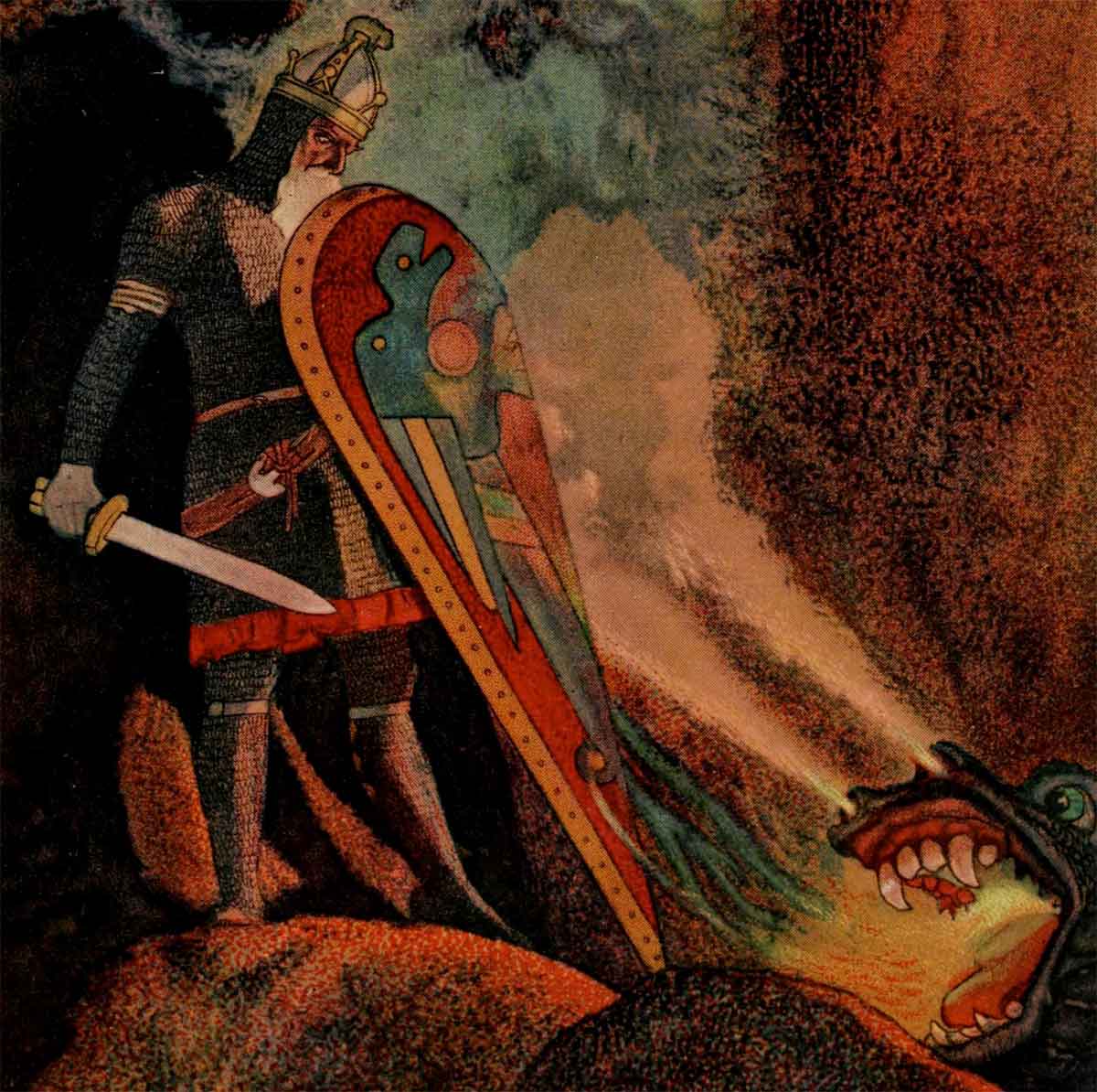
The Beowulf Poet Was a Shrewd Christian Apologist by Douglas Wilson

30.5—Sept/Oct 2017
on Costly Grace in Breece D'J Pancake's Flyover Country by Casey Chalk
30.2—March/April 2017
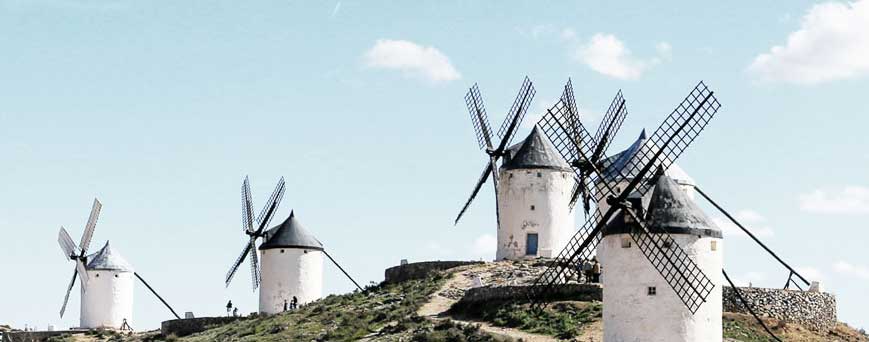
on Reading Don Quixote in Its Original Christian Context by Luis Cortest
more from the online archives
32.1—January/February 2019
Divine Love & the Love of Man & Woman Surpass Mere Consent by Anthony Esolen


24.5—Sept/Oct 2011
on Wondering or Wandering Through College Education by Anthony Esolen
calling all readers
Please Donate
"There are magazines worth reading but few worth saving . . . Touchstone is just such a magazine."
—Alice von Hildebrand
"Here we do not concede one square millimeter of territory to falsehood, folly, contemporary sentimentality, or fashion. We speak the truth, and let God be our judge. . . . Touchstone is the one committedly Christian conservative journal."
—Anthony Esolen, Touchstone senior editor
