





From Heavenly Harmony
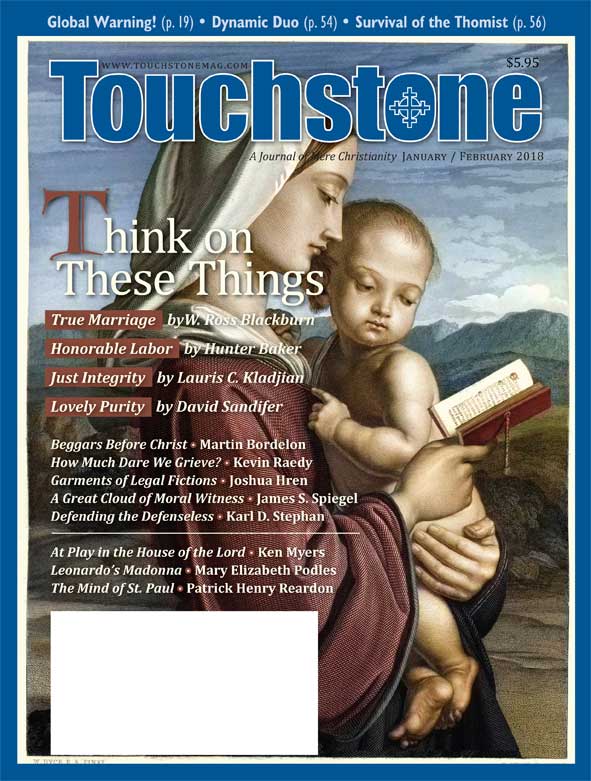
At Play in the House of the Lord
by Ken Myers
In anticipation of the Mozart bicentennial celebration in 1956, Karl Barth was invited by a Swiss newspaper to write "A Letter of Thanks to Mozart." Initially skeptical of the assignment, Barth obliged the editors with a brief epistle in the spirit of Mozartian playfulness. The correspondence closed with a much-cited speculation: "It may be that when the angels go about their task of praising God, they play only Bach. I am sure, however, that when they are together en famille, they play Mozart and that then too our Lord listens with special pleasure."
The music of Mozart, second only to that of J. S. Bach, has inspired the most enthusiastic recognition of spiritual qualities, although the distinction made in Barth's scenario captures an important difference in the kind of spiritual quality felt in the two composers' repertoires. While the music of each captures a sense of transcendent order, Mozart's work is typically heard in terms of a more domestic, earthly, and human scale. In Mozart's acoustic world, the light triumphs over the darkness with lightness—that is, deftness, not triviality—which makes his musical spaces seem friendlier than those described by Bach. Childlike joy is rarely ascribed to Bach's compositions, as it so often is to Mozart's, though Bach jokes and plays and dances not infrequently. In Mozart, the goodness of Creation is often warmly evoked. Bach seems to suggest the goodness of the Creator himself, at once awful and personal.
THIS ARTICLE ONLY AVAILABLE TO SUBSCRIBERS.
FOR QUICK ACCESS:
Ken Myers is the host and producer of the Mars Hill Audio Journal. Formerly an arts editor with National Public Radio, he also serves as music director at All Saints Anglican Church in Ivy, Virginia. He is a contributing editor for Touchstone.
A Journal of Mere Christianity—Delivered to Your Door
- Essays on theology, culture, and the Church
- Contributors from across the Christian traditions

Six print issues (one year) of Touchstone, plus full online access and PDF downloads for only $39.95.

Get a one-year full-access subscription to the Touchstone online archives for only $19.95.
bulk subscriptions
Order Touchstone subscriptions in bulk and save $10 per sub! Each subscription includes 6 issues of Touchstone plus full online access to touchstonemag.com—including archives, videos, and pdf downloads of recent issues for only $29.95 each! Great for churches or study groups.
Transactions will be processed on a secure server.
more on music from the online archives
33.3—May/June 2020
Bach's Cantata BWV 106, Gottes Zeit ist die allerbesteZeit (God's time is the very best time) by Ken Myers
more from the online archives
23.1—January/February 2010
It’s Bent on Bringing Down the House on the Family & the Church by Douglas Farrow

calling all readers
Please Donate
"There are magazines worth reading but few worth saving . . . Touchstone is just such a magazine."
—Alice von Hildebrand
"Here we do not concede one square millimeter of territory to falsehood, folly, contemporary sentimentality, or fashion. We speak the truth, and let God be our judge. . . . Touchstone is the one committedly Christian conservative journal."
—Anthony Esolen, Touchstone senior editor
