Titian's The Submersion of Pharaoh's Army in the Red Sea by Mary Elizabeth Podles

A Thousand Words

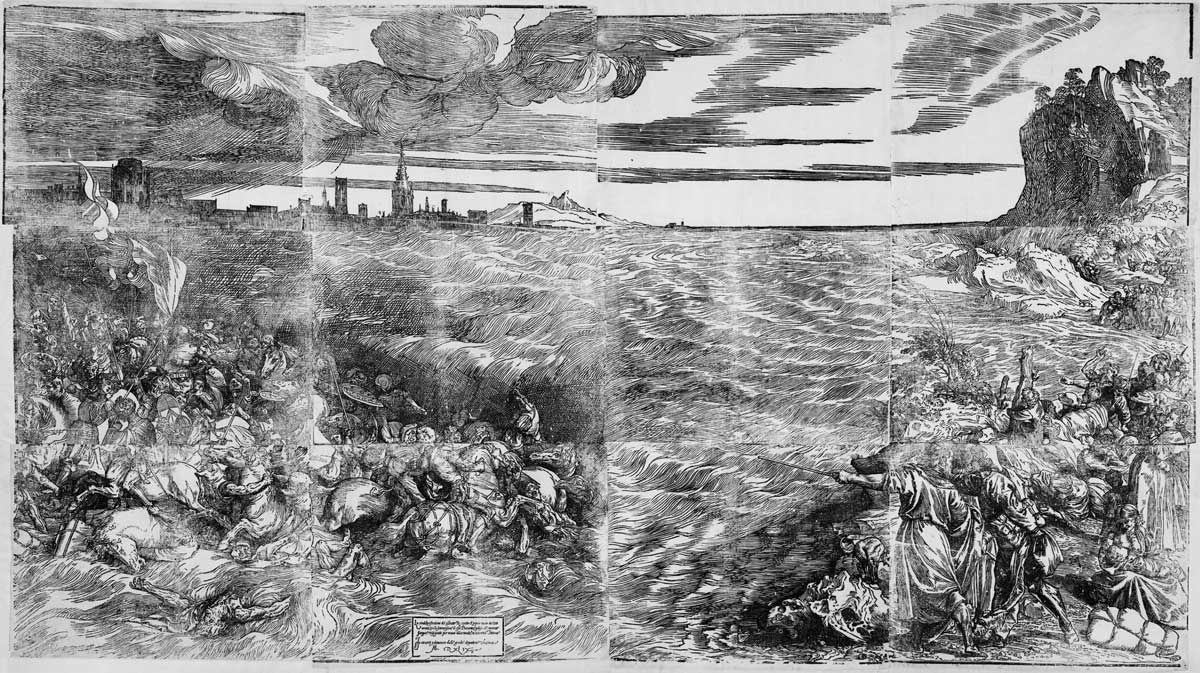
The Submersion of Pharaoh's Army in the Red Sea by Tiziano Vecellio (Titian)

by Mary Elizabeth Podles

When we think of Titian, we conjure up images of lushly painted jewel tones and golden Venetian light, and not of stark black and white. Yet he was a surprising master of the graphic arts, too, especially of the woodcut medium, as is evidenced by The Submersion of Pharaoh's Army in the Red Sea. This woodcut measures four feet by just over seven feet and is printed from twelve separate blocks. The artist must have drawn directly on the blocks with a broad-nibbed pen; the wood between the pen lines was then cut away so that the lines stood up in relief and could be inked for printing, all in all an extraordinary undertaking.

Extraordinary Image

Nor could the image itself be called ordinary. At the lower right, the commanding figure of Moses (figure 1) stretches out his rod over the sea, while the Israelites, with children, cattle, and baggage safely across, watch in wonderment as the waves lap benignly at their feet. Above them, at the far right, looms a rocky cliff (figure 2). In Byzantine icons, rocks like these always symbolize the wilderness. Venice was the West's principal point of contact with Byzantium, so Titian could easily have known about the motif and adopted it for his own. At the left, Pharaoh's soldiers, horses, and banners are all swept screaming under the onrushing wall of water; above them, standing in for the urbane and sophisticated fleshpots of Egypt, is the unmistakable skyline of Venice (figure 3).

The rest of the picture is entirely taken up with sea and sky. Above the Egyptians, stormy clouds roll leftwards as the army is engulfed, while the sky above the Israelites is clearing and bright. Recall that "the Lord went before them by day in a pillar of cloud to lead them along the way," and that on the last morning of flight, "in the morning watch the Lord in the pillar of fire and of cloud looked down upon the host of the Egyptians, and discomfited the host of the Egyptians, clogging their chariot wheels" just before giving the command to Moses to stretch out his rod over the waters. Thus, Titian here shows us the last action of the cloud, as it sweeps in the water and obliterates the following army.

Far and away the largest section of the picture is devoted to the water itself. Anyone who has ever tried to draw a convincing body of water knows the difficulty in finding a graphic equivalent for surface wave and motion; Titian has accomplished it with apparent ease, and in addition, has taught his carvers to exactly reproduce the fluid motion of his pen strokes in relief. In all its moods, from the peaceful ripples at the Israelites' feet to the crashing wall that engulfs the army, the sea itself is the real protagonist of the image.

Even Moses, whose figure is framed by the sea as he stretches out his arm, is seen from behind. Curiously, underneath his arm and also prominently framed, is a little dog pointedly defecating in the direction of the Egyptians. Such a profane touch is surprising in Titian, and suggests a deeper, hidden meaning. It has been suggested that Titian was making reference to a contemporary event: Venice's war with the League of Cambrai, waged from 1508 to 1516. Several chroniclers tell of the retreat of the imperial troops through the nearby Valsugana Mountains; to show their contempt, the inhabitants were said to have dropped their trousers and bared their buttocks toward the fleeing soldiers. Titian's Egyptians are dressed in the armor of contemporary mercenaries, so perhaps the little dog is a stand-in for the artist's own fellow citizens. In that case, the inclusion of Venice in the background also takes on a contemporary cast: Venice, which has always been protected from invasion from the sea, stands fast.

Uses of the Woodcut

So far we have not considered what a graphic image of this enormous size might have been for. Woodcuts from the beginning have mostly been a form of popular imagery, a cheap way to furnish even the houses of the poor with religious pictures. Sometimes the woodcuts reproduced painted images, and became a means of spreading new artistic ideas and compositions abroad; every artist collected prints. Nearly everyone had a set of woodcut playing cards. Books were illustrated with woodcuts, which could be set with raised type.

As the woodcut evolved into high art, connoisseurs began to collect them for themselves and to save them in special albums for private delectation. Surely The Submersion of Pharaoh's Army qualifies as high art, but there is no album anywhere big enough to house a print of this size. Furthermore, all the copies that do survive are from a late edition dated 1549, some 35 years after it is presumed to have been made, and the late edition shows signs of wear to the blocks from repeated printing. What happened to all the earlier editions?

The logical assumption is that a print of this size was intended to be displayed on a wall. The famous View of Venice published in 1500 was nearly nine feet long; it was meant to be pasted or hung on a wall, and it was a major inspiration for Titian's foray into the monumental woodcut. It is presumed, then, that the Submersion was intended as a substitute for fresco, an affordable church decoration that would cover a large amount of wall and could be colored or left in black and white, like a very sophisticated adult coloring book.


Mary Elizabeth Podles is the retired curator of Renaissance and Baroque art at the Walters Art Museum in Baltimore, Maryland. She is the author of A Thousand Words: Reflections on Art and Christianity (St. James Press, 2023). She and her husband Leon, a Touchstone senior editor, have six children and live in Baltimore, Maryland. She is a contributing editor for Touchstone.

A Journal of Mere Christianity—Delivered to Your Door

  • Essays on theology, culture, and the Church
  • Contributors from across the Christian traditions

Subscribe (Print + Online)

Six print issues (one year) of Touchstone, plus full online access and PDF downloads for only $39.95.

Subscribe (Online Only)

Get a one-year full-access subscription to the Touchstone online archives for only $19.95.


bulk subscriptions

Order Touchstone subscriptions in bulk and save $10 per sub! Each subscription includes 6 issues of Touchstone plus full online access to touchstonemag.com—including archives, videos, and pdf downloads of recent issues for only $29.95 each! Great for churches or study groups.

Transactions will be processed on a secure server.


more on art from the online archives
32.4—July/August 2019

Sojourner Knight

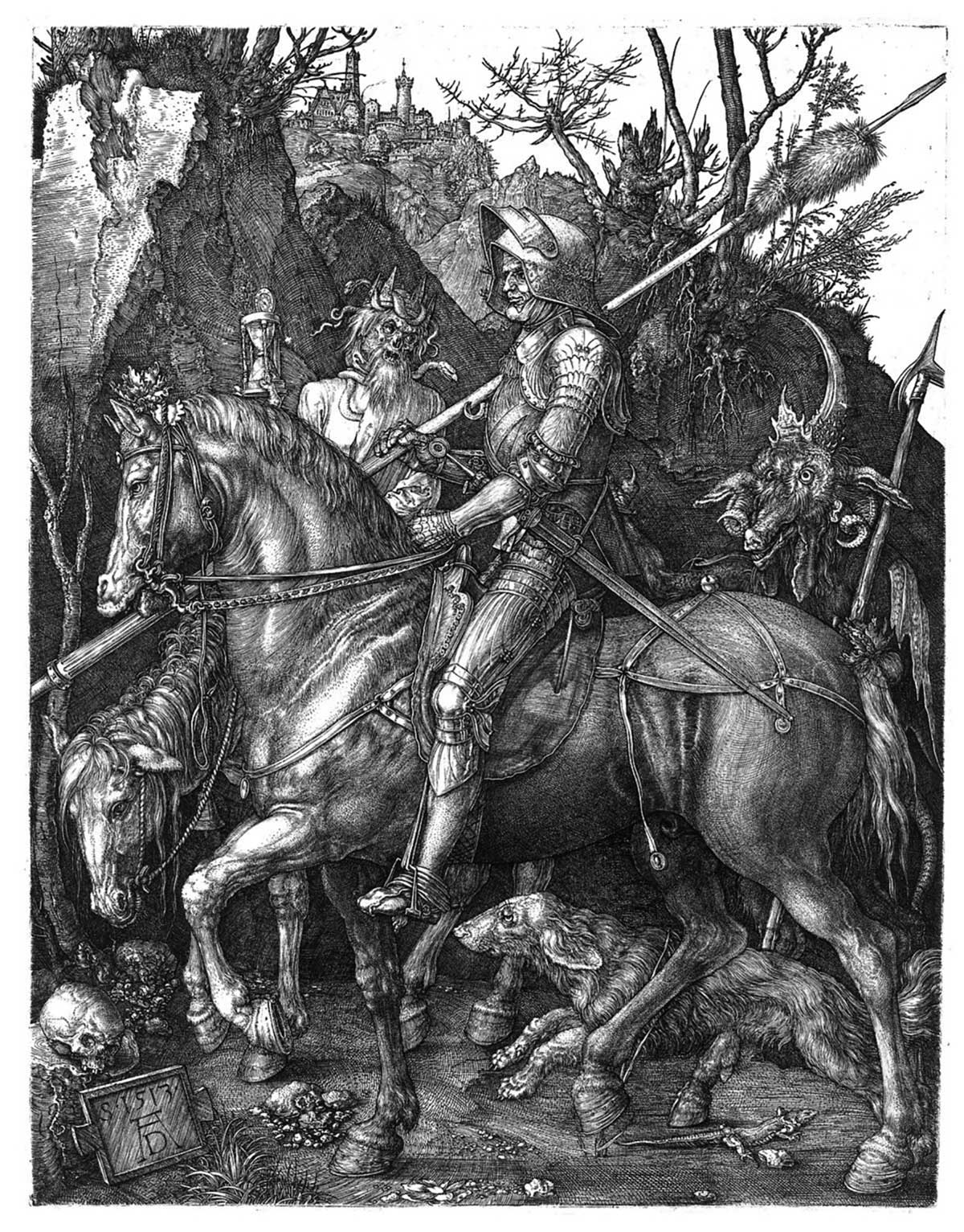
on Single-Mindedness in Durer's Ritter, Tod, und Teufel by Anthony Costello
30.3—May/June 2017

St. Luke the Evangelist

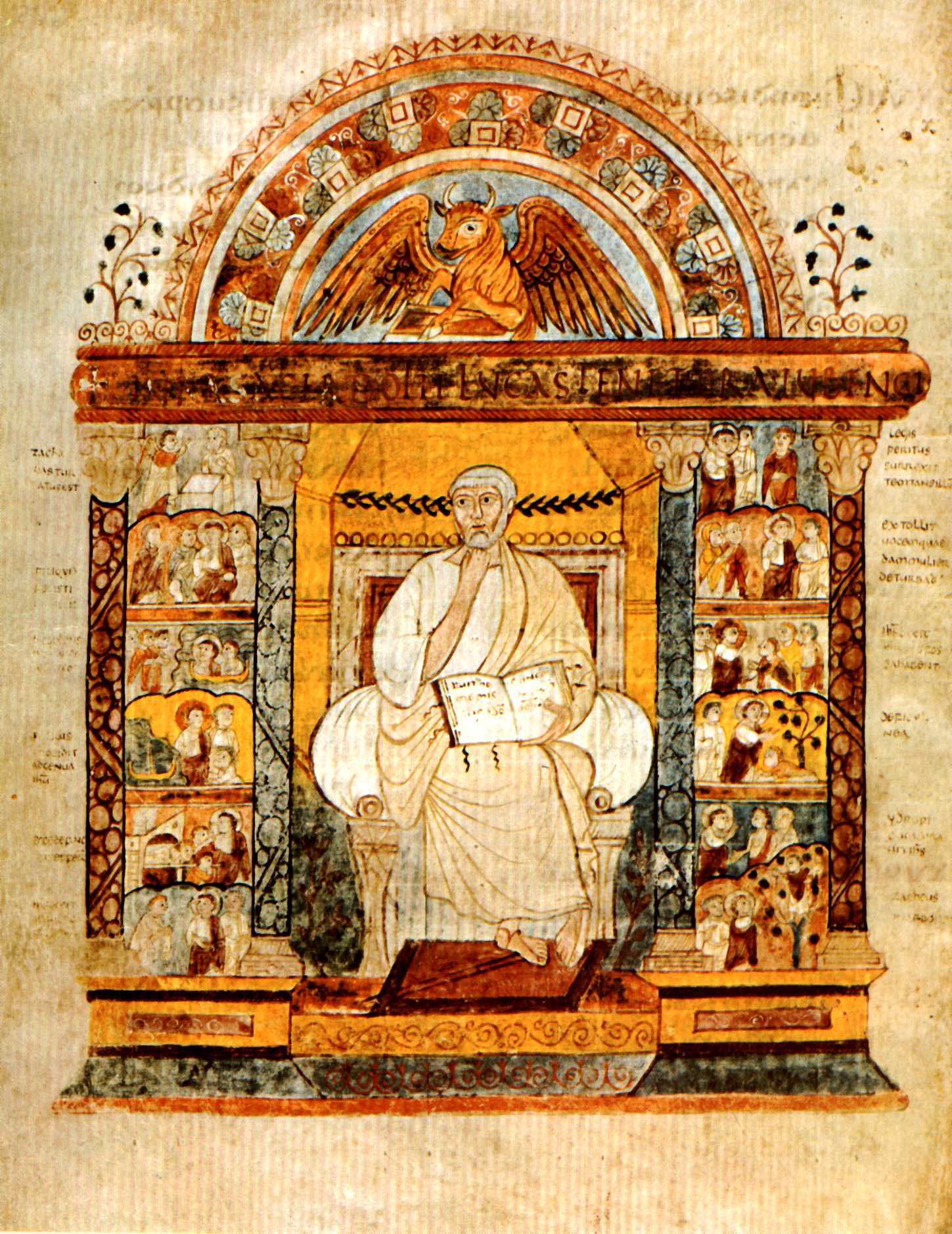
by Mary Elizabeth Podles

33.2—March/April 2020

Christ Chapel at Hillsdale

An Architectural Sign of Mere Christianity by Michael Ward


more from the online archives

27.5—Sept/Oct 2014

The Hundred Years' War

The Culture of Death's Campaign Against the Catholic Church by Brantly Millegan

30.6—Nov/Dec 2017

The Great Divorce

Christianity & the Liberal Society by James Hitchcock

33.1—January/February 2020

Do You Know Your Child’s Doctor?

The Politicization of Pediatrics in America by Alexander F. C. Webster

calling all readers

Please Donate

"There are magazines worth reading but few worth saving . . . Touchstone is just such a magazine."
—Alice von Hildebrand

"Here we do not concede one square millimeter of territory to falsehood, folly, contemporary sentimentality, or fashion. We speak the truth, and let God be our judge. . . . Touchstone is the one committedly Christian conservative journal."
—Anthony Esolen, Touchstone senior editor

Support Touchstone

00