




Memoir
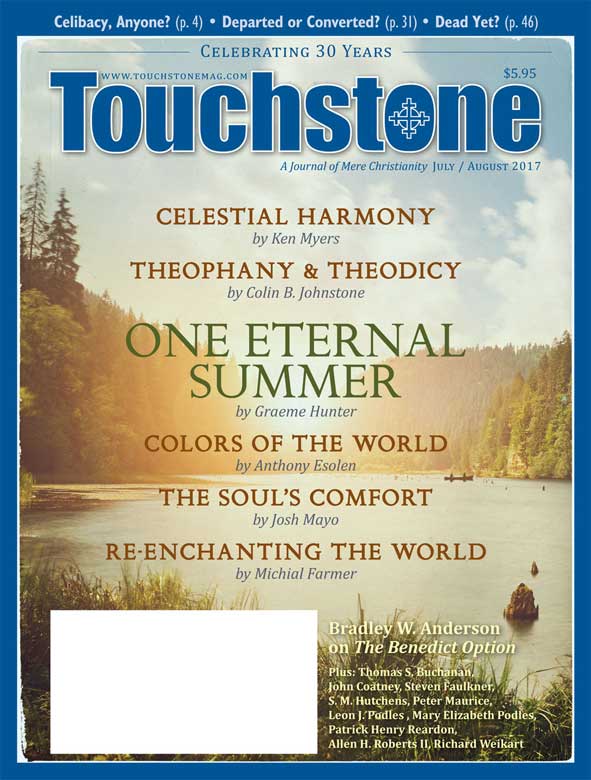
One Eternal Summer
An Officer Meets More than a Gentleman by Graeme Hunter
In linden-time the heart is high
For pride of summer passing by
—Swinburne
The finest job I ever had, probably the most delightful any fifteen-year-old was ever permitted to enjoy, was that of Officer of Her Majesty's (Victoria's, that is) Cavalry at Fort Kawandag, which was in the District of Parry Sound beside Muskoka Township in Ontario. Kawandag was the name of a magnificent lakeside estate which, like Glen Rocks, had at one time belonged to the Eaton family. Located near the head of Lake Rosseau, on the south side of the Village of Rosseau, Kawandag had formerly consisted of an elegant house with tasteful outbuildings and facilities in a matchless natural setting of many acres. Placed among the trees so as to be invisible from the house were clay tennis courts (once reputed to be among the best in the country) and stylish stables. The house itself was a structure of pink stone, full of large bright rooms with rich wooden trim, its two floors linked by carved wooden staircases. The many-windowed conservatory on the north side of the building opened to the west through multiple French doors onto an outdoor marble stairway sweeping grandly down to lakeshore gardens.
I have never seen a place where I would rather have lived. But when the Eatons moved on, the property was sold and resold, ultimately coming into the hands of men who saw in its graceful house and property the makings of a stately resort, in keeping with Muskoka's elegant tradition. And yet, for reasons no one ever understood, one after another of their enterprises failed.
East's Innovation
They went on failing until an experienced resort owner, Maurice East, bought the property with a new idea in mind. His innovation was to make the estate serve a dual purpose. The house would provide rooms for paying guests from the carriage trade, while doubling as the gubernatorial residence in a fantasy world aimed at the common tourist. In its first summer of operation, the rejuvenated Kawandag was definitely on the map. East created the necessary atmosphere without much expense, I think, but with lots of pizzazz.
For the most part, he simply used the outbuildings that were available. His principal innovation was to build upon a vacant piece of the property a primitive stockade, which would be called "Fort Kawandag." It reflected the building style of an imaginary age when a smallish fenced enclosure, with no place for stores, no barracks, and no stables, would house a garrison. The fort was, however, well equipped with interior walkways near the top of the ramparts, from which vantage point children could look between the conically pointed stakes and over them.
For the price of admission, six days a week, these children could participate as actor-spectators in a gripping pageant that absorbed them in its unfolding drama. Once admitted, they became settlers from the territory gathered in the fort that day to witness the signing of an important treaty with the Indians. The high point came when the fort was suddenly attacked by renegade Indians and the children, clutching their standard-issue popgun rifles, mounted to the rampart walkways to help repel the attack. The attack came punctually each afternoon at 4:30 p.m. and was successfully repelled by 5:15, in order that the heroes of the campaign could be reunited with their parents and home in time for dinner.
The Pageant
The routine was simple enough. At about 3:30, a flock of paying tourists with children in tow gathered at the lakeshore to see the friendly Indians arrive in their war canoe. As they tied up at the dock, the Governor would leave his mansion and descend the marble steps to the lakeshore to meet them. Once the Indians were safely landed and ceremoniously received, the Chief and the Governor would lead a colourful procession of infantry and Indians (followed by tourists and children) up to the fort, where the solemn peace-pipe ceremony would take place, its pomp enhanced by the cavalry guard, of which I was a member, looking on.
Just as that ceremony was successfully concluded, however, soul-harrowing war-whoops would be heard from renegade Indians outside the walls. There would be a general call to arms, and all the children, now cast as young settlers, would hasten to the ramparts brandishing the popguns newly issued to them from the armoury. In the confusion caused by getting one hundred or more little warriors into position, the friendly Indians disappeared through a door in the side of the wall nearest the woods, soon to return on horseback as Indian braves on the warpath. It was probably my first exposure to dramatic economy, the only kind of economy I have ever properly understood.
Graeme Hunter is a contributing editor to Touchstone and Research Professor of Philosophy at Dominican University College in Ottawa. He is the author of Radical Protestantism in Spinoza's Thought (Ashgate).
A Journal of Mere Christianity—Delivered to Your Door
- Essays on theology, culture, and the Church
- Contributors from across the Christian traditions

Six print issues (one year) of Touchstone, plus full online access and PDF downloads for only $39.95.

Get a one-year full-access subscription to the Touchstone online archives for only $19.95.
bulk subscriptions
Order Touchstone subscriptions in bulk and save $10 per sub! Each subscription includes 6 issues of Touchstone plus full online access to touchstonemag.com—including archives, videos, and pdf downloads of recent issues for only $29.95 each! Great for churches or study groups.
Transactions will be processed on a secure server.
more on memior from the online archives
more from the online archives
32.2—March/April 2019
on Properly Rendering Things to Caesar & to God by Peter J. Leithart
30.3—May/June 2017
Insider Attempts to Disorient the Orthodox by Alexander F. C. Webster

33.2—March/April 2020
Christian Pro-Family Governments?
Old & New Lessons from Europe by Allan C. Carlson
calling all readers
Please Donate
"There are magazines worth reading but few worth saving . . . Touchstone is just such a magazine."
—Alice von Hildebrand
"Here we do not concede one square millimeter of territory to falsehood, folly, contemporary sentimentality, or fashion. We speak the truth, and let God be our judge. . . . Touchstone is the one committedly Christian conservative journal."
—Anthony Esolen, Touchstone senior editor
