





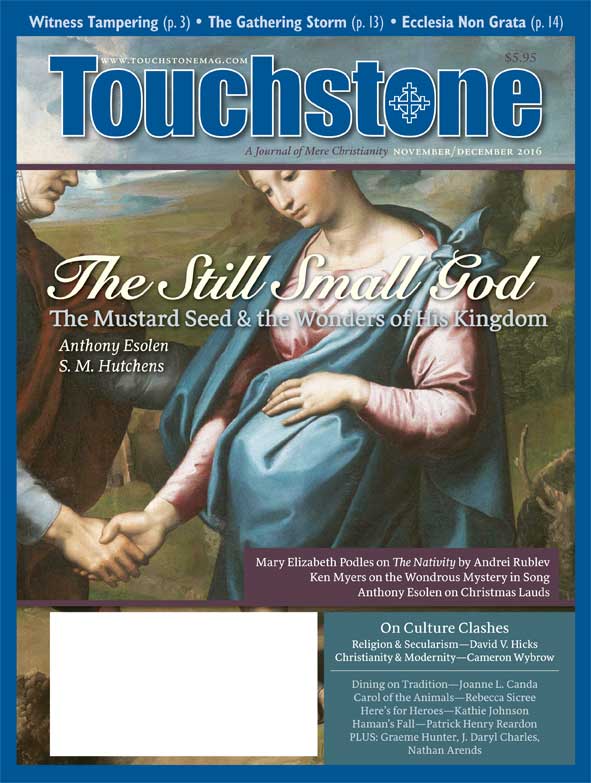
Andrei Rublev's The Nativity
by Mary Elizabeth Podles
The full title of Andrei Rublev's icon is The Nativity in the Flesh of Our Lord and Savior Jesus Christ; for all that, the poor infant Savior is given rather short shrift. He is placed at the center of the image, within a womb-like grotto like the one in Bethlehem traditionally associated with his birth. Sharp, angular rocks rise above it to symbolize the harshness of the world into which he is born. He is wrapped in swaddling clothes and laid in a tomblike manger as if to foreshadow his grave clothes and his future tomb. His very littleness seems to speak of the human frailty he was born to embrace. The lowly workaday animals, the ox and the ass, which symbolize the Jewish and the pagan peoples, regard this newcomer to their feedbox with appropriate surprise. He leans toward his mother, but even she turns her
face away.
Mary is the dominant figure of the icon. Stretched at the diagonal on a mandorla-shaped cushion, she who has just borne God leans her hand on her cheek in the traditional gesture of melancholy. Her gaze rests on a little gnarled tree at the right: this is the Tree of Jesse, and only she recognizes her little son's royal heritage. Or, it may at the same time be the Tree of Life, which the liturgical apolytikion proclaims "has blossomed from the Virgin in the cave." Her bed is like a bier and her pose similar to that of the Virgin in icons of the Dormition, so that we must wonder if she, too, looks toward her own earthly end.
In the corners below her are two additional scenes with a melancholy tinge. At the left, Joseph, head in hand, converses with a wild-looking old man who leans on a stick and peers at Joseph with a penetrating gaze. This is the Tempter, come to play upon Joseph's uncertainties. Joseph seems distressed, and struggles with his rational doubts, a theme that appears in the Eastern Church's Liturgy of the Nativity. On the right is a further scene of doubt, the story of the midwives from the apocryphal Protoevangelium of James. In the story, one of the midwives expresses skepticism at Mary's virginity and, for her doubts, burns her hand when she touches Mary.
Signs of Hope
Yet there is the hope of faith even among these scenes of doubt. The other midwife, identified as Salome the mother of James, pours out her faith in a kind of Magnificat even as she here pours out water for the baby's bath, and the doubting midwife is healed by the baby's touch.
The bath, incidentally, both points up the very humanity of Christ's birth, and looks forward to his Baptism in the Jordan and its revelation of his divinity; another tree, perhaps another reference to the Tree of Life, seems to spring from the upper edge of the fount.
Between the two lower vignettes Rublev has placed two sheep, apparently unattached to the shepherds at the center right: these are the flock that Christ will gather to himself in spite of the world's unbelief. In the upper half of the icon are further signs of hope. At the right, shepherds approach the Virgin. Their sheep, further foreshadowings of the Christian flock, nibble at the Tree of Life. The shepherds have heard the glad news announced by the angels at the upper right. There are four angels: the three who are fully visible are dressed in red, green, and the blue-and-red combination that Christ wears on earth (to symbolize his two natures). They are the Trinity, manifesting their workings in the Incarnation to the humble shepherds. The fourth angel is mostly hidden, representing the hidden face of God, the unknowable who is beyond our comprehension.
In the upper left-hand corner opposite the Trinity come the Magi, men of three ages, young, middle-aged, and old. The Eastern liturgy emphasizes their discovery of the light of Christ in the star, whose rays fall down the center of the panel before dividing, not surprisingly, into three. In the present state of preservation, the star and its rays are irreversibly blackened, but must once have been a dazzling silver, a reminder in the dark Moscow winter of the coming of the Light which men of every age must seek.
Finally, the Trinity, already manifest as the shepherds' angels and the star, puts in another appearance at the opening of the cave. In fact the babe is not alone: through the merciful working of the Trinity, the Godhead has broken through into our inhospitable world in the miracle of the Incarnation, and the world is
made new.
Russian Renewal
Rublev's icon, which dates to about 1405, was itself made during a time of renewal. In the thirteenth century, Russia was overrun by the Mongols and entered into a period of severe persecution. During this era, the Orthodox Church emerged as a symbol of Russian identity and a beacon to beleaguered Christians without a state; at this time, too, the ecclesiastical center of the Russian church moved from Kiev to Vladimir and eventually to Moscow. With the decay of the Mongol Empire, the Church began to rebuild. The Cathedral of the Annunciation of the Theotokos in the Kremlin was reconstructed on the site of an earlier cathedral, being finished in 1416 (it has since been rebuilt several times).
Mary Elizabeth Podles is the retired curator of Renaissance and Baroque art at the Walters Art Museum in Baltimore, Maryland. She is the author of A Thousand Words: Reflections on Art and Christianity (St. James Press, 2023). She and her husband Leon, a Touchstone senior editor, have six children and live in Baltimore, Maryland. She is a contributing editor for Touchstone.
A Journal of Mere Christianity—Delivered to Your Door
- Essays on theology, culture, and the Church
- Contributors from across the Christian traditions

Six print issues (one year) of Touchstone, plus full online access and PDF downloads for only $39.95.

Get a one-year full-access subscription to the Touchstone online archives for only $19.95.
bulk subscriptions
Order Touchstone subscriptions in bulk and save $10 per sub! Each subscription includes 6 issues of Touchstone plus full online access to touchstonemag.com—including archives, videos, and pdf downloads of recent issues for only $29.95 each! Great for churches or study groups.
Transactions will be processed on a secure server.
more on art from the online archives
33.2—March/April 2020
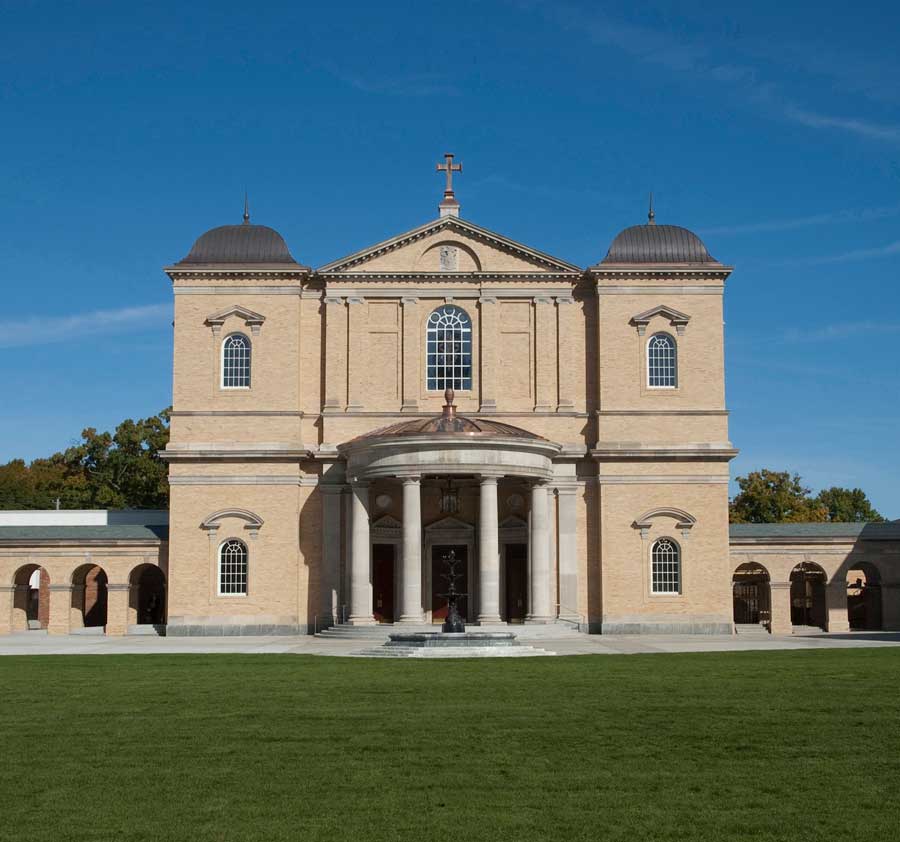
An Architectural Sign of Mere Christianity by Michael Ward
32.4—July/August 2019
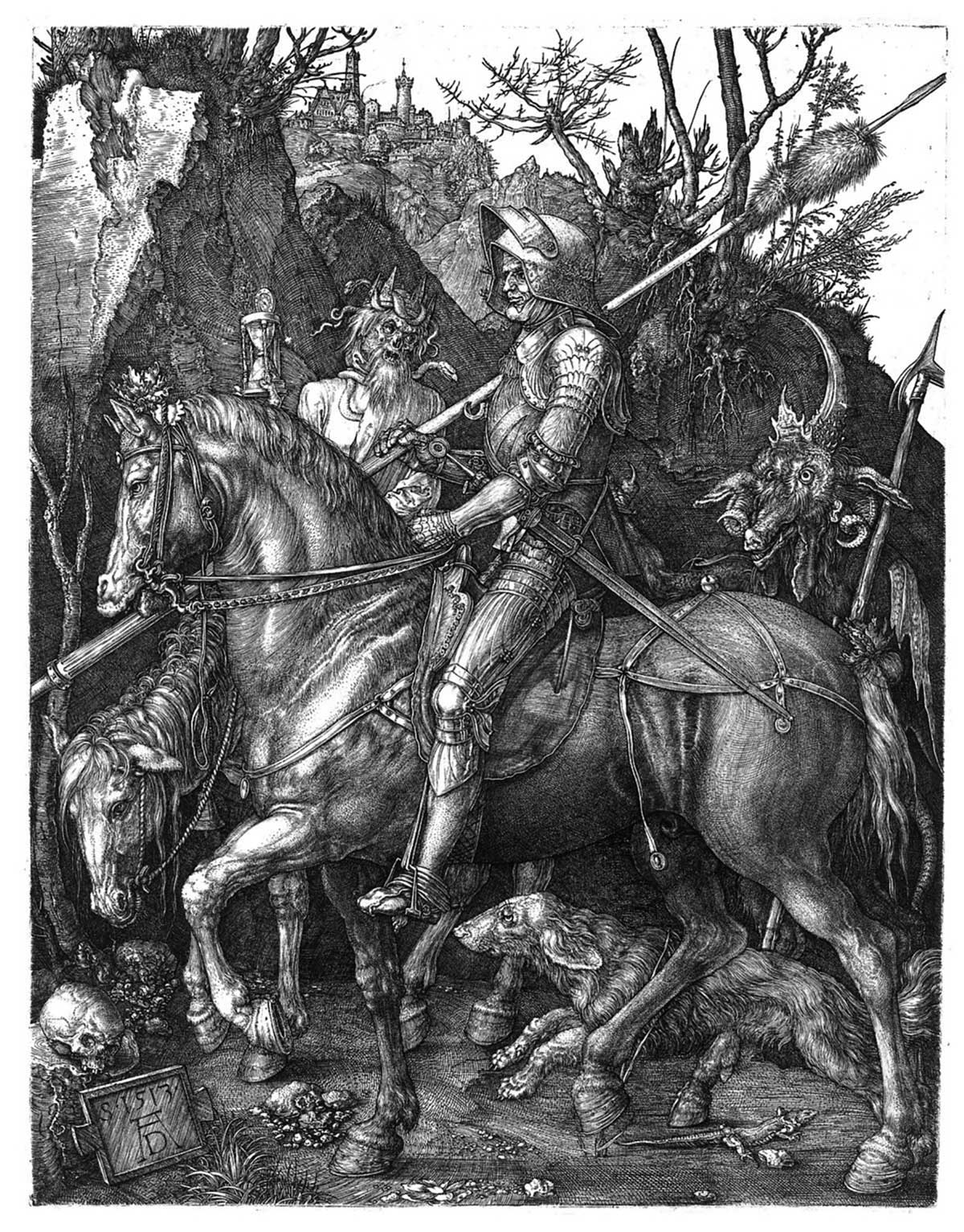
on Single-Mindedness in Durer's Ritter, Tod, und Teufel by Anthony Costello
more from the online archives
33.4—July/August 2020
on Boethius's Consolation in a Time of Plague by Thomas Albert Howard

28.6—Nov/Dec 2015
on the Deepest Longings of the Restless & the Lonely by William Graddy
calling all readers
Please Donate
"There are magazines worth reading but few worth saving . . . Touchstone is just such a magazine."
—Alice von Hildebrand
"Here we do not concede one square millimeter of territory to falsehood, folly, contemporary sentimentality, or fashion. We speak the truth, and let God be our judge. . . . Touchstone is the one committedly Christian conservative journal."
—Anthony Esolen, Touchstone senior editor
