




Column: A Thousand Words
The Ghent Altarpiece, Part II
Hubert & Jan van Eyck
by Mary Elizabeth Podles
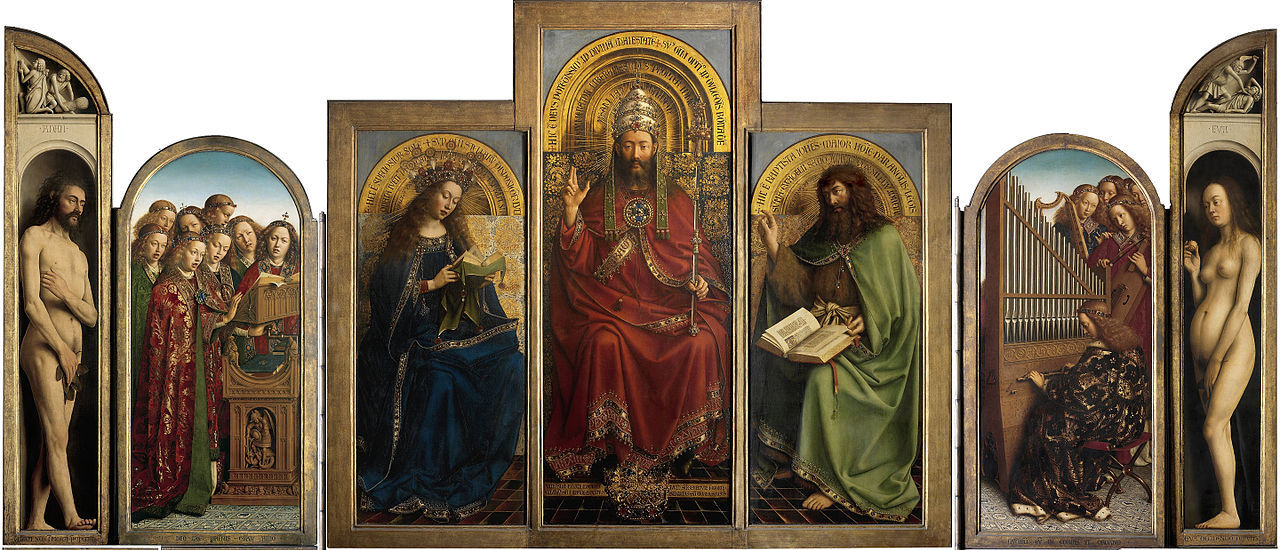
In the last issue, we looked at the exterior of the Ghent Altarpiece; in this issue, we open the doors. Accepting the theory that the panels were originally housed in a far more elaborate frame, and could be opened in different ways on different occasions, we will begin by unfolding the top tier and leave the lower doors shut for now.
The exterior panels are rather subdued and austere. Here, instead, is a sumptuous burst of golden light and color. The upper tier consists of seven panels, each roughly six feet in height. Before proceeding further, it might be well to pause a moment in admiration of the naturalistic effects the Van Eycks achieve. The relatively new medium of oil paint makes an astonishing range of visual effects possible. Unlike tempera, which is based in an opaque, egg-yolk medium, oil paints are translucent and can be superimposed in layers over a light-colored underpaint. Light passes through the layers and reflects off the underpainting, as if passing through stained glass, for unprecedented effects of naturalistic color and luminosity. The Van Eycks' use of the medium also underscores their Renaissance attitude: in contrast to the medieval worldview, which saw the world in ideal and symbolic terms, the Van Eycks demonstrate a fresh appreciation of the natural world as a blessing of creation.
Center Panels
The center three panels, depicting the Lord flanked by the Virgin and John the Baptist, closely resembles a Byzantine Deisis, in which Christ, robed in majesty, comes to judge the world while the two saints intercede for sinners. But it is somewhat more complex. The figure of the Lord bears the traditional dark-bearded face of the earthly Christ, and on the cloth of honor behind him are Eucharistic grapes and the Christological symbol of the pelican, which gives its own blood for the life of its offspring.
But the hand raised in blessing is unwounded, and on the step by his feet it reads, "Life without death on his head; Youth without age on his forehead." All of the inscriptions on the golden architecture and on his robes refer to his mighty power. Over his head begins the inscription, "This is the Lord most powerful"; "Sabaoth" is embroidered on his golden sash, and on his hem is written, "King of Kings and Lord of Lords." The crown at his feet tells us that he is king over all other kings. Moreover, he wears a jeweled triple tiara like the pope's, and, as in the pope's tiara, the three tiers represent the three persons of the Trinity. This is not so much
Christ, perhaps, as the Trinity itself made manifest as One.
This interpretation is reinforced by the somewhat unusual figure of John the Baptist on the right. He wears his traditional camel's-hair garment, but over it is a regal robe of green (recall that he was the cathedral's titular saint until the rededication to St. Bavo in 1540). The inscription over his head comes from a sermon of Peter Chrysologos, but with the references to him as Christ's precursor left out, presenting him instead as the revealer and mediator of the Trinity in its wholeness. His hand is raised in a speaking, teaching pose, and not one of pointing the way or making supplication for mercy.
Similarly, on the other side, Mary, crowned with gems and flowers like a bride, sits serene, not so much an intercessor as queen of the celestial court. Together the three panels form a coherent whole, drawn from a common perspective and sharing a heavenly deep blue sky. Interestingly, right and left are reversed, as if seen from God's point of view. Mary, in the place of honor, is on our left, but at the right hand of God.
Side Panels
Flanking these three panels are two groups of angels, wingless, and vested as if to participate in a heavenly liturgy. They occupy a space slightly lower than that of the celestial trio, and their sky shades from a naturalistic light blue into the deeper lapis blue of heaven. The singing angels on our left (God's right) seem to belong to the New Testament: their crowns bear crosses, and if we look closely, we can see that their lips and tongues are in different positions. That is, we can "hear" them singing polyphony. We can discern their voices, too: one strains to hit the high notes, another tucks in his chin to sing the deepest basso. On the other side, one angel plays David's instrument, the harp; the angels' crowns bear no crosses, and they accompany John the Baptist, last of the prophets; they are of the Old Testament world.
Mary Elizabeth Podles is the retired curator of Renaissance and Baroque art at the Walters Art Museum in Baltimore, Maryland. She is the author of A Thousand Words: Reflections on Art and Christianity (St. James Press, 2023). She and her husband Leon, a Touchstone senior editor, have six children and live in Baltimore, Maryland. She is a contributing editor for Touchstone.
A Journal of Mere Christianity—Delivered to Your Door
- Essays on theology, culture, and the Church
- Contributors from across the Christian traditions

Six print issues (one year) of Touchstone, plus full online access and PDF downloads for only $39.95.

Get a one-year full-access subscription to the Touchstone online archives for only $19.95.
bulk subscriptions
Order Touchstone subscriptions in bulk and save $10 per sub! Each subscription includes 6 issues of Touchstone plus full online access to touchstonemag.com—including archives, videos, and pdf downloads of recent issues for only $29.95 each! Great for churches or study groups.
Transactions will be processed on a secure server.
more on art from the online archives
33.2—March/April 2020
An Architectural Sign of Mere Christianity by Michael Ward
32.4—July/August 2019
on Single-Mindedness in Durer's Ritter, Tod, und Teufel by Anthony Costello
more from the online archives
33.3—May/June 2020
Bach's Cantata BWV 106, Gottes Zeit ist die allerbesteZeit (God's time is the very best time) by Ken Myers

19.10—December 2006
Training Up a Child Requires a Well-Formed Imagination by David Mills
calling all readers
Please Donate
"There are magazines worth reading but few worth saving . . . Touchstone is just such a magazine."
—Alice von Hildebrand
"Here we do not concede one square millimeter of territory to falsehood, folly, contemporary sentimentality, or fashion. We speak the truth, and let God be our judge. . . . Touchstone is the one committedly Christian conservative journal."
—Anthony Esolen, Touchstone senior editor
