





Column: A Thousand Words
Apse Mosaic
Church of Sant'Apollinare in Classe
by Mary Elizabeth Podles
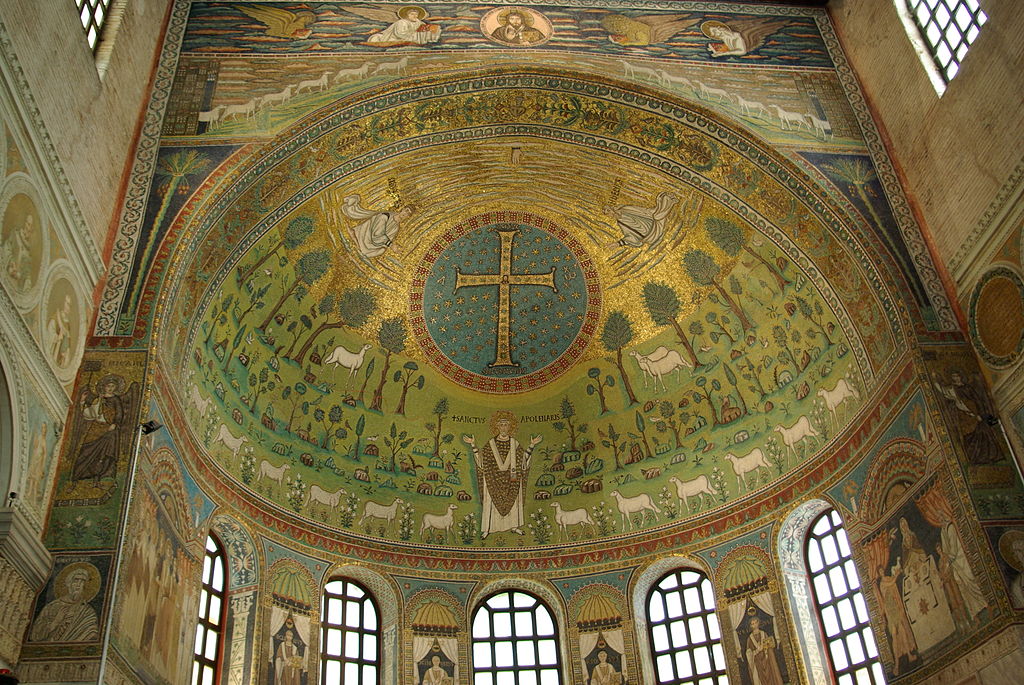
The Church of Sant'Apollinare, particularly its glorious apse mosaic, is the happy byproduct of the political, economic, and artistic boom in Ravenna, Italy, in the fifth and sixth centuries a.d.; the subsequent bust preserved it practically intact. Saint Apollinaris, pictured in the lower half of the mosaic, was the first bishop of Ravenna and was martyred under the reign of Vespasian. His relics were enshrined in the basilica when it was consecrated in 549 by the (legendarily disliked) Bishop Maximianus. Thus the saint's prominent placement in the apse.
The mosaicist presents the saint in classic icon form: a fully frontal, full-length figure, vested as in life as a bishop, with hands raised in an orans or praying posture. The sheep ranged on either side of him among lilies and flowers represent his earthly flock, who look toward him trustingly. Often in such Byzantine mosaics, the patron saint is flanked by real people, patrons of the church or imperial officials, as in the famous mosaics of Justinian and Theodora in the nearby basilica of San Vitale. Here, however, the flock is shown only symbolically. Only the saint appears as a human figure, appropriately enough, as his human remains rest in the altar directly beneath his feet. His praying posture also reflects that of the celebrant at the altar, as he partakes in heaven of the liturgy below.
THIS ARTICLE ONLY AVAILABLE TO SUBSCRIBERS.
FOR QUICK ACCESS:
Mary Elizabeth Podles is the retired curator of Renaissance and Baroque art at the Walters Art Museum in Baltimore, Maryland. She is the author of A Thousand Words: Reflections on Art and Christianity (St. James Press, 2023). She and her husband Leon, a Touchstone senior editor, have six children and live in Baltimore, Maryland. She is a contributing editor for Touchstone.
A Journal of Mere Christianity—Delivered to Your Door
- Essays on theology, culture, and the Church
- Contributors from across the Christian traditions

Six print issues (one year) of Touchstone, plus full online access and PDF downloads for only $39.95.

Get a one-year full-access subscription to the Touchstone online archives for only $19.95.
bulk subscriptions
Order Touchstone subscriptions in bulk and save $10 per sub! Each subscription includes 6 issues of Touchstone plus full online access to touchstonemag.com—including archives, videos, and pdf downloads of recent issues for only $29.95 each! Great for churches or study groups.
Transactions will be processed on a secure server.
more on art from the online archives

32.4—July/August 2019
on Single-Mindedness in Durer's Ritter, Tod, und Teufel by Anthony Costello
33.2—March/April 2020
An Architectural Sign of Mere Christianity by Michael Ward
more from the online archives

32.1—January/February 2019
on Down Syndrome & the Lives That Matter by David F. Watson

18.3—April 2005
on Being a Free Narnian & the Joy of Subordination by Donald T. Williams
32.6—November/December 2019
on Taking Heed of the Parallels Between the Crises of Yesterday & Today by Korey D. Maas
calling all readers
Please Donate
"There are magazines worth reading but few worth saving . . . Touchstone is just such a magazine."
—Alice von Hildebrand
"Here we do not concede one square millimeter of territory to falsehood, folly, contemporary sentimentality, or fashion. We speak the truth, and let God be our judge. . . . Touchstone is the one committedly Christian conservative journal."
—Anthony Esolen, Touchstone senior editor
