





Column: Illuminations
Our Dear Land
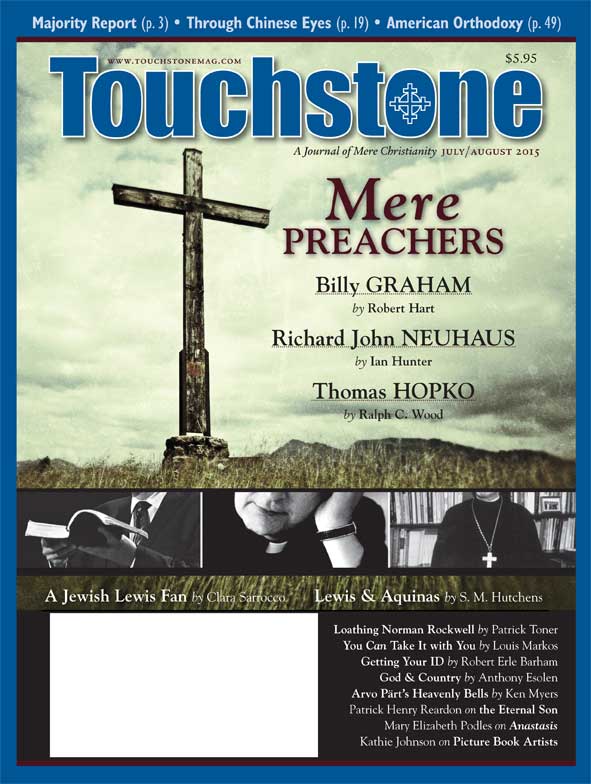
by Anthony Esolen
Americans have heard lately, mainly from American politicians, that it is not possible to love America unless you love its government, which means, practically speaking, its governors, the politicians themselves. L'etat, c'est moi, said the bloated old French dynast. He was in this regard gentler on his subjects than our governors are. There was only one Louis XIV that they all had to love, and his method of loving his subjects was the old and necessarily limited one of inviting a few of the prettier females to a closer acquaintance with their sovereign. Most Frenchmen lived safely beneath the enmity of their one king. If only Americans could live safely beneath the loving-kindness of their many thousands.
But what a sad thing it is, to have no country to love, but only The Congressional Record, or the by-laws of the senate of Arkansas! I'm flat-footed enough to believe that when you love your country, you love that place under your shoes. You love the red clay hills of north Georgia, or the shiny black coal that splinters under the grass in Pennsylvania. You love the snow-laden gales blowing across Lake Michigan (yes, you do). You love that there are such things as scrapple, Yankee Clippers, banjos, baseball fields, marching bands, and diners serving blueberry pancakes as big as hubcaps but heavier. You love the place, and all its peculiar ways, just as you love your cousins and your classmates, even when you fight with them, and sometimes especially when you fight.
THIS ARTICLE ONLY AVAILABLE TO SUBSCRIBERS.
FOR QUICK ACCESS:
Anthony Esolen is Distinguished Professor of Humanities at Thales College and the author of over 30 books, including Real Music: A Guide to the Timeless Hymns of the Church (Tan, with a CD), Out of the Ashes: Rebuilding American Culture (Regnery), and The Hundredfold: Songs for the Lord (Ignatius). He has also translated Dante’s Divine Comedy (Random House) and, with his wife Debra, publishes the web magazine Word and Song (anthonyesolen.substack.com). He is a senior editor of Touchstone.
subscription options
Order
Print/Online Subscription

Get six issues (one year) of Touchstone PLUS full online access including pdf downloads for only $39.95. That's only $3.34 per month!
Order
Online Only
Subscription

Get a one-year full-access subscription to the Touchstone online archives for only $19.95. That's only $1.66 per month!
bulk subscriptions
Order Touchstone subscriptions in bulk and save $10 per sub! Each subscription includes 6 issues of Touchstone plus full online access to touchstonemag.com—including archives, videos, and pdf downloads of recent issues for only $29.95 each! Great for churches or study groups.
Transactions will be processed on a secure server.
more from the online archives

28.6—Nov/Dec 2015
on the Deepest Longings of the Restless & the Lonely by William Graddy

22.6—July/August 2009
on a Noble Defense Doomed by Darwinian Materialism by John G. West

calling all readers
Please Donate
"There are magazines worth reading but few worth saving . . . Touchstone is just such a magazine."
—Alice von Hildebrand
"Here we do not concede one square millimeter of territory to falsehood, folly, contemporary sentimentality, or fashion. We speak the truth, and let God be our judge. . . . Touchstone is the one committedly Christian conservative journal."
—Anthony Esolen, Touchstone senior editor
