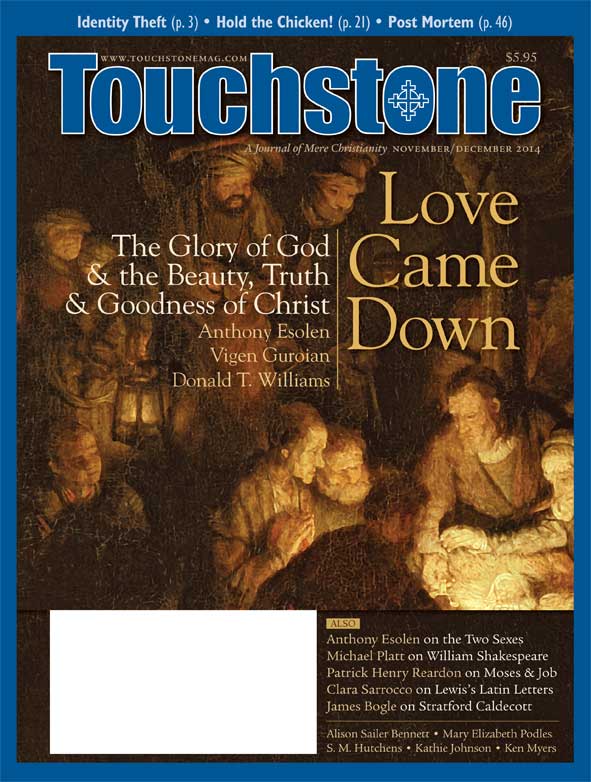
Love Came Down by Anthony Esolen

Illuminations

Love Came Down

Anthony Esolen on Christian Hymns

'Tis the season to be buying,
Fa la la la la, la la la la.
Mom's exhausted, baby's crying,
Fa la la la la, la la la la.
Charge on credit all we covet,
Fa la la, la la la, la la la!
Though we have no place to shove it,
Fa la la la la, la la la la.

One of the few columns of a Christian culture that still stands in the secular city is Dickens' A Christmas Carol. Everyone knows, or supposes, that Scrooge's problem was greed, and that Bob Cratchit's problem was poverty. Everyone knows, or supposes, that the whole aim of the three Ghosts of Christmas was to loosen up Scrooge's claw-hold on his purse, so that he might give a little to Bob Cratchit and his struggling family. That's why the strangely unpleasant film Scrooge ends with Albert Finney, a miser turned prodigal, shoveling out coins everywhere, looking like that old confidence man Santa Claus, with a jollity approaching the manic.

But Dickens' novel is not centrally about increasing your charitable donations. It is about the coming to life of a dead soul. There is an Easter in his Christmas. "I am quite a baby," says Scrooge the reborn, on that Christmas morning. Dickens has set his face like flint against all the paths of death, which is to say against all systems that reduce human beings to consumers, or to providers of goods, or to counters in a fearful utilitarian reckoning.

If you are someone who thinks for one moment that it might be "better" for everyone concerned if that child with Down syndrome is snuffed in the womb, Dickens has you ranged with far worse than Scrooge. Do you believe that the poor recipients of your giving ought to be rated according to how much of a utilitarian "return" they can give back? Kindly take your place among Dickens' other ideologues, parasites, extortionists, and villains, who regard their brothers and sisters as if they were members of a completely different species. Christmas is no holiday for followers of Malthus or Bentham.

"Love is not love," says Shakespeare, "which alters when it alteration finds, / Or bends with the remover to remove." Love does not tally advantages. It does not count the cost. We cannot say without contradicting ourselves, "I shall now consider how deeply I shall love you, adjusting the degree to my needs and circumstances." We cannot say without contradicting ourselves, "If you grow twice as wealthy, I shall love you twice as much."

Max Scheler says that Jesus praised the widow who gave her mite, not because it was a relatively large percentage of her means, but because it was a greater token of her love. We do not want "love" so that there will be more charitable giving. Love, says Scheler, is its own end: it is what we want more of; we want that there should be more love in the world.

What people are saying about Touchstone:


Gift & Sign

Which brings me to a beautiful little carol by one of Dickens' contemporaries, Christina Rossetti. Most of us know her haunting "In the Bleak Midwinter."This one, "Love Came Down at Christmas"(set to the childlike Irish melody, Garton), is in the same spirit, but is even simpler, one might say simple in its intensity. Miss Rossetti has one thing in mind: love. She will not let our attention stray from that. Jesus loves us, true enough. But he is himself Love:

Love came down at Christmas,
Love all lovely, Love Divine;
Love was born at Christmas,
Star and angel gave the sign.


Anthony Esolen is Distinguished Professor of Humanities at Thales College and the author of over 30 books, including Real Music: A Guide to the Timeless Hymns of the Church (Tan, with a CD), Out of the Ashes: Rebuilding American Culture (Regnery), and The Hundredfold: Songs for the Lord (Ignatius). He has also translated Dante’s Divine Comedy (Random House) and, with his wife Debra, publishes the web magazine Word and Song (anthonyesolen.substack.com). He is a senior editor of Touchstone.

A Journal of Mere Christianity—Delivered to Your Door

  • Essays on theology, culture, and the Church
  • Contributors from across the Christian traditions

Subscribe (Print + Online)

Six print issues (one year) of Touchstone, plus full online access and PDF downloads for only $39.95.

Subscribe (Online Only)

Get a one-year full-access subscription to the Touchstone online archives for only $19.95.


bulk subscriptions

Order Touchstone subscriptions in bulk and save $10 per sub! Each subscription includes 6 issues of Touchstone plus full online access to touchstonemag.com—including archives, videos, and pdf downloads of recent issues for only $29.95 each! Great for churches or study groups.

Transactions will be processed on a secure server.


more from the online archives
15.6—July/August 2002

Things Hidden Since the Beginning of the World

The Shape of Divine Providence & Human History by James Hitchcock

32.4—July/August 2019

To Spread His Glory

Four Theses on Christian Education by Donald T. Williams

33.3—May/June 2020

Consolation in Death

Bach's Cantata BWV 106, Gottes Zeit ist die allerbesteZeit (God's time is the very best time) by Ken Myers

calling all readers

Please Donate

"There are magazines worth reading but few worth saving . . . Touchstone is just such a magazine."
—Alice von Hildebrand

"Here we do not concede one square millimeter of territory to falsehood, folly, contemporary sentimentality, or fashion. We speak the truth, and let God be our judge. . . . Touchstone is the one committedly Christian conservative journal."
—Anthony Esolen, Touchstone senior editor

Support Touchstone

00