




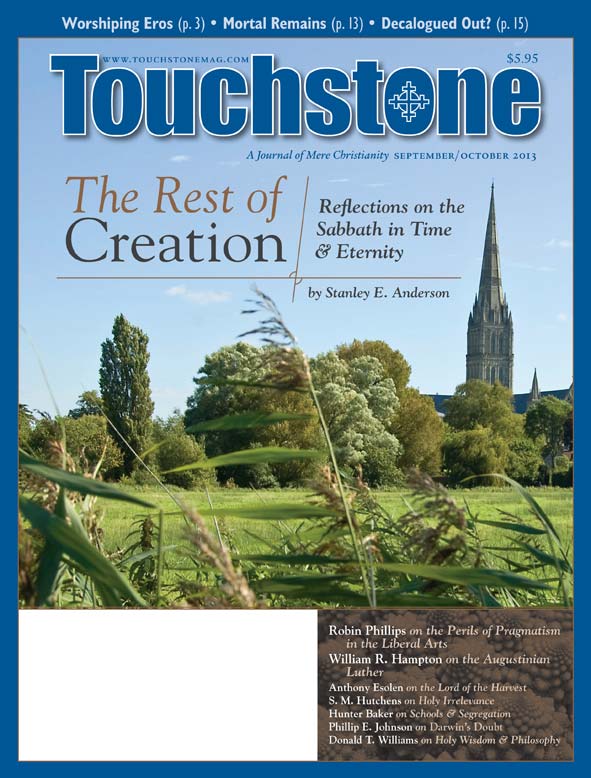
Column: Illuminations
The Lord of The Harvest
When Jesus walked the earth in Galilee, he knew the natural world as most men until our time have known it. He felt the sun and the wind and the rain upon his flesh. He traveled on foot over rugged hills; he retreated, or rather strode boldly, up to the mountaintops to pray, to find those artesian wells of silence, where hovered the Spirit of God.
Jesus, we are told, chose metaphors from nature because they were ready to hand, easy for his disciples to grasp. I think that's true, if we mean, for instance, that everyone had either sown seed in a field or seen someone doing it, and so could come to some initial awareness of what Jesus was talking about. But that's only a part of the truth, and probably the smallest part.
THIS ARTICLE ONLY AVAILABLE TO SUBSCRIBERS.
FOR QUICK ACCESS:
Anthony Esolen is Distinguished Professor of Humanities at Thales College and the author of over 30 books, including Real Music: A Guide to the Timeless Hymns of the Church (Tan, with a CD), Out of the Ashes: Rebuilding American Culture (Regnery), and The Hundredfold: Songs for the Lord (Ignatius). He has also translated Dante’s Divine Comedy (Random House) and, with his wife Debra, publishes the web magazine Word and Song (anthonyesolen.substack.com). He is a senior editor of Touchstone.
A Journal of Mere Christianity—Delivered to Your Door
- Essays on theology, culture, and the Church
- Contributors from across the Christian traditions

Six print issues (one year) of Touchstone, plus full online access and PDF downloads for only $39.95.

Get a one-year full-access subscription to the Touchstone online archives for only $19.95.
bulk subscriptions
Order Touchstone subscriptions in bulk and save $10 per sub! Each subscription includes 6 issues of Touchstone plus full online access to touchstonemag.com—including archives, videos, and pdf downloads of recent issues for only $29.95 each! Great for churches or study groups.
Transactions will be processed on a secure server.
more from the online archives
34.1—January/February 2021
Live Not by Lies: A Manual for Christian Dissidents by Rod Dreher by Hans Boersma
calling all readers
Please Donate
"There are magazines worth reading but few worth saving . . . Touchstone is just such a magazine."
—Alice von Hildebrand
"Here we do not concede one square millimeter of territory to falsehood, folly, contemporary sentimentality, or fashion. We speak the truth, and let God be our judge. . . . Touchstone is the one committedly Christian conservative journal."
—Anthony Esolen, Touchstone senior editor
