




A Thousand Words
Raphael's
Alba Madonna
by Mary Elizabeth Podles
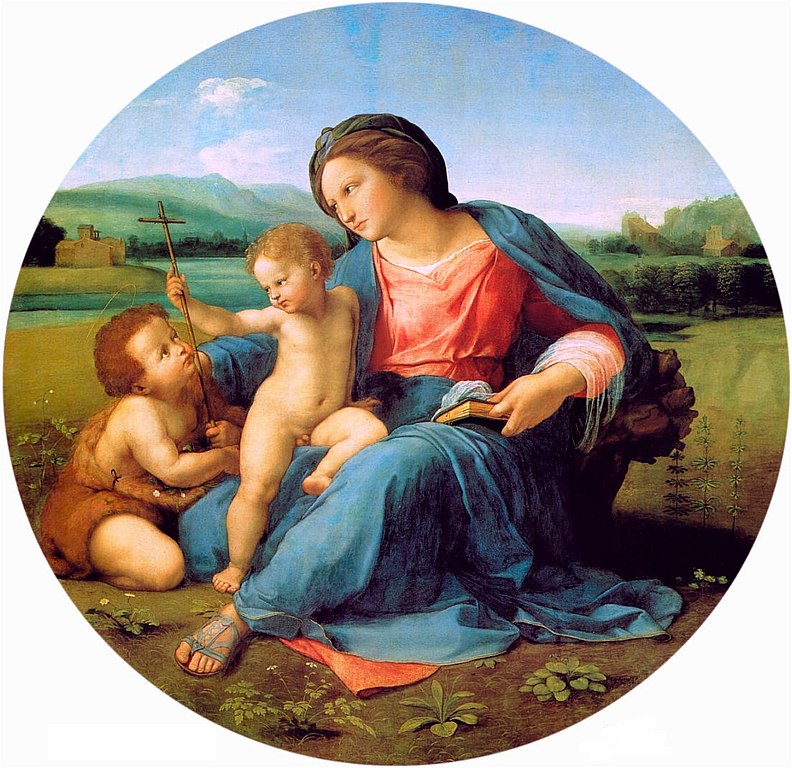
In 1508, the young Raffaello Sanzio was hired away from Florence to Rome to assist in the decorations of the Vatican Palace, work that occupied him until the time of his death. During his Roman years, he also accepted private commissions for easel paintings like this one (Figure 1). The physician, writer, and prelate Paolo Giovio most likely commissioned the Alba Madonna around 1510 or 1511, intending to hang it over the altar of his church in Nocera.
At first blush, it is a simple enough devotional image: the Madonna, seated on the ground and leaning against a grassy bank, holds the baby Jesus on her lap while the infant John the Baptist looks on; behind them spreads a serene and pastoral landscape.
The Tondo
The round shape is a little unusual. The tondo (from rotondo, round) shape was not unheard of for altarpieces in Florence and Rome, but it was more commonly used for paintings commissioned to celebrate the birth of a child. The circle suggested multiple meanings: the wedding ring, perhaps the birth canal, and certainly eternity. To have a child hedges against mortality, for at least a part of oneself lives on. The tondo, then, is certainly appropriate to celebrate the nativity on earth of the Eternal One.
The round shape presents the artist with something of a compositional challenge. A circle is inherently unstable, and if it is not anchored properly, it always looks as if it would like to roll away. The strong horizon line holds us steady here, and the solid pyramid of the three figures is firmly set on its broad base and will not be moved. While in Rome, Raphael undoubtedly knew Michelangelo's ongoing work on the Sistine Chapel ceiling, and, under its influence, his own figures take on the weight and muscularity Michelangelo had absorbed from the art of Antiquity.
Even Raphael's Jesus is solid, sturdy, and alert, a heroic baby. And in more ways than one: he reaches out to embrace the cross his little cousin offers to him, and the three exchange a series of sorrowful glances. John holds anemone flowers in his lap, and more blossom behind him (Figure 2). In the traditional iconography* of the West, the anemone signifies sorrow. Already implied in the joy of the Incarnation is the future sadness of the Passion.
The Flowers
Art historians love flowers. They very nearly always carry a veiled meaning. To the Christian way of thinking, everything in the natural world conveys a meaning beyond itself in the supernatural realm: the physical expresses the metaphysical. We know this from the extended metaphors of the wordiest of the church fathers, and it is often their writings that are the ultimate source of Renaissance visual symbolism.
In Raphael's painting, Mary, Jesus, and John sit in a circle of carefully painted plants, each of which is a clue to our ultimate understanding of the picture. The next two plants, reading from left to right, are the lowly dandelion and sweet cicely (Figure 3). Traditionally, the dandelion was used as one of the bitter herbs of the Passover supper, and in Christian times it came to symbolize the bitterness of Christ's own Passover. The Latin name of the sweet cicely is Myrrhus odoratus, the scented myrrh, which recalls the embalming spice brought by the Magi to the infant Christ: even at the moment of his birth, the manner of his death was foreshadowed.
At the far right is sweet woodruff, or bedstraw, which is also associated with Christ's Nativity: tradition has it that woodruff, which smells sweet even when dried, was laid in the manger (Figure 4). Some people still dry it for use in their Christmas creches.
Mary Elizabeth Podles is the retired curator of Renaissance and Baroque art at the Walters Art Museum in Baltimore, Maryland. She is the author of A Thousand Words: Reflections on Art and Christianity (St. James Press, 2023). She and her husband Leon, a Touchstone senior editor, have six children and live in Baltimore, Maryland. She is a contributing editor for Touchstone.
A Journal of Mere Christianity—Delivered to Your Door
- Essays on theology, culture, and the Church
- Contributors from across the Christian traditions

Six print issues (one year) of Touchstone, plus full online access and PDF downloads for only $39.95.

Get a one-year full-access subscription to the Touchstone online archives for only $19.95.
bulk subscriptions
Order Touchstone subscriptions in bulk and save $10 per sub! Each subscription includes 6 issues of Touchstone plus full online access to touchstonemag.com—including archives, videos, and pdf downloads of recent issues for only $29.95 each! Great for churches or study groups.
Transactions will be processed on a secure server.
more on art from the online archives
33.2—March/April 2020
An Architectural Sign of Mere Christianity by Michael Ward
32.4—July/August 2019
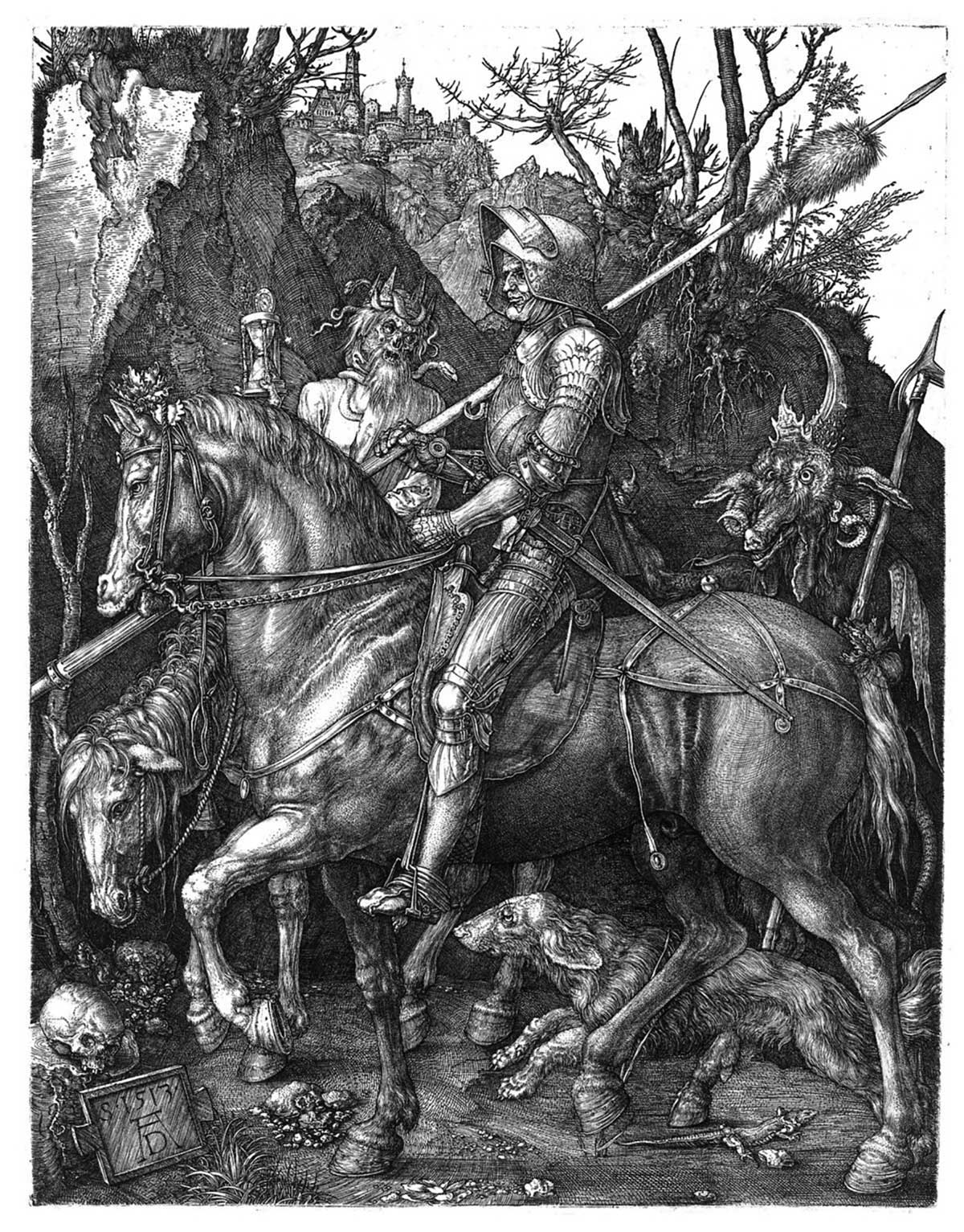
on Single-Mindedness in Durer's Ritter, Tod, und Teufel by Anthony Costello
more from the online archives
32.1—January/February 2019
The Diabolical Failure of Leaders in the Present Crises by James M. Kushiner
30.5—Sept/Oct 2017
The Critical History Before, During & After Martin Luther by James Hitchcock
calling all readers
Please Donate
"There are magazines worth reading but few worth saving . . . Touchstone is just such a magazine."
—Alice von Hildebrand
"Here we do not concede one square millimeter of territory to falsehood, folly, contemporary sentimentality, or fashion. We speak the truth, and let God be our judge. . . . Touchstone is the one committedly Christian conservative journal."
—Anthony Esolen, Touchstone senior editor

