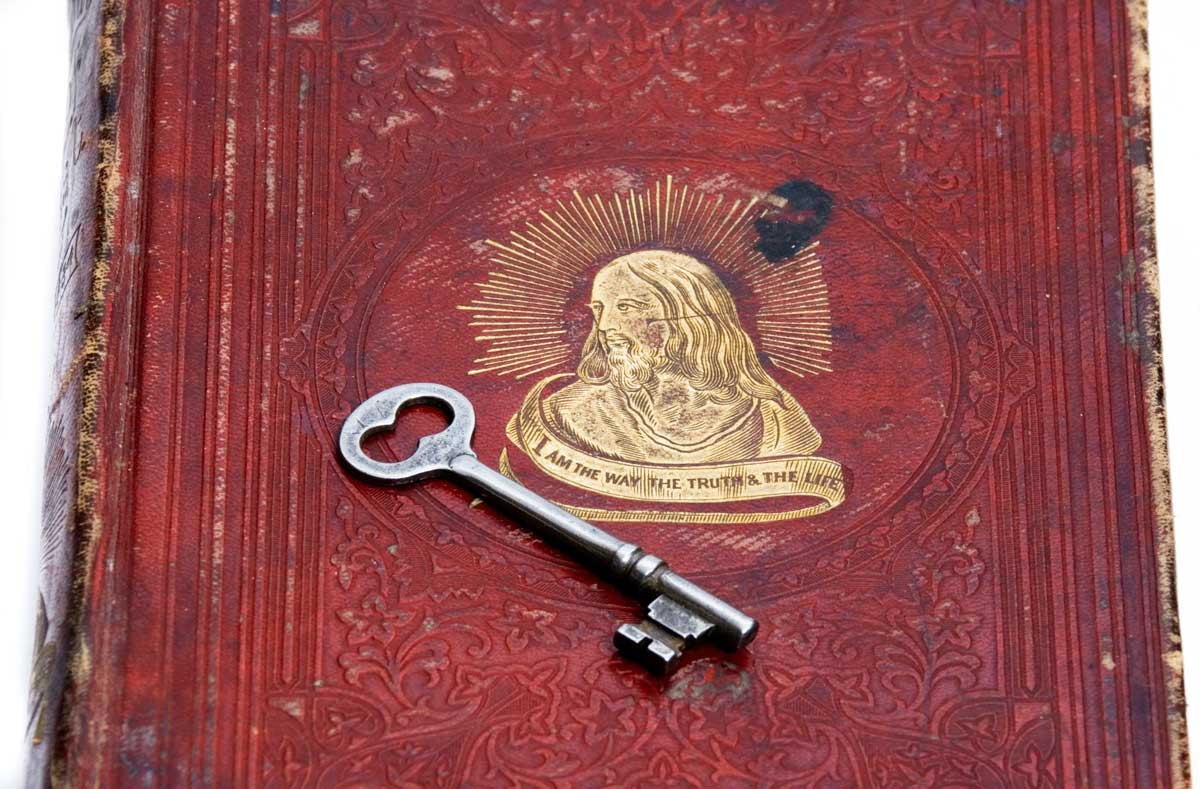
God’s Word & Me
To assert—as Christians do—that man is on this earth to be a hearer of God’s Word is to invite reflections on a great paradox. For, if the assertion is true, its truth identifies man at a level deeper than his existence. It goes to the base of his being. The full import of this assertion means:
First, if God makes me to be a hearer of the Word, his first Word to me is that which summons me from nothingness. The first truth about me is not my existence but the free divine evocation that brings about my existence: “I am, because I hear.”
To put the thing another way: my capacity to hear God’s Word is the most rudimentary and foundational fact of my existence, because it is the point at which I am pried away from nothingness. Hearing God’s initial Word is my deepest “experience,” a memory too deep in my essence to be retrieved.
Second, God’s initial Word to me is also redemptive; it liberates me from the bondage of non-being. Nothingness, after all, is not neutral; it is inimical to being.
The very fact that God’s creative act is called “work” (Gen. 2:2–3; John 5:17) suggests that it encounters some measure of resistance. Even as he summons the light, God must divide it from darkness (Gen. 1:3–4). If the darkness does not overcome the light (John 1:5), it is not from want of trying.
This is the reason Holy Scripture sometimes portrays Creation as a victory over primeval chaos: “You broke the heads of the sea / the serpents in the waters. / You broke the heads of Leviathan in pieces, / And gave him as food to the people dwelling in the wilderness” (Ps. 74[73]:13–14).
Third, however we are to interpret the resistance God’s Word meets in the act of Creation, there is nothing unclear about the opposition it encounters when addressed to man in his fallen condition. In this regard, the Word of God necessarily includes a negative element, because of “the inscrutable abyss between the judgments of our God on the one hand, and, on the other, the impossibility for man, in his present state, to fathom the divine will” (Archimandrite Zacharias).
Thus, even as Jesus offers the Living Water to the woman at the well, his offer contains an allusion to her sin (“Go, call your husband”) and a reference to the need for repentance (“You have had five husbands, and the one whom you now have is not your husband”—John 4:16–18). God’s Word is unable simply to “affirm” the sinner.
Fourth, God’s original Word to me—when he separated me from nothingness—sets the redemptive pattern for everything he says to me subsequently. As he continues to speak to me at sundry times and in various ways, it is always with the same intent: to pull me forth from bondage to darkness, to set me free from selfishness and untamed passions, to challenge my inveterate and deliberate ignorance, to commune with me in the truth, to fashion me as his child in Christ, and to confer eternal life on an undeserving sinner.
Fifth, Jesus explicitly identified the enemies of God’s Word, in order to set me on guard against them: “Satan, [who] comes immediately and takes away the Word,” as well as “the cares of this world, the deceitfulness of riches, and the desires for other things [which], entering in, choke the Word” (Mark 4:15,19). The destruction brought by the first is described as immediate, while the suffocation induced by the second appears to be gradual, but the result is ultimately the same: the loss of my true being as a hearer of the Word.
In addition to these external enemies of the Word, Jesus also warns against an internal obstacle, referring to “the ones sown on stony ground who, when they hear the word, immediately receive it with gladness, but they have no root in themselves” (Mark 4:16–17). That is to say, the Word—in the case of deracinated people—remains a thing external; the rocklike quality of their inner soil prevents the Word’s deeper penetration into their being.
Patrick Henry Reardon is pastor emeritus of All Saints Antiochian Orthodox Church in Chicago, Illinois, and the author of numerous books, including, most recently, Out of Step with God: Orthodox Christian Reflections on the Book of Numbers (Ancient Faith Publishing, 2019).
A Journal of Mere Christianity—Delivered to Your Door
- Essays on theology, culture, and the Church
- Contributors from across the Christian traditions

Six print issues (one year) of Touchstone, plus full online access and PDF downloads for only $39.95.

Get a one-year full-access subscription to the Touchstone online archives for only $19.95.
bulk subscriptions
Order Touchstone subscriptions in bulk and save $10 per sub! Each subscription includes 6 issues of Touchstone plus full online access to touchstonemag.com—including archives, videos, and pdf downloads of recent issues for only $29.95 each! Great for churches or study groups.
Transactions will be processed on a secure server.
more from the online archives
19.10—December 2006
Workers of Another World United
A Personal Commemoration of Poland’s Solidarity 25 Years Later by John Harmon McElroy
calling all readers
Please Donate
"There are magazines worth reading but few worth saving . . . Touchstone is just such a magazine."
—Alice von Hildebrand
"Here we do not concede one square millimeter of territory to falsehood, folly, contemporary sentimentality, or fashion. We speak the truth, and let God be our judge. . . . Touchstone is the one committedly Christian conservative journal."
—Anthony Esolen, Touchstone senior editor