




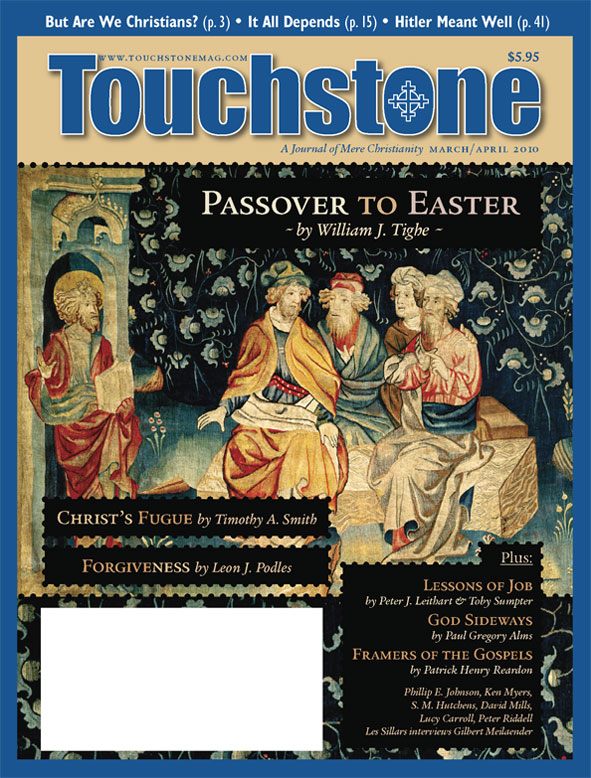
Framers of the Gospel
Among the literary characteristics of the Gospels, one of the most significant is their episodic structure. Although each Gospel is an integral literary composition, anyone can see that they were intended to be read story-by-story. These small narratives go by the Greek name pericope, which means “a rounded section.” Obviously, the established lectionaries present the Gospels this way.
Christians assimilate the mystery of Redemption in bite-size stories. The life, ministry, and teaching of Jesus are mediated to the Church in these enclosed frames of narrative. Each account represents a window, as it were, through which believers contemplate the apologos katholikos, the story as a whole.
Let me suggest that the episodic quality of the Gospels prompts a comparison with framed art and the stage. Indeed, I submit that all these forms take their rise from the same impulse: the need for a concentrated regard in order to contemplate the whole. Chesterton perceived this need when he remarked on “the boundary line that brings one thing sharply against another.” He went on to explain, “All my life I have loved frames and limits; and I will maintain that the largest wilderness looks larger seen through a window.”
A framed gaze at reality—whether in the theater, or pictorial art, or episodic narrative—enjoys a two-fold advantage:
First, recognizing that limitation is necessary to form, it draws contemplation to a focus. Whether in a scene of Macbeth or a seascape of Turner, one receives the whole truth in a size not too hard to ingest.
Second, the lines of a frame indicate an appropriate humility in the presentation. A framework announces, even before the story begins, that the composition strives to be no more than an “outline.” I prefer here the German expression, Grundriss, which better insinuates both the foundational aspect of the enterprise and the humility of the ground.
The gospel itself declares the benefit of this humility: “Whoever humbles himself will be exalted.” In a framed presentation, the myriad elements left unspoken form an internal and luminous exaltation, an intimation of energy. The cataphatic components of a scene implicitly convey a greater glory.
That is to say, the limitations imposed by the frame are not negative, but positive. For instance, neither in life nor on canvas does a viewer gaze straight at the sun. Indeed, a direct attention to the sun precludes the sight of anything else. The sun’s exaltation is discerned, rather, in the contrast of lights and shadows. The wind, too, humbles itself on the canvas; its exaltation is conveyed in the bent branches and the turbulence of the waves.
In the theater, the energy and exaltation of a given scene come largely from off-stage, being derived from the plot and context of the whole story. Indeed, few theatrical scenes are intelligible except within an “act” and the entire production. Plot and assumed context provide the sun and wind, as it were, of the narrative in the immediate scene.
Windows are usually quadrangular, in contrast to the proscenium’s arch and the circularity suggested by the noun “pericope.” Quadrangles are far more reliable than circles; these have a tendency to roll away. The quadrangle, by keeping everything steady, favors an analytic consideration of the subject. The viewer is disposed to pose questions. Angles encourage rationality.
Indeed, the quadrangle is a bold effort to hold a circle in place. It deliberately sunders the fluidity of the curve, for the purpose of critical appraisal. Parsing the 360 degrees around the circle’s center, it sends them off into four corners to turn around and face one another. The viewer is obliged to come at the subject from dialectically contrasted points, where progressing lines actually “bend back.” Angles—literally—reflect.
Patrick Henry Reardon is pastor emeritus of All Saints Antiochian Orthodox Church in Chicago, Illinois, and the author of numerous books, including, most recently, Out of Step with God: Orthodox Christian Reflections on the Book of Numbers (Ancient Faith Publishing, 2019).
A Journal of Mere Christianity—Delivered to Your Door
- Essays on theology, culture, and the Church
- Contributors from across the Christian traditions

Six print issues (one year) of Touchstone, plus full online access and PDF downloads for only $39.95.

Get a one-year full-access subscription to the Touchstone online archives for only $19.95.
bulk subscriptions
Order Touchstone subscriptions in bulk and save $10 per sub! Each subscription includes 6 issues of Touchstone plus full online access to touchstonemag.com—including archives, videos, and pdf downloads of recent issues for only $29.95 each! Great for churches or study groups.
Transactions will be processed on a secure server.
more from the online archives
28.2—March/April 2015
Neo-Pagan Family Policies Doom Any Recovery by Allan C. Carlson

35.4—Jul/Aug 2022
The Death Rattle of a Tradition
Contemporary Catholic Thinking on the Question of War by Andrew Latham

37.5—Sept/Oct 2024
Why Law Schools Can't Teach Law
A sidebar to How Law Lost Its Way by Adam MacLeod
calling all readers
Please Donate
"There are magazines worth reading but few worth saving . . . Touchstone is just such a magazine."
—Alice von Hildebrand
"Here we do not concede one square millimeter of territory to falsehood, folly, contemporary sentimentality, or fashion. We speak the truth, and let God be our judge. . . . Touchstone is the one committedly Christian conservative journal."
—Anthony Esolen, Touchstone senior editor
