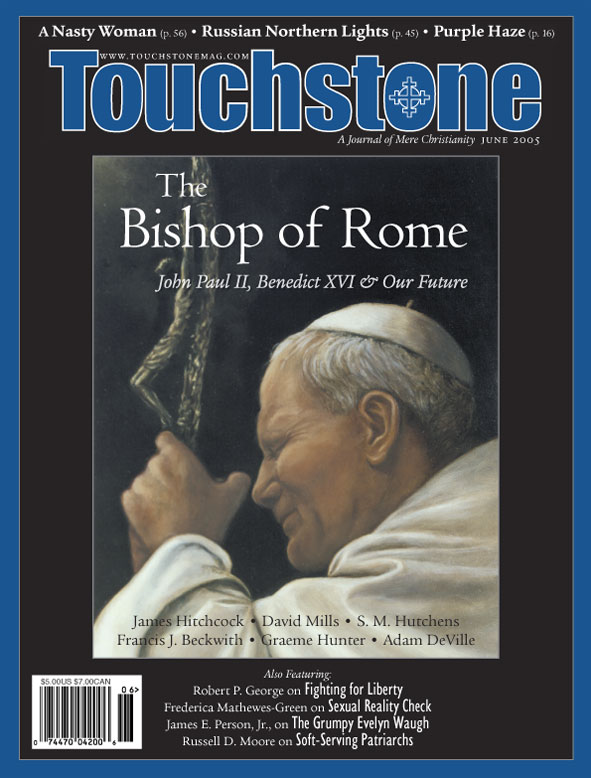
The Pope Is Christian!
S. M. Hutchens on Disappointing Catholic Revisionists
I have now lived through five papal elections, those of John XXIII (which I remember as a young boy) through Benedict XVI. In each of them we heard from a “progressive” element in the Catholic Church that was very interested in a pope who would bring it up to date. From early days I found this confusing.
Just what was it about the Catholic Church that could be “brought up to date,” at least that would have enough significance to justify the fuss certain Catholics were making about its old-fashionedness? (My Catholic playmates would have suggested the retirement of Sister Ursula and her yardstick as a useful update, but nobody asked them.)
Might the papal tiara be replaced by a ceremonial homburg, those red slippers with Earth Shoes? The Ave Maria performed in rock-and-roll mode? How could guitar Masses or even the sprouting of all those ugly church buildings change what was essentially Catholic? I had been brought up to understand that the differences between us and the Catholics were doctrinal. What, really, could a pope do to update the doctrine of his church? Could he make Leviathan believe anything different than it did? Any change by way of making the Catholic Church more “relevant,” as the liberalizing Protestants were so intent to effect among us, must be a change in its very constitution.
Change doctrine, and it wouldn’t be the Catholic Church anymore, at least as we conservative Protestants understood it. Anything less would be merely a stylistic adjustment, and surely not worth all the agitation we were hearing from Catholic progressives. Just what did they want of each new pope, anyway? An ex cathedra pronouncement that “mistakes have been made”? Would the pope who made it be Catholic?
The progressives clearly didn’t find Vatican II (much less Pope Paul VI) as helpful as they had hoped, but seized upon its “spirit” (fairly well disembodied from its letter, I later discovered) to question traditional church teachings—not to deny them outright, but to establish themselves in a persistent interrogatory state that escaped obedience while not directly renouncing it.
I experienced this first-hand while taking classes at the Catholic Theological Union in Chicago. There was constant questioning of the “opinions” of the pope, then John Paul II, and outright contempt for his odious henchman Cardinal Ratzinger. When the title “Holy Father” was used, one could expect the slight smile and ironic inflection that made it mean “that old fool in Rome.” The Catholics seemed to expect this, but comparing notes with the other Protestants, I found that they were, with me, deeply disturbed. Why on earth, we kept asking ourselves, were these people Catholics?
That, indeed, was the question. At every papal election the ante seemed to up, and the progressives sounded more like radicals who wanted to make the Catholic Church not only different than it had been, but very much like what we knew as liberal Protestantism, and therefore not only not-Catholic, but not-Christian. These progressive Catholics were singing a tune we had heard before.
They were not asking for changes in manner, but were after much more. The litany by now has become familiar: birth control, married priests, and priestesses at least, and from some, more openness to homosexuality and euthanasia. They wished for the Catholic Church to adopt these things and remain not only Catholic, but “the Church.”
A Miscalculation
There is, in my view, a major miscalculation in all of this. These people seem to think that in their media-supported campaign to change the Catholic Church they are dealing only with the Catholic Church—that their quarrels with Catholic traditionalism are essentially an internal matter to be settled among Catholic factions, success being marked by the election of progressive popes who will work with the enlightened to make the church over in their own image. Once this is done, it will be much more open, more reasonable, and more acceptable to the people who count, to the kind of people who believe that the church must change with the times to relate to people who are formed by the times.
S. M. Hutchens is a senior editor and longtime writer for Touchstone.
A Journal of Mere Christianity—Delivered to Your Door
- Essays on theology, culture, and the Church
- Contributors from across the Christian traditions

Six print issues (one year) of Touchstone, plus full online access and PDF downloads for only $39.95.

Get a one-year full-access subscription to the Touchstone online archives for only $19.95.
bulk subscriptions
Order Touchstone subscriptions in bulk and save $10 per sub! Each subscription includes 6 issues of Touchstone plus full online access to touchstonemag.com—including archives, videos, and pdf downloads of recent issues for only $29.95 each! Great for churches or study groups.
Transactions will be processed on a secure server.
more on Catholic from the online archives
35.4—Jul/Aug 2022
The Death Rattle of a Tradition
Contemporary Catholic Thinking on the Question of War by Andrew Latham
more from the online archives
calling all readers
Please Donate
"There are magazines worth reading but few worth saving . . . Touchstone is just such a magazine."
—Alice von Hildebrand
"Here we do not concede one square millimeter of territory to falsehood, folly, contemporary sentimentality, or fashion. We speak the truth, and let God be our judge. . . . Touchstone is the one committedly Christian conservative journal."
—Anthony Esolen, Touchstone senior editor