




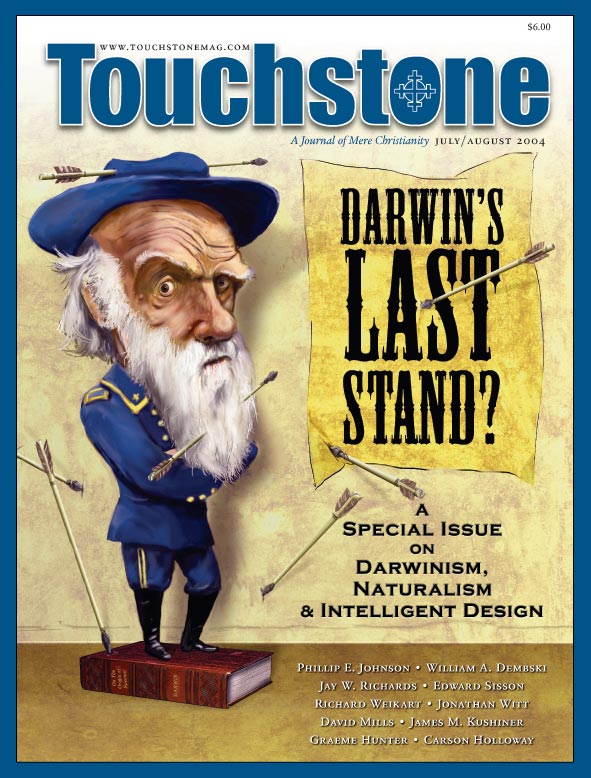
Science & Wisdom
A Sidebar in Edward Sisson’s “Darwin or Lose”
In a spring issue of The New York Review of Books, the physicist Freeman Dyson reviewed Debunked!, a book exposing paranormal quackery by the Nobel laureate George Charpak and Henri Broch. At the end of the review, he described the “two extreme points of view concerning the role of science in human understanding.”
The reductionist view holds “that all kinds of knowledge, from physics and chemistry to psychology and philosophy and sociology and history and ethics and religion, can be reduced to science. Whatever cannot be reduced to science is not knowledge.” The traditional view holds “that knowledge comes from many independent sources, and science is only one of them. Knowledge of good and evil, knowledge of grace and beauty, knowledge of ethical and artistic values, knowledge of human nature derived from meditation or from religion, all are sources of knowledge that stand side by side with science, parts of a human heritage that is older than science and perhaps more enduring.”
Most people, he continued “hold views intermediate between the two extremes. Charpak and Broch are close to the reductionist extreme, while I am close to the traditional extreme.”
One hates to argue with someone like Dyson, but I do not think I would use the language of extremes for the distinction he is drawing. This matter can be put as a simple question: “Is science the only source of knowledge?” to which question one can only answer yes or no. “No” is not an extreme answer if the only alternative is “yes.” There are no truly “intermediate views,” and if most people hold them, most people are not thinking clearly.
That said, we can say that “yes” is an extreme answer when “no” is not. To answer “no,” to say that we have other sources of knowledge beside science, is to answer as the great mass of humanity has always answered and answers even today. It is the natural position, the (to most people) self-evident position, the centrist position. The reductionist position, the position that strips away every other source of knowledge but science and denies what the great mass of humanity has always thought it knew, consciously rejects this center and is therefore eccentric and thus by definition extreme.
We can use Dyson’s idea of a spectrum or continuum if we add another popular alternative: the other extreme view, seriously propounded by some, that whatever anyone claims to be knowledge is knowledge, and knowledge of equal value with any other. So claim many postmodernists, who have, for example, insisted that Indian shamans have as much knowledge of medicine as doctors. This we may call the pluralist extreme.
Difficult Centrism
Of the three views, the centrist position—which is the Christian’s position—is the subtlest and most difficult to take. It is intellectually the riskiest. While one extreme says that we have only one source of knowledge and the other extreme says that we have as many as we like, the centrist (what we might call the judicious pluralist) says that we have several, but that they need to be discerned and evaluated. The difficulty of doing this well is one reason the extremes appeal. They provide simple answers and do not carry the historical baggage (e.g., Galileo, sort of) that seems to discredit the traditional answer.
Actually, they do, but the baggage they carry is not the sort most people will ever notice: the reductionist professor who has destroyed his students’ faith in God, and with it their confidence in their moral code and their membership in the community that helped them live up to it, is never blamed for the spiritual and emotional damage that follows. No one sees the soul in Hell, encouraged in its journey there by an old prof’s reductionist attack on religion. And though people may see the divorce or depression, they will never trace it back to the old prof’s cheerful undermining of his student’s faith.
At any rate, even the reductionists themselves do not live by the philosophy they promote. Dyson quotes the authors of Debunked! as declaring: “Isn’t scientific thought the indispensable companion to wisdom, to clear thinking, and to the love of those virtues, which is expressed not only in vain incantations to the sky but also in logical actions?”
David Mills has been editor of Touchstone and executive editor of First Things. He edits the opinion page of the Pittsburgh Post-Gazette.
A Journal of Mere Christianity—Delivered to Your Door
- Essays on theology, culture, and the Church
- Contributors from across the Christian traditions

Six print issues (one year) of Touchstone, plus full online access and PDF downloads for only $39.95.

Get a one-year full-access subscription to the Touchstone online archives for only $19.95.
bulk subscriptions
Order Touchstone subscriptions in bulk and save $10 per sub! Each subscription includes 6 issues of Touchstone plus full online access to touchstonemag.com—including archives, videos, and pdf downloads of recent issues for only $29.95 each! Great for churches or study groups.
Transactions will be processed on a secure server.
more on evolution from the online archives

32.2—March/April 2019
Flight from the Absolute: Cynical Observations on the Postmodern West, Volume II by Paul Gosselin by Louis Markos
23.6—November/December 2010
Darwin, Design & Thomas Aquinas
The Mythical Conflict Between Thomism & Intelligent Design by Logan Paul Gage

22.6—July/August 2009
on a Noble Defense Doomed by Darwinian Materialism by John G. West
more from the online archives
17.4—May 2004
The Unhappy & Abusive Marriage of Liberalism & Modernism by James Hitchcock
20.6—July/August 2007
The Beowulf Poet Was a Shrewd Christian Apologist by Douglas Wilson

19.6—July/August 2006
The Three-Fold Cord of Imagination, Reason & Will in C. S. Lewis by Michael Ward
calling all readers
Please Donate
"There are magazines worth reading but few worth saving . . . Touchstone is just such a magazine."
—Alice von Hildebrand
"Here we do not concede one square millimeter of territory to falsehood, folly, contemporary sentimentality, or fashion. We speak the truth, and let God be our judge. . . . Touchstone is the one committedly Christian conservative journal."
—Anthony Esolen, Touchstone senior editor
