




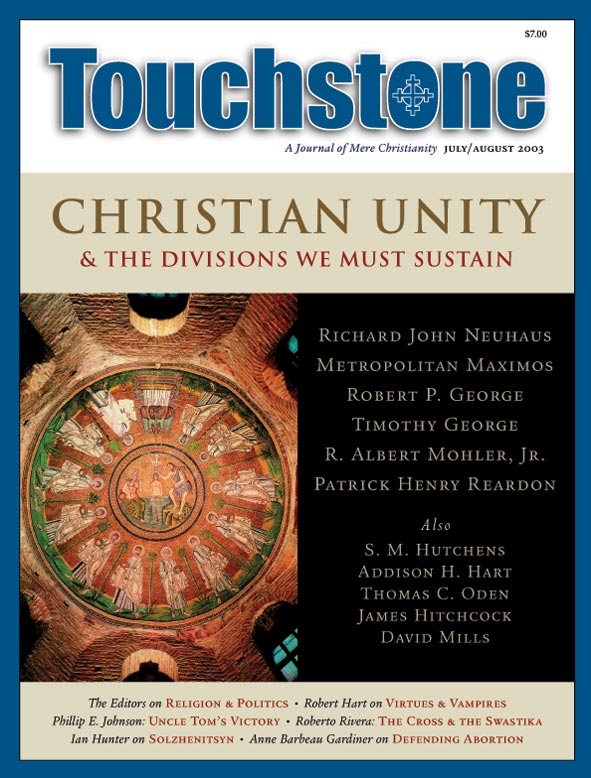
The Unity of Faith
Evangelicalism & “Mere Christianity”
by Timothy George
We are gathered at a conference entitled, “Christian Unity and the Divisions We Must Sustain,” and subtitled, “A Gathering of Traditional Christians.” It is sponsored by Touchstone, a periodical that describes itself as “a journal of mere Christianity.” Touchstone further describes itself as “a Christian journal, conservative in doctrine and eclectic in content, with editors and readers from each of the three great divisions of Christendom—Protestant, Catholic, and Orthodox.” The mission of the journal is “to provide a place where Christians of various backgrounds can speak with one another on the basis of shared belief in the fundamental doctrines of the faith as revealed in Holy Scripture and summarized in the ancient creeds of the church.”
For some time now, many of us have recognized that we are living through a great realignment within the worldwide Christian movement. As Robert Wuthnow and others have shown, basic theological differences within denominations are frequently more pronounced than the traditional differences between denominations. This is not altogether a new insight. J. Gresham Machen was engaged in a gigantic struggle between what he called Christianity and liberalism. Machen was a conservative Protestant of a distinctively Presbyterian stripe, and he knew very well the depth of the historic divide between Roman Catholicism and his own Protestant confessional tradition. And yet, in the context of resurgent unbelief and the evacuation of historic Christian truth claims, he was able to say that the gulf between Rome and Geneva (and in his case Edinburgh and Princeton) was negligible compared to the gaping chasm—he used the word abyss—separating mere Christians from those who eviscerated the historic Christian faith.
What Machen said was true in the 1920s and is even more evident today. Not long ago, I was sitting with Dr. Geoffrey Wainwright at a theological conference. After listening to a particularly bad presentation, he whispered to me, “Timothy, there are only two kinds of theologians in the world anymore: those of us who believe in something, and the others, who don’t.” So here we are, a conclave of mere Christians, successors of J. Gresham Machen and G. K. Chesterton, of Georges Florovsky and Jean Daniélou, of Karl Barth and Christopher Dawson, of John Meyendorff and Carl F. H. Henry. It’s a pretty strange group. Eclectic, to borrow that word from the Touchstone masthead, would seem to fit us well.
Perhaps some of you are asking, why should an Evangelical be interested in a conference like this, at least a card-carrying Evangelical of the Wheaton College, Christianity Today, Billy Graham type? I can assure you that some of my fellow Evangelical and fundamentalist fellow travelers are asking that same question! And it is a good question to ask. I want to try to get at this question in three ways. First, to offer a brief definition of Evangelicalism; second, to examine the concept of “mere Christianity”; and third, to ask what mere Christians who happen to be Evangelicals bring to our common quest for Christian unity.
What Is Evangelicalism?
Wolfhart Pannenberg has said that Evangelicals, along with Roman Catholics and Orthodox believers, constitute one of the three ascendant, most resilient forces within world Christianity as it enters the third millennium. But who are these Evangelicals? Taxonomies and definitions abound, including this one drawn largely from a recent article by Alister McGrath: Evangelicals are a worldwide fellowship of Bible-believing Christians whose faith and life emphasize four things: (1) the authority and sufficiency of Holy Scripture, the only normative rule of faith and practice for all true believers; (2) the uniqueness of redemption through the death of Christ upon the cross, the benefits of which are imputed to believers who are justified by faith alone; (3) the necessity of personal conversion, wrought by the Holy Spirit through personal repentance and faith and issuing in a life of obedience and growth in Christ; and (4) the priority and urgency of evangelism and missions in fulfillment of the Great Commission of Christ himself.1
It is possible, of course, to define Evangelicalism in other ways as well: sociologically, demographically, or even anecdotally, as in Dr. Bob Jones, Sr.’s famous quip that an Evangelical is a person who says to a liberal, “I’ll call you a Christian if you’ll call me a scholar!” Jerry Falwell has said that a fundamentalist is just an Evangelical who is mad at somebody. It is relatively easy to say who a Roman Catholic is: A Roman Catholic is a person who belongs to a church whose bishop is in communion with the bishop of Rome. Likewise, Orthodox believers can be fairly easily recognized by certain creedal commitments and liturgical practices, as well as by national and ethnic loyalties.
But Evangelicalism is a movement of bewildering diversity, made up of congregations, denominations, and para-church movements whose shared identity is not tied to a particular view of church polity or ministerial orders. Evangelicalism has been fed by many diverse rivulets and tributaries, including Puritanism, Pietism, and, most vigorously in the last hundred years, Pentecostalism. For our present purposes, however, I would like to propose a new definition: Evangelicalism is a renewal movement within historic Christian orthodoxy, a movement that has been shaped synchronically by four historical complexes or “moments,” which continue to shape Evangelical theology and identity today.
The Trinitarian & Christological Consensus of the Early Church
Timothy George is dean of Beeson Divinity School of Samford University (www.samford.edu) and an executive editor of Christianity Today (www.christianitytoday.com). A different version of this essay is appearing in Karl Barth and Evangelical Theology, edited by Sung Wook Chung, forthcoming from Baker Academic.
A Journal of Mere Christianity—Delivered to Your Door
- Essays on theology, culture, and the Church
- Contributors from across the Christian traditions

Six print issues (one year) of Touchstone, plus full online access and PDF downloads for only $39.95.

Get a one-year full-access subscription to the Touchstone online archives for only $19.95.
bulk subscriptions
Order Touchstone subscriptions in bulk and save $10 per sub! Each subscription includes 6 issues of Touchstone plus full online access to touchstonemag.com—including archives, videos, and pdf downloads of recent issues for only $29.95 each! Great for churches or study groups.
Transactions will be processed on a secure server.
more on ecumenism from the online archives

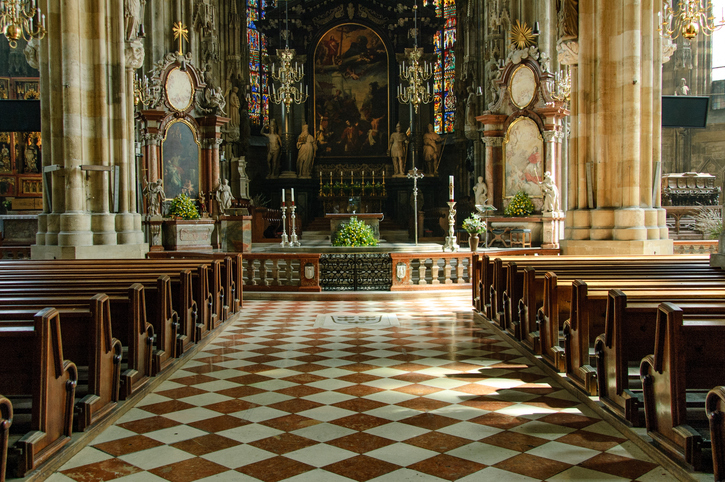

31.4—July/August 2018
Labels & the Ecumenism of Discipleship by James M. Kushiner
more from the online archives
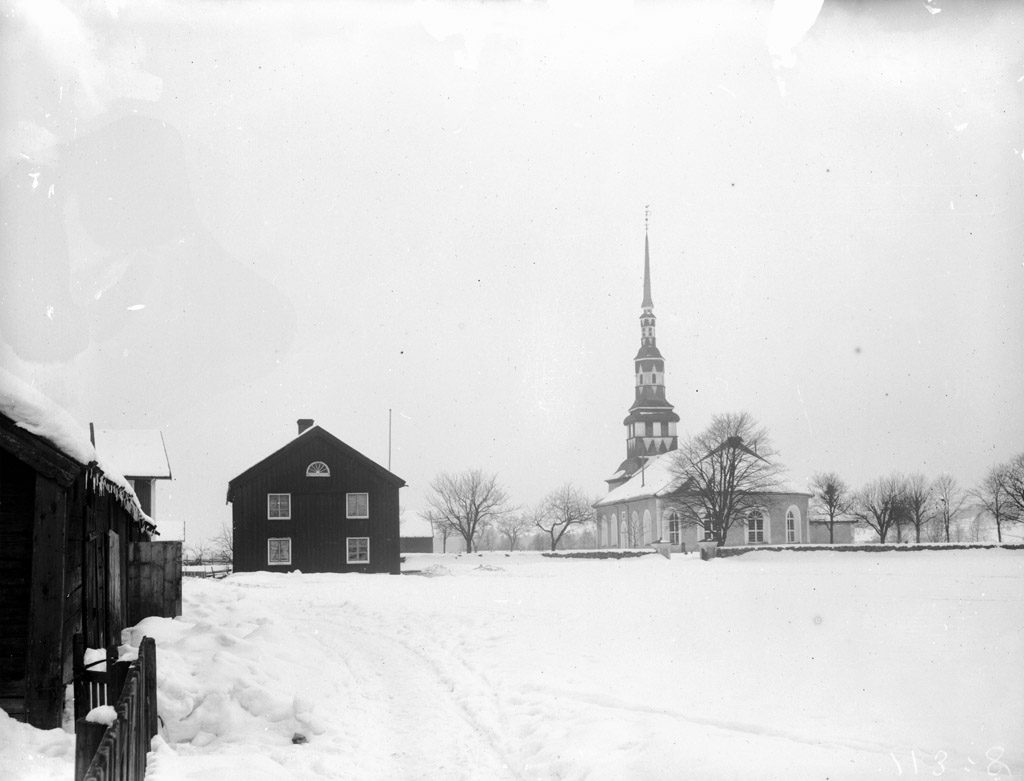
28.2—March/April 2015
Neo-Pagan Family Policies Doom Any Recovery by Allan C. Carlson
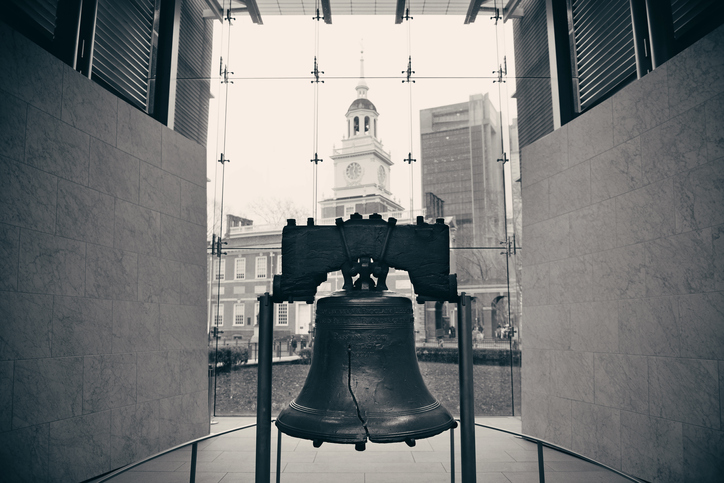
25.3—May/Jun 2012
Calls for Freedom, Democracy & Secularism End Up with None of the Above by Hunter Baker

22.6—July/August 2009
on a Noble Defense Doomed by Darwinian Materialism by John G. West
calling all readers
Please Donate
"There are magazines worth reading but few worth saving . . . Touchstone is just such a magazine."
—Alice von Hildebrand
"Here we do not concede one square millimeter of territory to falsehood, folly, contemporary sentimentality, or fashion. We speak the truth, and let God be our judge. . . . Touchstone is the one committedly Christian conservative journal."
—Anthony Esolen, Touchstone senior editor
