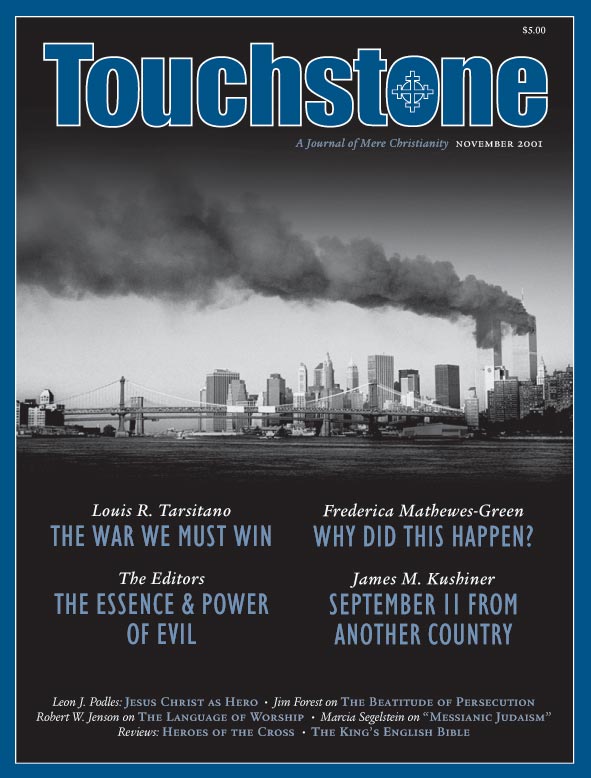
Editorial
The Essence & Power of Evil
The horrendous events of September 11 confront us with a reality even more disturbing than our apparent vulnerability to terrorist attacks. They require us to reexamine our entire understanding of the nature of reality.
In the face of unimaginable catastrophe there has been much talk about tragedy, human suffering, heroism, cowardice, patriotism, and resisting hatred, all of which are true as far as they go.
But events now confront us with realities so enormous that little can be said, and our culture’s ultimate failure is that it actively works against the ability to understand such things. As most Westerners view reality, there is no reason why such things should happen. Thus, it seems that those who perpetrate such acts have simply made certain mistakes of understanding, reinforced by excessive emotion. Terrorism, we are told, solves nothing. The terrorists’ grievances are understandable, but they have chosen the wrong methods.
For some people, the whole episode revolves around technical problems—better security systems, the necessity henceforth to be more vigilant, in ways other peoples simply take for granted. For others, the solution is retaliation against the terrorists, followed by diplomatic efforts to “get to the root of the problem.” What these have in common is the assumption that what we face is containable and comprehensible within the categories of understanding that our culture permits.
People turn to religion at such moments, but even the most devout realize the limits of the comfort that the faith provides for bereaved people. Christianity offers no “answer” to the questions, no coherent resolution of all perplexities. Rather, it speaks of the “mystery of iniquity.” The common religious responses are not wrong—comfort for the bereaved, the promise of resurrection, a righteous desire for justice, love of enemies. But none of these explain “why.” Rather, our faith opens us to the eternal and cosmic perspective.
This is not only our belief that the dead still live in Christ, which provides comfort and meaning in a way no purely worldly creed can equal. It means rather that our faith makes us understand that events of this kind are not merely bizarre anomalies. We are engaged, as we always have been, in a war against principalities and powers, something we can forget only because of the numerous comforts our culture provides.
Despite our Puritan heritage, most Americans simply do not believe in evil. They prefer to believe in “mistakes,” “failure to grow,” “misguided zeal,” “social causes,” “lack of empathy for others,” and similar rationalizations. We apply those ideas routinely to our own lives; thus, we see the cosmic picture in the same way.
The two common explanations of terrorism are a sense of injustice and religious fanaticism, and both are real enough.
Predictably, fanaticism will be used to argue that religious belief is a dangerous thing, the source of many of the world’s evils, and there is a point to that claim, albeit not the one that its proponents make. Precisely because religion does put us in touch with the deepest wellsprings of existence, it has the greatest potential for both good and evil. A religionless world, whatever else it might be, would be a spiritually impoverished world. Religion is indeed a volatile substance, precisely because it is the realm where good and evil directly meet.
The “problem of evil” is insoluble even for Christians, because finally we do not know why the all-good God permits evil, although our greatest glory—our freedom—is also the instrument by which we thwart the divine will.
James Hitchcock is Professor emeritus of History at St. Louis University in St. Louis. He and his late wife Helen have four daughters. His most recent book is the two-volume work, The Supreme Court and Religion in American Life (Princeton University Press, 2004). He is a senior editor of Touchstone.
A Journal of Mere Christianity—Delivered to Your Door
- Essays on theology, culture, and the Church
- Contributors from across the Christian traditions

Six print issues (one year) of Touchstone, plus full online access and PDF downloads for only $39.95.

Get a one-year full-access subscription to the Touchstone online archives for only $19.95.
bulk subscriptions
Order Touchstone subscriptions in bulk and save $10 per sub! Each subscription includes 6 issues of Touchstone plus full online access to touchstonemag.com—including archives, videos, and pdf downloads of recent issues for only $29.95 each! Great for churches or study groups.
Transactions will be processed on a secure server.
more from the online archives

calling all readers
Please Donate
"There are magazines worth reading but few worth saving . . . Touchstone is just such a magazine."
—Alice von Hildebrand
"Here we do not concede one square millimeter of territory to falsehood, folly, contemporary sentimentality, or fashion. We speak the truth, and let God be our judge. . . . Touchstone is the one committedly Christian conservative journal."
—Anthony Esolen, Touchstone senior editor