




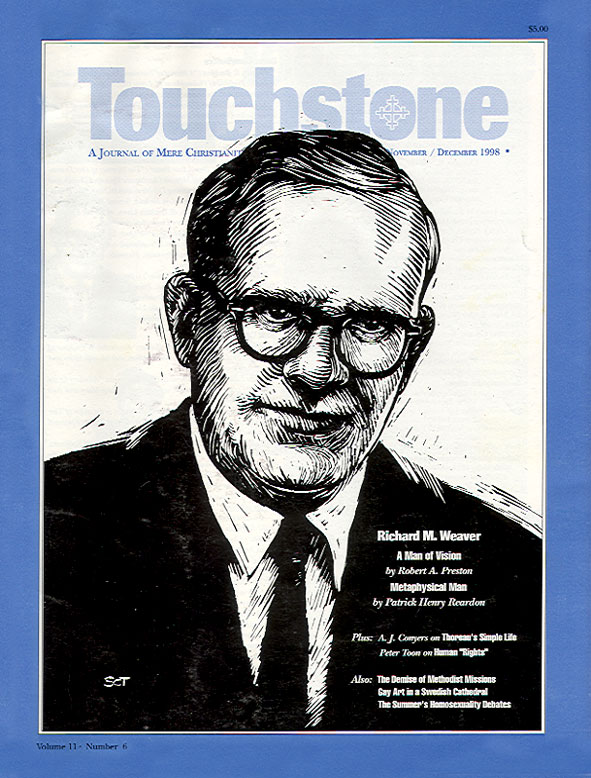
Much Adieu About Nothing
Donald DeMarco on Television (Part I)
May 14, 1998 at 8:00 pm EST. That is the time my San Francisco caller had selected to do a book interview with me. “Don’t you realize,” I said to him, “that this is the exact time that an estimated 80 million Americans will be glued to their seats watching the long-awaited and much ballyhooed final episode of Seinfeld?” He exclaimed, without making any attempt to conceal his pride, that he had never watched even a single episode of America’s favorite TV sit-com, a revelation that moved me to envy his mind that had remained virginal and unprofaned by a show whose empty-headedness was exceeded only by its bad taste.
“I’d be happy to do the interview at another time,” I told him. I said this not because I felt any commitment to be on hand for the final episode, but because at that hour, ironically, I would be at a small college in New England presenting a lecture on virtue. Given the immense popularity of Seinfeld, in which vice is routinely given preferred status, the simple act of extolling virtue is enough to make one a cultural subversive. We agreed to play this role for his radio network at a later date.
Alan Dershowitz, the celebrated Harvard lawyer who recently admitted that he acts “as if there probably is no God,” has a different take on Seinfeld. It is his favorite show. A liberal among liberals, Dershowitz recalled a recent conversation he had with Al Gore in Israel: “The vice president asked me when I would be back in the United States and I told him and he said, ‘That’s great, you’ll be back in time for the last episode [of Seinfeld].’” Celebrities sustain their celebrity status by associating with other celebrities. Celebrity can decay very rapidly into anonymity if one gets unplugged from the media circuit that keeps his name alive and electrified.
How important was the last episode to American televiewers? A 30-second commercial spot cost $1.5 million. A 35-foot-high screen was erected in Times Square to carry the event, while negotiations were taking place to televise the show on a giant screen to 500,000 viewers in Central Park. The Smithsonian Institution made inquiries about obtaining the entire set of Seinfeld. It was the climax of a show that people said “defines our generation,” and is the “quintessential identification of the ’90s.” It was an eschatology built on nine years of hype (hope’s replacement in a world of synthetic images). It was, as some said, “a national holiday.”
Yet, in a more realistic sense, the final episode was nothing more than a pseudo-event, though it eclipsed, by far, another pseudo-event that occurred on that very same evening, namely, the sale at Sotheby’s in New York City of Andy Warhol’s Orange Marilyn for $17.3 million.
The pseudo-event, as historian Daniel Boorstin originally described it in 1961, is a synthetic novelty that creates the illusion among the masses of being more real than reality. The pseudo-event generates the celebrity. A hero is distinguished by his achievements, a celebrity by the media. A hero is a big man; a celebrity is a big name. Seinfeld, who laments that playing his role caused him to miss the nineties, is regarded by the media as its most accurate representative. Reality and fantasy are not exactly on speaking terms.
Our culture is given over to the pseudo-event, its own reflected image of the pseudo-life. The Seinfeld characters, indeed, are the personifications of the pseudo-person.
The pseudo-life begins when people decide that life should be lived not with virtue, but with vice. According to the moral metaphysics of the mass media, vice is fascinating, arousing, delightful, and memorable. Virtue, on the other hand, is seen as boring, sleep-inducing, insipid, and forgettable. This is why the spectacle of the sinking of the Titanic is infinitely more popular than the sailing of the Good Ship Lollipop (not to mention the bark of Peter, which has managed to remain afloat for 2,000 years).
When Seinfeld first became a cultural icon, deconstructionists were joyfully proclaiming that it was made in their own image. It was about nothing. There certainly were no heroes, no one who would want to venture into something as turbulent and unpredictable as marriage. But more than this, no one could lay reasonable claim to possessing character. The seven major characters over the 169 episodes lived according to the shibboleth that “vice is nice, but virtue can hurt you.” It was security they sought, not life. No one character, however, is burdened by too many vices. The writers are most democratic in their distribution of the Seven Deadly Sins—one to each. Thus, Kramer is Pride, while George is Envy, and his father and mother, Wrath and Avarice, respectively. Elaine is Lust and Newman is Gluttony. Jerry, whose ruling vice is the least recognizable, is Sloth. Together, they are exquisitely poised to get on each other’s nerves. They represent the comic side of Jean-Paul Sartre’s No Exit, in which hell is other people. Their vices prevent them from forming a community. Instead, they form a catatonic collective.
“I used to be indecisive, but now I’m not so sure,” someone once said, charting an imaginary progress that is the moral equivalent to the T. S. Eliot character who “measures out his life with coffee spoons” (at Monk’s Restaurant, for the Seinfeld gang).
A Journal of Mere Christianity—Delivered to Your Door
- Essays on theology, culture, and the Church
- Contributors from across the Christian traditions

Six print issues (one year) of Touchstone, plus full online access and PDF downloads for only $39.95.

Get a one-year full-access subscription to the Touchstone online archives for only $19.95.
bulk subscriptions
Order Touchstone subscriptions in bulk and save $10 per sub! Each subscription includes 6 issues of Touchstone plus full online access to touchstonemag.com—including archives, videos, and pdf downloads of recent issues for only $29.95 each! Great for churches or study groups.
Transactions will be processed on a secure server.
more from the online archives

33.2—March/April 2020
Christian Pro-Family Governments?
Old & New Lessons from Europe by Allan C. Carlson
30.2—March/April 2017
Our Path to Holiness Runs Straight Through Calvary by Robin Phillips
37.5—Sept/Oct 2024
An Abandoned Ruling Principle & How to Get It Back by Adam MacLeod
calling all readers
Please Donate
"There are magazines worth reading but few worth saving . . . Touchstone is just such a magazine."
—Alice von Hildebrand
"Here we do not concede one square millimeter of territory to falsehood, folly, contemporary sentimentality, or fashion. We speak the truth, and let God be our judge. . . . Touchstone is the one committedly Christian conservative journal."
—Anthony Esolen, Touchstone senior editor
