A Thousand Words
The School of Athens
Mary Elizabeth Podles on Christian Art
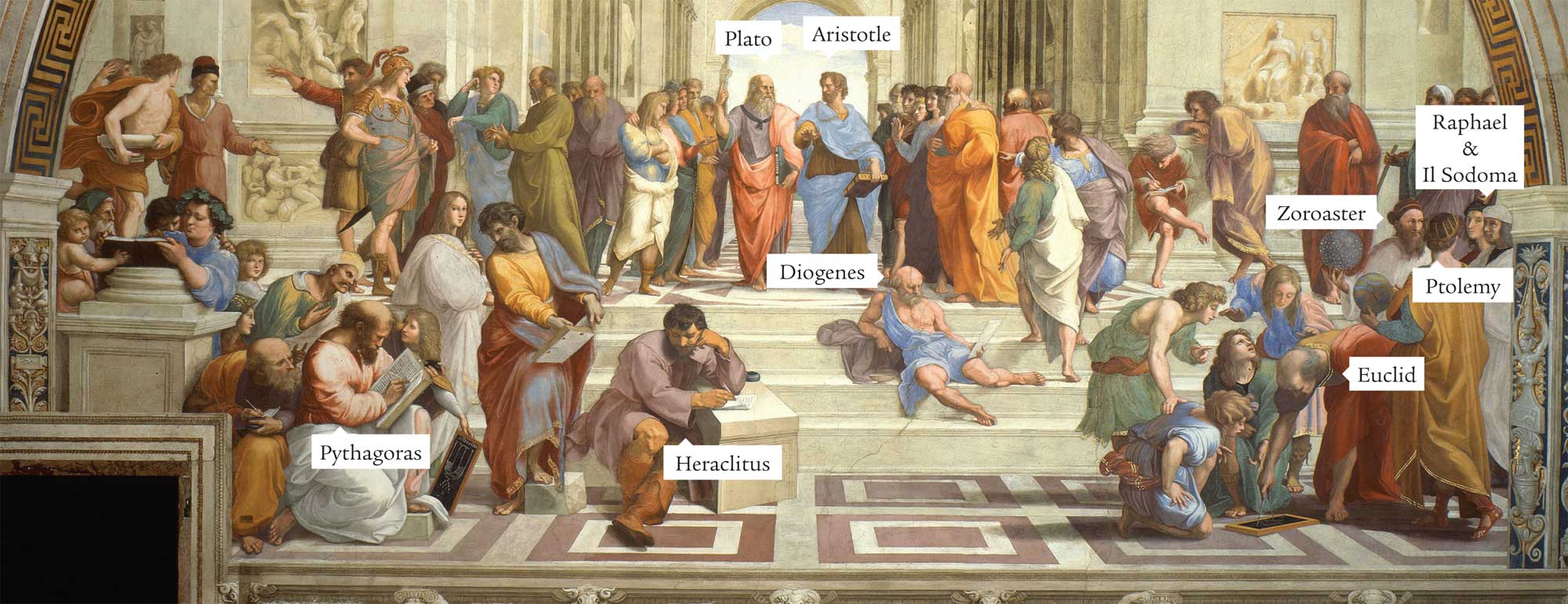
By the time he finished the Disputa in 1509, Raphael had already begun work on the opposite wall of the papal library. Facing off against the Disputa's Trinitarian theology was its humanist counterpart, Classical philosophy, the fresco generally known as The School of Athens. The young artist's compositional skill has grown. This wall is even more populous and complicated, yet just as coherent a whole as the Disputa, if only we can find the key to reading it.

Click here to enlarge with identifying labels
In a Renaissance painting, it is always a good idea to look at where the perspective lines converge. Since the eye is drawn to that point, a sensible artist makes it the focus of the picture. Here, all the lines of the pavement and the massive architecture meet at the two figures framed under the central arch. They are clearly labeled as Plato and Aristotle. Plato, on the left, is carrying his Timaios, and Aristotle is holding the Ethics. One is a treatise on the cosmic harmonies, and the other an inquiry into the rules of moral behavior; so, on the one hand, we have man's place in the universe, and on the other, how he is to behave there.

Natural and moral philosophy are the proper spheres of inquiry for the philosopher, and they divide the composition in two. On the left side, a sculpted Apollo, the god of music, cosmic harmony, and inspiration, presides over the natural philosophers, while on the right, Athena, the goddess of wisdom and science, holds sway over those who ponder philosophy's practical applications. There is a further division into two in each half of the painting, an upper and a lower level, which suggests a hierarchy of philosophers as well. Theoretical and practical, higher and lower, just as in the Disputa—but who are all these men, and how can we tell?
Pythagorean & Euclidean Groups
The group at the lower left surrounds the philosopher Pythagoras, the first to describe the mathematics of musical harmonies, which he saw to be the fundamental measures of the foundations of the universe. Behind him a strange hooded figure holds up two fingers, possibly as a sign of the doubling of the octaves that was fundamental to Pythagorean thought; another holds a tablet inscribed with elaborations of the perfect number, ten. Other mathematicians crowd around and elaborate his fundamental insights. (The morose and Michelangelesque figure sitting by himself at the right of this group is the philosopher Heraclitus, the pessimist. He was not included in any of the original design drawings but seems to have been put in as an afterthought. Raphael put him in as a homage to, and possibly portrait of, Michelangelo, after he was finally allowed in to see the ceiling of the Sistine Chapel.)
What people are saying about Touchstone:

Yet this is a closed group, from which no one goes up to the higher level of Plato's domain. The theoretical math of the ancients, an inspired mystical knowledge, was seen as a closed system, a beautiful, good, and true thing in itself, but not one that necessarily leads to a higher level of thought. An angelic figure in white looks at us and points upward, but the gesturing hand is hidden. The way is not perfectly clear.
At the lower right, however, the realm of applied mathematics is not closed but fraught with comings and goings. The geometer Euclid is giving a lesson to students in varying stages of mathematical comprehension, to demonstrate the turning of Pythagoras' mystical insight into practical, usable geometry. The geometer, incidentally, bears the features of Bramante, the architect of St. Peter's, and at the far right are portraits of Raphael and the painter called Il Sodoma. Raphael places artists squarely in the camp of the practical Aristotelian philosophers. Between them stand two men with globes, Ptolemy, who first measured the earth, and Zoroaster, who took the measure of the heavens. Beyond them, there is exchange between the upper and lower levels: a young man ascends to study higher philosophy, and a mature man comes down as if to put into practice what he has learned. At Aristotle's feet sprawls Diogenes the Cynic, a higher philosopher who casts aside his cup, a metaphor for the fripperies of philosophy.
Upper-Level Groups
On this upper level on Aristotle's side, however, we encounter several closed groups: the Peripatetics tend to go their own ways. Reading from Aristotle rightwards, we find first a group of philosophers debating with the master, then a boy and his tutor, possibly representing the process of grammatical instruction, and a solitary thinker in brown who points downward to the practical basis of his philosophy. At the far right, a young man is leaving, as if to join the practical world, while an old man, perhaps reaching retirement, returns to the world of pure philosophy. A middle-aged man in the middle stands for the middle way. Together, they represent philosophy past, present, and future.
On Plato's side, philosophy is more of an interactive outdoor sport. At the far left, a young man rushes in and is beckoned into the group surrounding Socrates, who is ticking off questions on his fingers. The discourse flows from one figure to another until it reaches the master of the dialogue, Plato, deep in conversation with Aristotle. What might their conversation be?
Mary Elizabeth Podles is the retired curator of Renaissance and Baroque art at the Walters Art Museum in Baltimore, Maryland. She is the author of A Thousand Words: Reflections on Art and Christianity (St. James Press, 2023). She and her husband Leon, a Touchstone senior editor, have six children and live in Baltimore, Maryland. She is a contributing editor for Touchstone.
A Journal of Mere Christianity—Delivered to Your Door
- Essays on theology, culture, and the Church
- Contributors from across the Christian traditions

Six print issues (one year) of Touchstone, plus full online access and PDF downloads for only $39.95.

Get a one-year full-access subscription to the Touchstone online archives for only $19.95.
bulk subscriptions
Order Touchstone subscriptions in bulk and save $10 per sub! Each subscription includes 6 issues of Touchstone plus full online access to touchstonemag.com—including archives, videos, and pdf downloads of recent issues for only $29.95 each! Great for churches or study groups.
Transactions will be processed on a secure server.
more on art from the online archives
32.4—July/August 2019
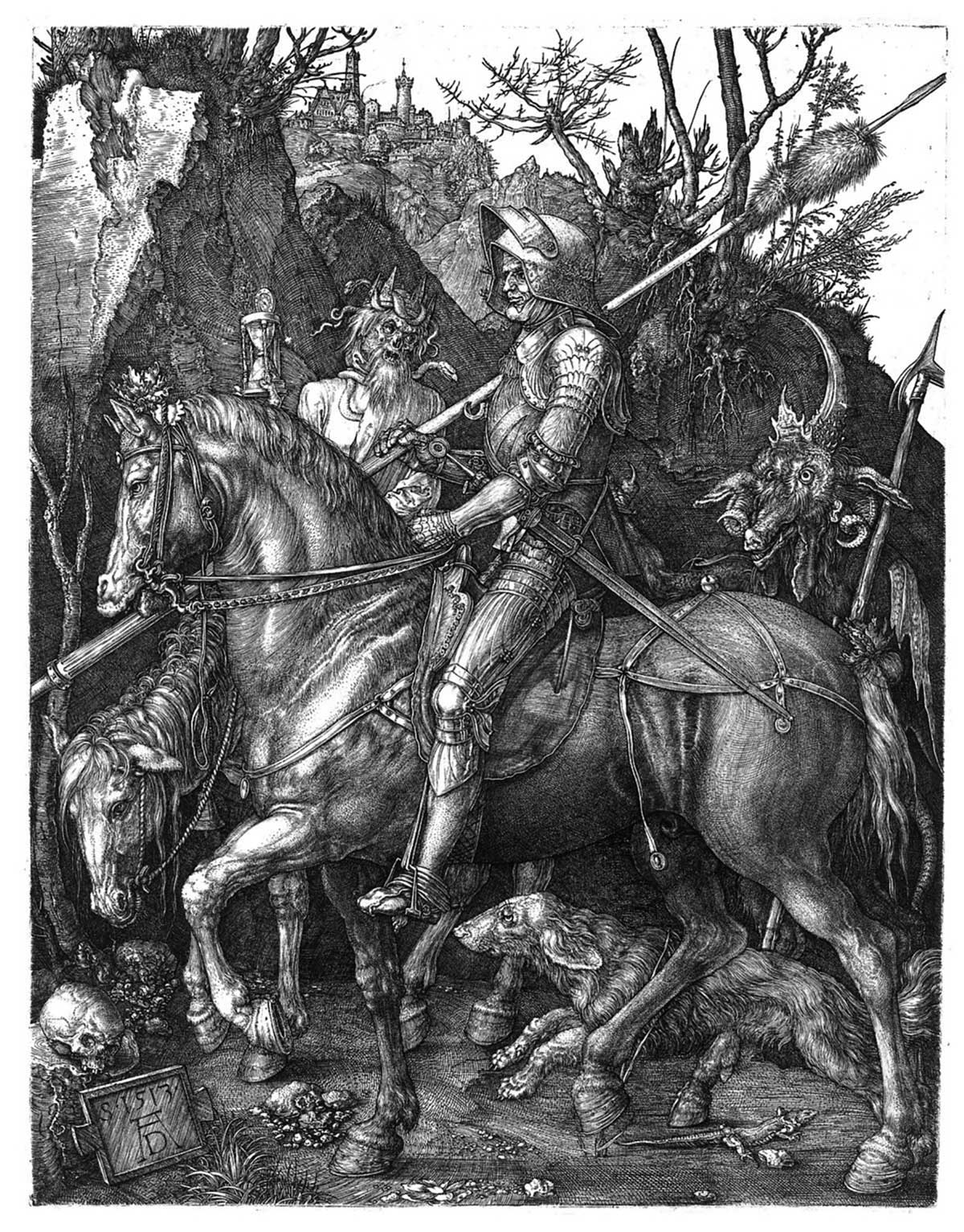
on Single-Mindedness in Durer's Ritter, Tod, und Teufel by Anthony Costello
33.2—March/April 2020
An Architectural Sign of Mere Christianity by Michael Ward
more from the online archives
30.2—March/April 2017
on Reading Don Quixote in Its Original Christian Context by Luis Cortest

18.2—March 2005
On Conservatism as Vexation, Vanity & Near Impossibility by Graeme Hunter
31.1—January/February 2018
on Ragnarök, an Extreme Weather Event & the Paths to Conversion by Timothy J. Burbery
calling all readers
Please Donate
"There are magazines worth reading but few worth saving . . . Touchstone is just such a magazine."
—Alice von Hildebrand
"Here we do not concede one square millimeter of territory to falsehood, folly, contemporary sentimentality, or fashion. We speak the truth, and let God be our judge. . . . Touchstone is the one committedly Christian conservative journal."
—Anthony Esolen, Touchstone senior editor