




ILLUMINATIONS
Anthony Esolen on Christian Hymns
A Song for a Nation
One of the great pleasures of riding a bicycle in a state as long-settled as Rhode Island is that, when you're not in the city, you often find yourself in the midst of a palimpsest of human life in its passage through the many years. There are the little "historical cemeteries," about a thousand of them, sometimes no more than a small family plot, protected by iron fences and dutifully tended. There are the miles of low stone walls running zigzag through the woods, marking what used to be fields and pastures. There are square pits in the earth, old root cellars, perhaps; and sometimes the walled embankments of a diverted stream, to provide power for a gristmill that no longer stands.
I wasn't born here, but I have grown fond of the place, with its geographical and historical bumps. I now can order a grinder at a diner or a cabinet at an ice cream stand, and can, for the voice of a Cyclops, turn a short a into a triphthong and swallow my r's like any tattooed fisherman or real estate salesman around. I know where the fallen trestle is on the train bed that is now a bike path, and something in me is fond of that big broken tooth, though I'll admit that it might provide a rude surprise for the unwary.
I find it hard to love my country without first turning to the crazy coal heap in Pennsylvania where I was born, or to this bumptious county trying so very hard to be a real state. Yet I suspect that's all right, after all. C. S. Lewis imagined heaven as an English countryside—why not? Surely there is some of heaven in that land, however difficult it may be to see sometimes, or to hear, or to touch. The old pagani, the "hillbillies," to translate the Roman word loosely, knew that love well, and clung to their old ways long after the Good News had been preached in the cities. I hope the Lord looked gently upon their blockheadedness, because just as to love one's father on earth is preparation for loving one's Father in heaven, so to love the land of one's mortality is preparation for loving the land of immortality.
That's why we ought to sing patriotic hymns. I don't mean songs that merely boast of the military bravery of Frenchmen or the cool wisdom of Italians, or the enlightenment of the sprouts of Brussels: "See where the meddling lawyer comes!" I mean hymns, songs that place love of country in the only light where it can really flourish and not grow wild and bitter, or wither away: in the light of the countenance of God.
Therefore my favorite anthem on Independence Day is the humble one that was once simply called "America":
My country, 'tis of thee,
Sweet land of liberty,
Of thee I sing:
Land where my fathers died,
Land of the pilgrims' pride,
From every mountainside
Let freedom ring.
The mortal part of my father, God bless him, now rests on a sunny hillside in my hometown; and how could I not love that place? When I was a child, I heard Mass there every year with all the paraders on Memorial Day, and now, beside his grave, as beside so many others, stands a small American flag, witness to his service.
But lest we suppose that our love is only to a concept—freedom, so little understood—the second stanza brings us to the little country bridge that spans earth and heaven:
My native country, thee,
Land of the noble free,
Thy name I love
I love thy rocks and rills,
Thy woods and templed hills;
My heart with rapture thrills
Like that above.
I doubt whether one person in a hundred could now understand those words. We sing—not of Mount Rushmore or the Mississippi, but of the small and the beloved, the running streams and the hills that are hushed like holy temples, and we can nearly say, with the saint, that whether in the body or out of the body, we are caught up to the heaven of heavens.
Anthony Esolen is Distinguished Professor of Humanities at Thales College and the author of over 30 books, including Real Music: A Guide to the Timeless Hymns of the Church (Tan, with a CD), Out of the Ashes: Rebuilding American Culture (Regnery), and The Hundredfold: Songs for the Lord (Ignatius). He has also translated Dante’s Divine Comedy (Random House) and, with his wife Debra, publishes the web magazine Word and Song (anthonyesolen.substack.com). He is a senior editor of Touchstone.
A Journal of Mere Christianity—Delivered to Your Door
- Essays on theology, culture, and the Church
- Contributors from across the Christian traditions

Six print issues (one year) of Touchstone, plus full online access and PDF downloads for only $39.95.

Get a one-year full-access subscription to the Touchstone online archives for only $19.95.
bulk subscriptions
Order Touchstone subscriptions in bulk and save $10 per sub! Each subscription includes 6 issues of Touchstone plus full online access to touchstonemag.com—including archives, videos, and pdf downloads of recent issues for only $29.95 each! Great for churches or study groups.
Transactions will be processed on a secure server.
more from the online archives

31.2—March/April 2018
The Transmission of Christianity Is Not a New Task by Nathanael Devlin
19.10—December 2006
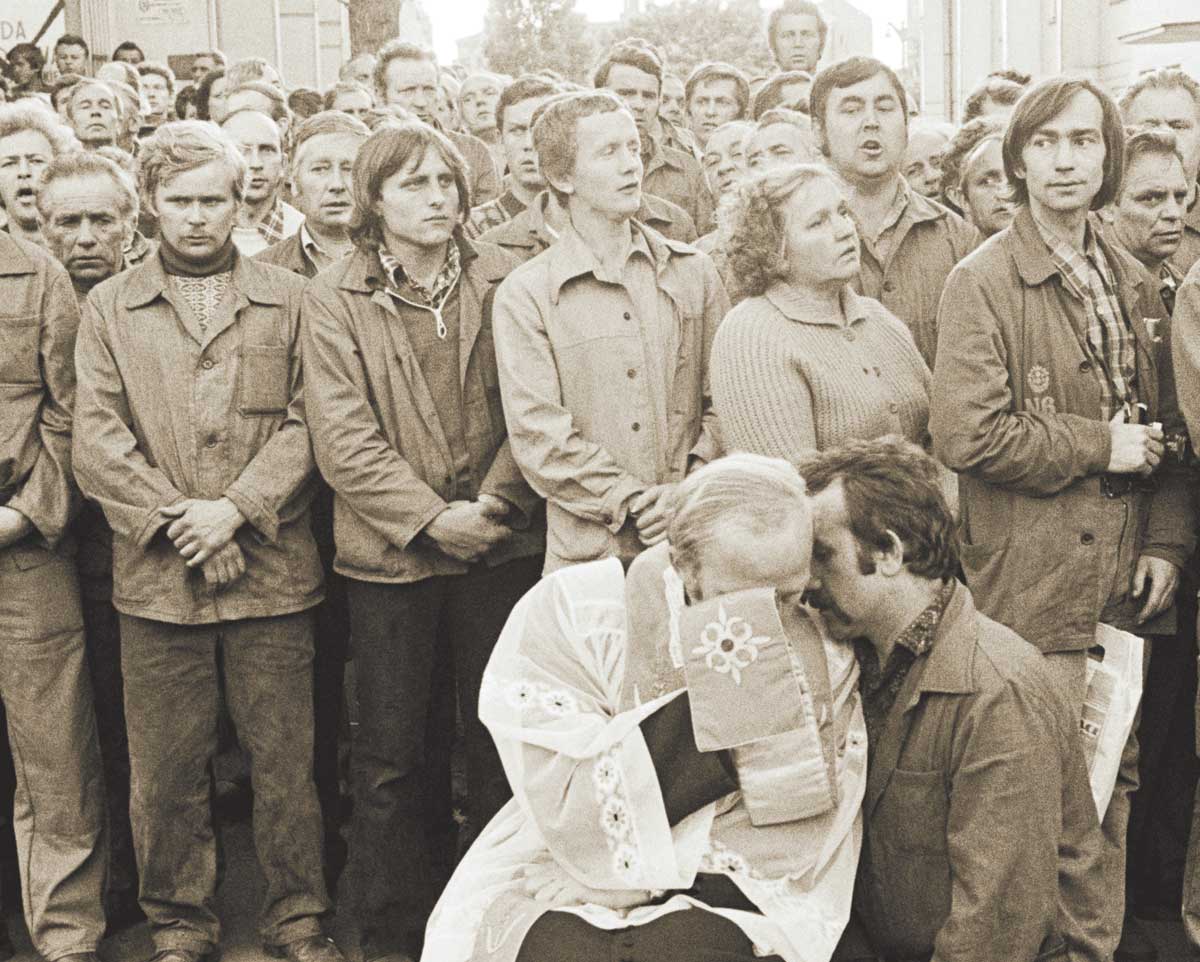
Workers of Another World United
A Personal Commemoration of Poland’s Solidarity 25 Years Later by John Harmon McElroy
calling all readers
Please Donate
"There are magazines worth reading but few worth saving . . . Touchstone is just such a magazine."
—Alice von Hildebrand
"Here we do not concede one square millimeter of territory to falsehood, folly, contemporary sentimentality, or fashion. We speak the truth, and let God be our judge. . . . Touchstone is the one committedly Christian conservative journal."
—Anthony Esolen, Touchstone senior editor
