





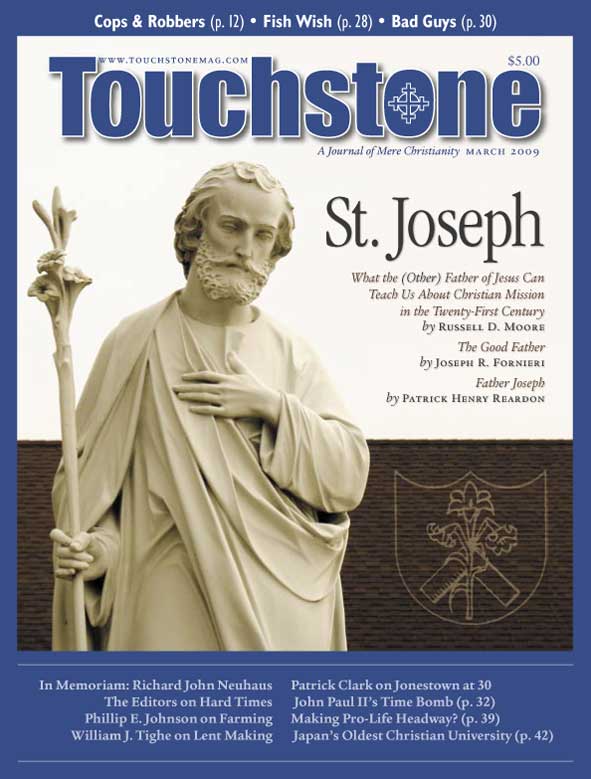
Editorial
Love, Sex & Mammon
Hard Times, Hard Truths & the Economics of the Christian Family
We are not, we pray, on the verge of another Great Depression. Still, we see signs of economic failure all around us. Stores in the strip malls we drive past every day advertise “going out of business” sales. Those of us who are pastors know church members who have lost jobs, and we weekly see the faces of others who fear that the next pink slip belongs to them.
Some Christians, on the Left and on the Right, would tell us that economic matters are of paramount concern right now. They would assert that we’ve no time for the “luxury” of “culture war” discussions about “abstinence” or divorce or “gender roles” or other such matters. Instead, they tell us, we should concentrate on tax cuts or economic stimulus projects or Wall Street bailouts or home ownership.
They’re wrong.
They’re wrong not only because the family is, ultimately, more important than the marketplace, but also because the two are interconnected. They’re wrong also because, as Marxists and hyper-capitalists both correctly grasp (though wrongly apply), man as an economic being cannot be abstracted from other aspects of life.
A time of economic crisis is, therefore, a time for the Church to reconsider—and re-imagine—her priorities. The first step is to recognize that one of the roots of the family crisis all around us—in the pews we sit in or preach to every week—is the wallet in our own back pocket.
Consuming Ourselves to Death
It is no accident, after all, that our Ancient Foe first appears in Holy Scripture as a snake—imagery that follows the devil all through the canon to the closing vision of the Revelation to St. John. As philosopher Leon Kass puts it, “For the serpent is a mobile digestive tract that swallows its prey whole; in this sense the serpent stands for pure appetite.” Indeed he does—and the whole of Scripture and of Christian tradition warns the Church against the way of the appetites, the way of consuming oneself to death.
We are commanded away from the path of Esau, who sells his inheritance for a pile of red stew (Heb. 12:16–17). We’re directed away from the god of the belly (Phil. 3:19). From the Tree in the garden to the wilderness beyond the Jordan to the present hour, the people of God are tempted to turn their digestive or reproductive tracts away from the mystery of Christ and toward the self as god.
This is true in any era, but there is a special danger, it seems, for those of us living in an era of unparalleled affluence. We have become the people Jesus warned us about. Whether Irish Catholics or Appalachian Baptists or Armenian Orthodox, too many of us want desperately to distance ourselves from our blue-collar, economically impoverished roots, and more and more wish to be seen as affluent, upwardly mobile, and politically influential. But this has come with a cost.
Too many of our churches, too many of us, have made peace with the sexual revolution and the familial chaos left in its wake precisely because we made peace, long before, with the love of money. We wish to live with the same standard of living as the culture around us (there is no sin in that), but we are willing to get there by any means necessary.
Russell D. Moore is president of the Ethics and Religious Liberty Commission of the Southern Baptist Convention. He is a senior editor of Touchstone.
A Journal of Mere Christianity—Delivered to Your Door
- Essays on theology, culture, and the Church
- Contributors from across the Christian traditions

Six print issues (one year) of Touchstone, plus full online access and PDF downloads for only $39.95.

Get a one-year full-access subscription to the Touchstone online archives for only $19.95.
bulk subscriptions
Order Touchstone subscriptions in bulk and save $10 per sub! Each subscription includes 6 issues of Touchstone plus full online access to touchstonemag.com—including archives, videos, and pdf downloads of recent issues for only $29.95 each! Great for churches or study groups.
Transactions will be processed on a secure server.
more on sex from the online archives

33.1—January/February 2020
Speaking Truth About the Sexes Is Not Optional by Anthony Esolen

31.6—November/December 2018
on the Church's Response to the Anti-marriage Tide by Diane Woerner
32.5—September/October 2019
on the Inhuman Transformation of Transgenderism by Anthony Esolen
more from the online archives
22.6—July/August 2009
on the Integration of Anger into the Virtuous Life by Leon J. Podles

35.4—Jul/Aug 2022
The Death Rattle of a Tradition
Contemporary Catholic Thinking on the Question of War by Andrew Latham
22.5—June 2009
C. S. Lewis on Civilization & the Natural Order by Timothy L. Hall
calling all readers
Please Donate
"There are magazines worth reading but few worth saving . . . Touchstone is just such a magazine."
—Alice von Hildebrand
"Here we do not concede one square millimeter of territory to falsehood, folly, contemporary sentimentality, or fashion. We speak the truth, and let God be our judge. . . . Touchstone is the one committedly Christian conservative journal."
—Anthony Esolen, Touchstone senior editor
