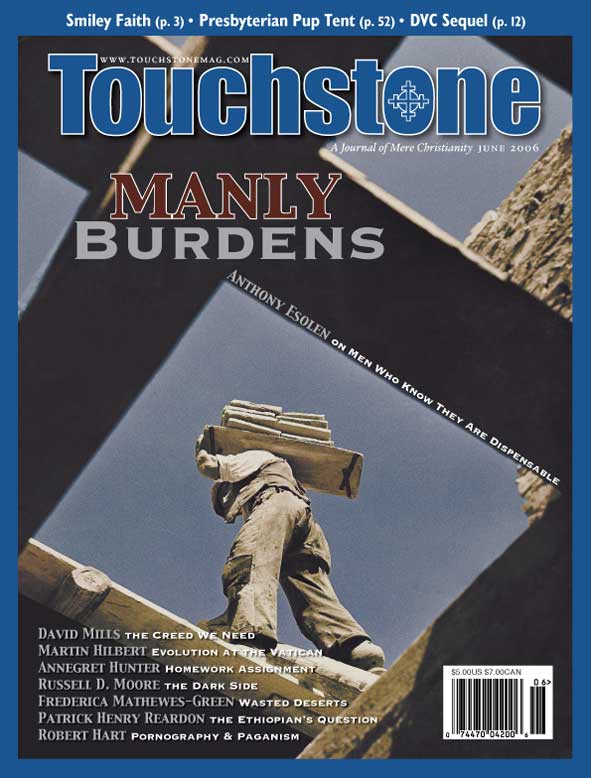
Darwin’s Divisions by Martin Hilbert
Darwin’s Divisions
The Pope, the Cardinal, the Jesuit & the Evolving Debate About Origins
by Martin Hilbert
It makes no obvious difference to our salvation whether the geometry of our
universe is Euclidian, whether quantum mechanics is the last word in atomic
physics, or whether the Big Bang is the correct model for the development of
the universe. These theories witness to the power of the human intellect, but
few would claim that they bear on questions of faith and morals.
Evolution, on the other hand, says something about the origin of man, and
in this way can, at least in theory, conflict with religious dogma. And so,
although the Catholic Church seldom speaks about scientific theories, from
time to time it breaks the silence to address the question of biological evolution.
It does so when it perceives that some Catholics accept as true a scientific
theory that denies some important Christian teaching about man and his origins.
Darwinism has famously become just such an alternative creation account.
Both the classical theory and the enhanced neo-Darwinist synthesis (which includes
genetics, statistics, and molecular biology) claim that apparent design can
result from blind forces. Although some Darwinists and neo-Darwinists might
protest that their scheme does not banish God from the picture, most are, whether
they know it or not, crass materialists.
Both (the distinction does not make a difference at this point) assert a
materialistic explanation for the realities that Christians know as the creation
and the fall. They assume that human intelligence, will, and even morality
can be fully explained in terms of material causes. Their theory provides its
own explanation of why man is violent and lustful, and it understands death
as part of the process that created us.
The church does not pretend to give scientific answers to biological questions.
But it does point out that some Darwinist claims are mere materialist metaphysics
pretending to be science, because it knows that were it to remain silent on
a truth—the nature of man—that has been entrusted to it by God,
that truth would soon disappear, only to be replaced by the ever-changing dogmas
of a materialist science.
Even so, the Catholic Church has been surprisingly sparing in its pronouncements
on the subject, given that Darwin’s theory has been used to underpin
some fairly disastrous worldviews, such as Nazism and communism. The church
has never been very comfortable with the theory, but, perhaps fearing bad press
of the kind that arose from its condemnation of Galileo, has usually preferred
to deal with theologians who were enthusiastic about evolution in more discreet
ways than by magisterial interventions.
Papal Permission
But it has made some exceptions. The first was a short section of the encyclical Humani
Generis (1950), in which Pope Pius XII gave Catholic theologians and
scientists permission to consider the possibility that the human
body evolved from pre-existing life forms, provided that such people were
open to all the evidence, pro and con.
At the same time, the pope insisted that each and every human soul was immediately
created by God. Evolution may or may not explain the origin of the body, but
it certainly could not explain the soul.
Pius XII also ruled out polygenism—the theory that the human race had
multiple “first” parents—for it was in “no way apparent
how such an opinion can be reconciled with that which the sources of revealed
truth and the documents of the Teaching Authority of the Church propose with
regard to original sin, which proceeds from a sin actually committed by an
individual, Adam, and which, through generation, is passed on to all and is
in everyone as his own.”
The faithful had to wait almost fifty years, until 1996, for the next papal
intervention on evolution, which took the form of an address John Paul II made
to the Pontifical Academy of Sciences. This address was widely publicized,
mainly because of the following sentence: “Today, more than a half-century
[ sic] after the appearance of that encyclical [ Humani Generis],
some new findings lead us toward the recognition of evolution as more than
an hypothesis.” The news in most mainstream media spread under the headline “Pope
Accepts Darwinism,” suggesting that the church had finally caught up
to modernity.
Recently the topic of evolution and the church became newsworthy again. First,
Benedict XVI chose to mention evolution in the homily of his inaugural Mass
as pope: “Only when we meet the living God in Christ do we know what
life is. We are not some casual and meaningless product of evolution. Each
of us is the result of a thought of God. Each of us is willed, each of us is
loved, each of us is necessary.”
It was as though he were directly responding to a Darwinist dogma put most
clearly in the widely read Meaning of Evolution: “Man is the
result of a purposeless and natural process that did not have him in mind.” That
the new pope should mention the theory in such an important context shows that
he thinks that it can be taken to have a tremendous (and pernicious) influence
on man’s understanding of himself and his relation to God.
Abdicated Reason
Several months later, on July 7, the New York Times published an
op-ed piece on neo-Darwinism by Christoph Cardinal Schönborn, the archbishop
of Vienna. Schönborn, a former student of Joseph Ratzinger and the main
editor of the Catechism of the Catholic Church, argued that the media
had misrepresented John Paul II’s address to the Pontifical Academy of
Sciences.
The media is interested in selling news, so it does not distinguish the degree
of authority that these various interventions on evolution possess. To be sure,
Catholic theologians also argue among themselves as to how much authority a
particular mode of teaching possesses, but it is safe to say that an encyclical
letter like Humani Generis carries much more weight than a papal
general audience or even an address to the Pontifical Academy of Science.
References to evolution in homilies, even in important papal homilies, or
op-ed pieces, even when written by cardinals, are not means for settling doctrinal
questions. But they can provide clues as to how the church understands particular
teachings. And they can be effective means of reminding the faithful what the
church teaches and of engaging the world at large in a dialogue on important
issues.
In the op-ed piece, “Finding Design in Nature,” Schönborn
said that to accept Darwinism was to abdicate reason, as was clear from a talk
John Paul II had given to a general audience eleven years before he addressed
the Pontifical Academy of Science. “The evolution of living things, of
which science seeks to determine the stages and to discern the mechanism, presents
an internal finality, which arouses admiration,” said the pope. This
finality “directs beings in a direction for which they are not responsible
or in charge” and thus “obliges one to suppose a Mind, which is
its inventor, its creator.”
To all these indications of the existence of God the Creator, some oppose
the power of chance or of the proper mechanisms of matter. To speak of chance
for a universe which presents such a complex organization in its elements and
such marvelous finality in its life would be equivalent to giving up the search
for an explanation of the world as it appears to us. In fact, this would be
equivalent to admitting effects without a cause. It would be to abdicate human
intelligence, which would thus refuse to think and to seek a -solution for
its problems.
When John Paul II, a philosopher, used the term “finality,” he
did so with the full awareness that he was defending design in nature and a
designer of nature. Schönborn himself entered the fray with one very important
consideration about the danger of neo-Darwinism: its degradation of human reason
by ruling out of bounds the intellect’s ability to see design.
The cardinal was particularly irked by attempts to make a Darwinian out of
Benedict XVI. Cardinal -Ratzinger had been the head of the International Theological
Commission in 2004 when it published Communion and Stewardship: Human
Persons Created in the Image of God, a report dealing with the bearing
of biological evolution on the Catholic faith, among many other topics. Some
interpreted the report as favorable to neo-Darwinism, and hence an argument
that Benedict finds no problem with the theory. In rebuttal, Schönborn
quoted Benedict XVI’s inaugural homily.
A Livid Coyne
In a telephone interview given after the Times article appeared,
Schönborn said that although his article had not been vetted by the Vatican,
he had spoken with Ratzinger a few weeks before his elevation to the papacy
about what he perceived to be misrepresentations of the church’s views
on evolution, and the future pope had encouraged him to work to set the record
straight.
In the interview, Schönborn admitted that he was angered by those who
taught that neo-Darwinian evolution was compatible with the Catholic faith. “Evolution
in the sense of common ancestry might be true, but evolution in the neo-Darwinian
sense—an unguided, unplanned process of random variation and natural
selection—is not.”
If the cardinal was angry at the misrepresentations of John Paul’s
and Benedict’s thought, the head of the Vatican Observatory, Father George
Coyne, S.J., was livid at the cardinal’s intervention. In an essay, “God’s
chance creation,” published in the English Catholic magazine The
Tablet in early August, he accused the cardinal of muddying the already “murky
waters of the rapport between the Church and science” by attacking the “best
of modern science.”
Coyne conjured up the ghost of the Galileo case as an example of what he
meant by incompetent handling of the relation between the church and science.
In the case of evolution, he thought that Communion and Stewardship was
a step in the right direction. Schönborn’s piece, on the other hand,
put the church on a collision course with science once again.
To work towards avoiding unnecessary antagonism is laudable, but there are
two serious problems with Coyne’s analysis. First, he is wrong in thinking
that Schönborn’s op-ed piece was at odds with John Paul II and the
International Theological Commission. Second, he claims that science is neutral
with regard to religion, but then blatantly contradicts himself when he says
that the results of modern science make it necessary to adjust our concepts
of divine omniscience and omnipotence. Coyne is neither a careful reader of
texts, nor a coherent philosopher.
Theology’s Competence
Let us look at Coyne’s first mistake. In his 1996 address to the Pontifical
Academy of Sciences, John Paul II did indeed say that evolution was more than
a hypothesis, and in his subsequent remarks he made it clear that he was quite
convinced that today’s flora and fauna were different from the flora
and fauna of earlier epochs and yet originated from those ancestral forms.
But he also made it clear that although “evolution” might be
more than a hypothesis, Darwin’s explanation of evolution enjoys no such
intellectual respectability. “[R]ather than speaking about the theory
of evolution, it is more accurate to speak of the theories of evolution,” he
said.
The use of the plural is required here—in part -because of the diversity
of explanations regarding the mechanism of evolution, and in part because
of the diversity of philosophies involved. There are materialist and reductionist
theories, as well as spiritualist theories. Here the final judgment is
within
the competence of philosophy and, beyond that, of theology.
Later on in the address, the pope in fact did apply principles of theological
anthropology to rule out the Darwinist account. Citing Pius XII’s Humani
Generis, St. Thomas Aquinas’s Summa Theologiae, and Vatican
II’s Gaudium et Spes, he concluded: “The theories of
evolution which, because of the philosophies which inspire them, regard the
spirit either as emerging from the forces of living matter, or as a simple
epiphenomenon of that matter, are incompatible with the truth about man. They
are therefore unable to serve as the basis for the dignity of the human person.”
It is a deep mystery how anyone could have read the 1996 address and thought
that the church had accepted Darwinism. Schönborn may not have helped
his cause by referring to the address as insignificant—it did after all
go beyond Humani Generis in judging that the evidence for bodily
transformation of species was quite convincing. But he is absolutely right
in complaining that the address is misrepresented when it is cited in favor
of Darwinian evolution.
God’s Contingency
The report of the International Theological Commission may at first sight
appear friendlier to Darwinist evolutionary theory (and to Coyne’s claim),
for it holds out the possibility that empirical data may yet show that there
are processes and potentialities inherent in nature that can function as (secondary)
causes of the emergence of the complexities found in biological structures.
But, the commission goes on to say,
in the Catholic perspective, neo-Darwinians who adduce random genetic variation
and natural selection as evidence that the process of evolution is absolutely
unguided are straying beyond what can be demonstrated by science. Divine causality
can be active in a process that is both contingent and guided.
Any evolutionary mechanism that is contingent can only be contingent because
God
made it so. An unguided evolutionary process—one that falls outside the
bounds of divine providence—simply cannot exist.
This is hardly new, as may be gathered from the commission’s citation
of St. Thomas. It is as old as the theological problem of reconciling God’s
providence with contingent affairs or with freedom of action.
The commission was aware of the problems of invoking God as an explanation
for currently unknown chains of causality: the so-called God-of-the-gaps approach,
which tends to embarrass religious believers when science progresses and proposes
an alternative solution that credibly fills in the gaps. Nevertheless, the
document insisted that there are ontological gaps, as distinct from gaps in
explanation, which do require divine intervention:
Acting indirectly through causal chains operating from the beginning of
cosmic history, God prepared the way for what Pope John Paul II has called “an
ontological leap . . . the moment of transition to the spiritual.” While
science can study these causal chains, it falls to theology to locate this
account of the special creation of the human soul within the overarching
plan of the triune God to share the communion of trinitarian life with human
persons
who are created out of nothing in the image and likeness of God.
Neither of the commission’s considerations can be seen as an endorsement
of Darwinism, which, as it is popularly presented, specifically denies purpose
in the universe in general and human life in particular. If anything, Coyne
undermines his case that Schönborn misrepresented John Paul and Benedict
by citing these documents.
Coyne’s Necessity
That is Coyne’s first mistake. The second is more substantial. The
main problem with his argument is not his attempt to claim papal authority
for neo-Darwinism, but his attempt to portray science as a religiously neutral
enterprise and at the same time as the ultimate basis for a rational worldview.
“Science,” he declares at one point, “is completely neutral
with respect to philosophical or theological implications that may be drawn
from its conclusions.” Yet he goes on to say that science has a bearing
on our understanding of divine omnipotence and omniscience. So is it neutral
or is it not? He informs us that “in the universe as known by science,
there are essentially three processes at work: chance, necessity, and the fertility
of the universe.”
Let us begin with chance and necessity. If this is a statement of scientific
methodology, very well and good. Science tries to explain the realities of
this world in terms of other realities in this world. It looks for patterns
and demands that experiments adduced in favor of theories be replicable. Any
given situation in nature is assumed to unfold by necessity: Identical initial
conditions must lead to the same outcomes. It does not include any personal
element, such as divine intervention. Science as we know it could only begin
when the denizens of Mount Olympus ceased to count as explanations for natural
phenomena.
Once found, the causal connections are expressed in terms of necessary laws.
Chance stands for whatever is still unknown, either conceptually or because
it escapes our finite ability to measure or compute. To be sure, quantum mechanics
adds its own complexities to the discussion about chance, but there is no need
to take these up to understand what Coyne is saying. Two hydrogen atoms, he
says, will of necessity combine under the right conditions, but will not do
so if by chance the conditions are not right when they meet. Coyne is using
the terms chance and necessity as a working scientist would use them.
Working scientists need not be blamed for being realists by force of habit,
but such naiveté is another matter in someone trying to philosophize
about science. Is chance something real in the universe? In a telephone interview
he gave to John Allen, published in the National Catholic Reporter, Coyne
implied that chance is merely a statement of our ignorance: “Chance is
the way we scientists see the universe. It has nothing to do with God. It’s
not chancy to God, it’s chancy to us.”
Yet, in the Tablet article, he says that “if we confront
what we know of our origins scientifically with religious faith in God the
Creator—if, that is, we take the results of modern science seriously—it
is difficult to believe that God is omnipotent and omniscient in the sense
of many of the scholastic philosophers. For the believer, science tells us
of a God who must be very different from God as seen by them.” This implies
that chance must be something real and not just shorthand for our ignorance.
Here, the way that scientists see the universe does tell us something about
God that theology does not.
Legitimate criticisms can be made of Schönborn’s argument, of
course. Stephen Barr, writing in the October 2005 issue of First Things, took
Schönborn to task for equating “random” with “unguided.” Scientists
can use the term “random” in statistically precise ways, without
implying that a random process can give rise to effects that God cannot foresee
or control.
God can use a random process, such as radioactive decay, to achieve his purpose.
This, as Barr points out, is perfectly consonant with what the International
Theological Commission taught: “An unguided evolutionary process—one
that falls outside the bounds of divine providence—simply cannot exist.”
Given that the commission’s report at this point quoted St. Thomas
Aquinas in support of its position, one is at a loss as to how Coyne should
see support for his belief that the report got the relation between science
and religion right, and yet that science makes holding medieval ideas about
God’s omniscience and omnipotence impossible. It seems that he reads
magisterial documents very selectively.
The Fertile Universe
Coyne’s third scientific category may come as a surprise to many working
scientists: the fertility of the universe. This is not chance or necessity.
This is not a particle or field. It is an expression of faith that the universe
as created by God has so much inherent potential in it that it produces the
most complex forms without divine intervention. This is Coyne’s attempt
to give the universe an intrinsic value and dignity, but with the result that
he effectively asserts that God could neither know it perfectly nor guide it
to achieve his ends: hardly a philosophically and theologically neutral scientific
category.
Further insights into the “fertility of the universe” may be
gathered from the end of the article. Modern science “provides a challenge,
an enriching challenge, to traditional beliefs about God,” he claims.
God lets the world be what it will be in its continuous evolution. He is
not continually intervening, but rather allows, participates, loves. Is such
thinking adequate to preserve the special character attributed by religious
thought to the emergence not only of life but also of spirit, while avoiding
a crude creationism? Only a protracted dialogue will tell.
Although he acknowledges that theologians have the concept of “continuous
creation” with which to explore God’s relation to the universe,
this last paragraph suggests that he has attributed to the universe too much
power and autonomy. He holds out the possibility that the world in its continuous
evolution could bring about the emergence of spiritual realities without divine
intervention.
This is precisely what Catholics are not to believe, as John Paul II said
in the address that Coyne thought was a model of sensitivity: “It is
by virtue of his eternal soul that the whole person, including his body, possesses
such great dignity. Pius XII underlined the essential point: if the origin
of the human body comes through living matter which existed previously, the
spiritual soul is created directly by God.”
In Coyne’s scenario, the “fertility of the universe” takes
over God’s role. An impersonal creative force—a creative chaos—accounts
for the most amazing elements of the universe, while at the same time doing
away with a Personal Designer. In refusing to adopt Coyne’s vision of
the “fertility of the universe,” the church need not worry that
it is closing the door on “the best of modern science.” Rather,
it is rejecting a nebulous philosophy that claims for itself the mantle of
science.
Wise Orthodoxy
It is puzzling that Coyne should undertake his analysis of the relationship
of science and religion in defense of Darwinian evolution, a theory that is
hardly “the best of modern science.” This is not the place to rehearse
the scientific problems with the theory. There are many good books available
on the subject, including Phillip Johnson’s Darwin on Trial, Michael
Behe’s Darwin’s Black Box, and Denyse O’Leary’s By
Design or by Chance?
As I mentioned above, Schönborn argued against one very important danger
of neo-Darwinism: its degradation of human reason by ruling out of bounds the
intellect’s ability to see design. His objection would lose much of its
force if the fossil beds provided evidence of continuity, if there were no “pre-Cambrian
explosion” of life, if the simplest forms of life were not so unbelievably
complex, and many other facts that all make clear that there is very little
substantial evidence for the grand claims of Darwinism.
If such evidence were there, proponents of the argument for God’s existence
from design in nature would not be able to cite the human eye or the bacterial
flagellum as being beyond the ability of natural processes to create without
God’s intervention, but would have to see design in the whole grand scheme
of things. This is the possibility that may have alarmed Coyne and led him
to his criticism of Schönborn.
The International Theological Commission allows for this possibility. But
it does not allow for a process that could produce a universe with features
that God’s omniscience could not have predicted or that did not need
God’s intelligence as their first cause. It would then simply be clear
that God has been molding the universe in small and apparently random ways.
Coyne need not fear that the church is backing into an embarrassing God-of-the-gaps
fallacy.
In other words, arguments such as Coyne’s are not necessary to save
the church from adopting positions that seem reasonable now but will be an
embarrassment if science should make some startling discoveries in the future.
One does not have to accept that God created each species in its present state
or assert that there are no secondary causes that God could have used to develop
birds from dinosaurs as a premise for arguing against Darwinism.
Darwinian Death
It may be that Coyne’s daily association with scientists leads him
to view Darwinism as “the best of modern science.” Many sincere
Christians have done this. But as a priest, Coyne should know that there are
basic theological questions that need to be addressed if a Christian seriously
contemplates accepting Darwinism.
Darwinism not only does away with an immaterial soul, it also comes with
its own account of original sin. Death, on the neo-Darwinian view, is not the
result of the envy of the devil and of a human choice, as the Scriptures teach.
It is, rather, an impersonal, potent, creative force that combined with chance
mutation to make us what we are.
We are lustful and violent, not because we fell from a privileged pedestal
through original sin, but because our ancestors copulated and fought their
way, red in tooth and claw, to biological predominance. Those who by chance
were not obsessed with copulation or who were slow to anger and violence were
culled from the ancient gene pools that eventually led to the present gene
pool that we call human.
If Darwinism is accepted as true, we have no choice but to accept that the
Christian understanding of created and fallen man is just a pious fable, a
myth intended to assign personal agency to a universe that has none. And if
the nature of man is a fable, so must be the Incarnation.
There has been little attempt by Catholics who are favorable towards evolutionary
theory to deal directly with the theological truths revealed by the story of
Adam and Eve. The opening chapters of Genesis tell us, first of all, that human
beings are the pinnacle of creation. God made us in his image, something that
is said of no other animal. Scripture also speaks of the original innocence
of our first parents. They were naked and not ashamed.
Theologians have differed among themselves about the details of this state
of original justice, but they agree that man was created immortal. It was only
through the disobedience of Adam and Eve that death became part of the human
condition.
Darwinism collapses the story of creation and the fall into one. The economy
of the Darwinist explanation is itself a powerful argument in favor of the
theory. And one should not underestimate the allurement of Darwinism as an
excuse to dismiss both God and sin from the world.
Such considerations make Darwinism attractive to atheists and agnostics.
Christians, however, should know better than to wish sin away by denying its
reality. The Catechism refers to original sin as an “essential
truth of the faith,” and for Catholics, Pius XII’s censure of polygenism
appears to retain its force. The third chapter of Genesis need not be read
in a naively literalistic sense, but any serious reading of the text must acknowledge
that our first parents, whenever and wherever they lived, chose to rebel against
God, and consequently became subject to sin and death.
The Faith Preserved
Many people who do not see any problems with reconciling Darwinism and Christianity
have endorsed the common tendency to view science as rational and religion
as emotional. Their attempts to delineate the spheres of science and religion
in effect deny that religion has any objective truth claims. But given that
there is no universally accepted definition of science and a fortiori of
religion, how could this separation ever be effected in a universally accepted
way, even if we thought it desirable?
Coyne may not explicitly deny that religion has objective truth claims. But
his insistence that the church give biology the sole right to determine whether
man’s spiritual nature can arise out of secondary causes is tantamount
to relegating theology to the status of an emotional reflection on the world
as it really is. That is, among other things, to deny that Christianity offers
man a revelation of truths he cannot know on his own.
The church would do a great disservice to believers and to humanity as a
whole were it to remain silent when science tried to pass off as fact an unsubstantiated
theory. To criticize Darwinism, as the three popes and the cardinal have done,
is not meddling in a neutral science. It is preserving intact the deposit of
faith, which says some very definite things about the origin and fall of man,
by rejecting theological claims made in the name of science that science itself
cannot sustain.
Cardinal Newman, in his Idea of a University, warned of the danger
of excluding any science, and especially philosophical discourse about God,
from a complete understanding of reality:
If you drop any science out of the circle of knowledge, you cannot keep its
place vacant for it; that science is forgotten; the other sciences close up,
or, in other words, they exceed their proper bounds, and intrude where they
have no right. . . . We cannot do without a view, and we put up with an illusion,
when we cannot get at truth.
If Coyne had his way, scientists and their popularizers would become the
sole arbiters of reality. Darwinism, rather than theology, would provide the
ultimate truth about God and man. Some Christians might see this as evidence
of a more thoughtful and enlightened approach to religion. But Christianity
without an omniscient and all-powerful God is not truth. And to accept the
Darwinian explanation for both man’s grandeur and his depravity is to
put up with an illusion.
Cardinal Schönborn’s article can be found at www.catholiceducation.org/articles/science/sc0060.html;
George Coyne’s article at www.thetablet.co.uk/cgi-bin/register.cgi/tablet-01063;
John Paul II’s address to the Pontifical Academy of Sciences at www.ewtn.com/library/PAPALDOC/JP961022.HTM;
and Communion and Stewardship (the Report of the International Theological
Commission) at academic.regis.edu/mghedott/communionstewardship.htm.
The Gould Standard
It may be useful to cite one particularly
revealing passage from one of Steven Jay Gould’s popular
books on evolution. Gould was a paleontologist at Harvard and a
talented writer who was a Darwinist
even though he openly declared that the fossils told a different
story.
In Hen’s Teeth and Horse’s Toes, he admitted that the
critics of evolution had a powerful case at the Scopes trial in 1926,
but he did not hesitate
to say that the intellectual descendants of these people need to be resisted.
He called them “a motley collection” whose “core of practical
support lies in the evangelical right,” and then declared that
creationism is a mere stalking horse or subsidiary issue in a
political program that would ban abortion, erase the political
and social
gains of women by reducing
the vital concept of family to an outmoded paternalism, and reinstitute all
the jingoism and distrust of learning that prepares a nation for
demagoguery.
No doubt it would be inaccurate to suggest that all Darwinists
are pro-abortion zealots bent on destroying any remaining vestiges
of Christian civilization,
but the passage indicates that the debate about the status of neo-Darwinism
is not likely to be a dispassionate discussion among philosophers
of science. Whether
or not all the protagonists are explicitly aware of it, the debate is about
alternative worldviews.
— Martin Hilbert
|
Martin Hilbert is a priest of the Oratory of St. Philip Neri in Toronto (www.oratory-toronto.org). He holds a doctorate in the history and philosophy of science from the University of Toronto and teaches a course in the philosophy of science at St. Philip?s Seminary. |