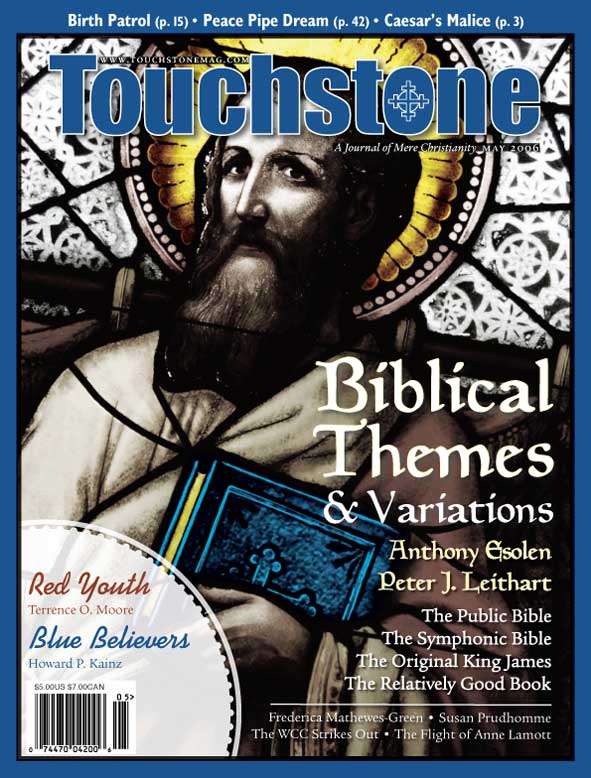
Bottom of the Ninth Assembly by George Conger
Bottom of the Ninth Assembly
The Recent World Council of Churches Assembly & the End of the Ecumenical
Movement
by George Conger
The decision has been a generation in the making, and no single vote, speech,
motion, paper, legislative minute, consciousness-raising session, litany of
repentance, people’s drama, or interpretive dance arising from the World
Council of Churches’ 9th Assembly, held February 14–23, 2006, in
Porto Alegre, Brazil, can be accounted as the definitive end of its Christian
life. The thirty-year battle for the soul of the World Council of Churches
(WCC) and the institutional ecumenical movement has ended.
Founded in 1948 to foster the reunification of Christian Churches, the WCC
has effectively shed its religious calling, and in its place has chosen social
activism in the pursuit of "relevance.”
The Relevant WCC
This “relevance” found voice at the opening session of the 9th
Assembly when the North American delegates offered a litany of repentance.
Americans and Canadians confessed to the delegates from more than one hundred
countries “the sin of racism,” “our compulsion to despoil
the earth,” “our thirst for violence,” “the hunger
for revenge,” “our lust for empire,” our “self satisfaction
and self-adoration,” and our “hearts hardened by terror and media
manipulation.”
Latin American delegates joined the chorus agreeing that America was the
problem, confessing to having “to breathe air polluted by foreign-owned
industries” and to being “subjected unilaterally to the interests
of large corporations or the countries reckoned to be great.”
Asian delegates added a refrain, calling for repentance for “the invalid
babies still born in Vietnam as a result of Agent Orange used [by America]
during the war in Vietnam.” The call had to be made in absentia, however,
as no Vietnamese were actually present.
But while the seed of political relevance has taken root in the institutional
ecumenical movement, it has yet to flower in all of the WCC’s 348 member
churches, and thus prompted the call for a new “ecumencial paradigm” at
this gathering. The 691 delegates learned from the WCC’s Moderator, Aram
I, the Armenian Catholicos of Cilicia, that some believed their organization
was in “crisis.”
The ecumenical movement had lost “contact with the vision; and the
vision appears to be vague and ambiguous” he said; yet this presented
an opportunity for the WCC. The way forward was not to regain the WCC’s
founding vision of a fellowship of churches but to adapt the WCC to the changing
state of the world.
“More and more churches and ecumenical circles consider the ecumenical
movement as a ‘forum’ or a ‘space’ for encounter and
collaboration,” he said. Although this had led to “sidelining the
goal of visible unity,” this should not be of concern, Aram concluded,
as “we should not waste any more time and energy on the perpetuation
of vestiges of ageing ecumenism. The ecumenical movement must serve its sacred
cause and not remain paralyzed within ossified structures.”
Imposed Agape
Over the following ten days, the assembly served the cause. Delegates were
asked to “take a firm faith stance against hegemonic powers” and
to “make ourselves accountable to the victims of the project of economic
globalization.” There was no need for the delegates to vote, however,
as the playfully named AGAPE document (Alternative Globalization
Addressing People and Earth) had been pre-approved by the WCC’s Central
Committee.
Not satisfied with their opening litany, the 34 American Churches present
at the assembly returned to the confessional and offered an apology to the
WCC, lamenting their having “turned a deaf ear to the voices of church
leaders throughout our nation and world.” “By seeking to reclaim
a privileged and secure place in the world,” America was “raining
down terror on the truly vulnerable among our global neighbors,” they
said. The United States was further “complicit in a culture of consumption
that diminishes the earth,” despoiling the environment and promoting
racism, economic inequality, and other generally bad things.
Workshops, dramas (pantomime and spoken), and poetry readings explained the
injustices of Israel and the need for solidarity with the Palestinian cause.
Peruvian panpipe musicians serenaded delegates at presentations on the environment,
while Swedish Lutherans, clothed in wool stockings and open-toed sandals, danced
in time, their pale arms swaying in the Brazilian night like sea fans in an
ocean current.
Other Voices
Not all of the assembly was so insubstantial, as some speakers from the margins
of the WCC’s power structure offered alternatives to the politicized
religion.
Dr. Jacob Kurien, an Oriental Orthodox seminary professor from India, decried
the “comparative silence on holiness,” saying it was “conspicuous” by
its absence from the WCC’s deliberations. “Is this symbolic of
the growing signs of unholiness becoming legitimized in the Churches? Is not
this ‘missing’ a reminder to rethink the Churches’ preoccupation
with money and power-politics?” Dr. Kurien asked.
An Argentine Pentecostal speaker, Norberto Saccaro, suggested that the best
paradigm for ecumenism was evangelism. Dr. Saccaro, whose church is not a member
of the WCC, explained: “An ecumenism of mission is possible insofar as
Jesus Christ is proclaimed as Savior and Lord, and the gospel presented in
its entirety. We believe that the centrality of Jesus Christ points up the
difference between the mission of the church and religious compassion. We need
to be clear. Latin America needs Jesus Christ and we should come together in
mission to declare that truth.”
The President of the Pontifical Council for Promoting Christian Unity, Cardinal
Walter Kasper, explained that the Catholic Church valued the work of the WCC,
but it had no intention of joining. Rome, he explained to the media, was a “universal
Church,” while the WCC was a collection of “local and regional
ecclesial bodies.” The Vatican much preferred bilateral dialogue, he
said, citing the church’s exchanges with the Orthodox, Anglicans, and
Lutherans.
The Archbishop of Canterbury, Rowan Williams, jetted in for a day to address
the topic of “Christian Identity and Religious Pluralism” and decisively,
but circuitously, affirmed the centrality of the creeds, sacraments, and Scripture
in the life of the Church. However, in line with his thinking about the ecclesiology
of the Anglican Communion, he declined to say where the line should be drawn
between those who were part of the Christian Church and those who were not.
While uncomfortable with the language of the “hidden Christ” in
other faiths, he argued that glimpses of the divine were present outside the
Church. “In spite of the heritage of sin, there is still the possibility
of some kind of constructive response to the gift of God among human beings
by the virtue of being made in God’s image,” he argued.
No Conversion
Archbishop Desmond Tutu went a step further, telling the WCC that “God
is not a Christian,” in the most warmly received speech of the week,
and one that seemed to express the mind of the majority.
After first thanking the WCC for its support of the African National Congress,
which “was quite critical in saying our cause was just and noble and
that those who as a last resort had opted for the armed struggle were not terrorists
but freedom fighters,” he told the assembly that “God is allowing
any and everybody into heaven.” The Nobel laureate noted, “I myself
have not felt that I needed to convert other people.”
“Black and white, yellow and red, rich and poor, educated and not edu-cated,
beautiful and not so beautiful, Christian, Muslim, Buddhist, Hindu, atheist,
all belong, all are held in a divine embrace that will not let us go, all,
for God has no enemies,” he said. “Bush, Bin Laden all belong,
gay, lesbian, so-called straight, all belong and are loved, are precious.”
While the WCC holds its conferences, writes its reports, and congratulates
itself on its high-mindedness and “inclusivity,” the real work
of Christian ecumenism has passed it by. Dialogue between churches and denominations
has grown over the past decade, but the WCC’s role in it has declined.
Ecumenical enterprises independent of the WCC—missions programs, social
action, publishing, theological dialogue—continue to grow rapidly without
the involvement of a group that sees the institutional church as a drag upon
its social agenda.
Supported by funding primarily from German, Scandinavian, and American churches,
the WCC will not be disappearing soon, however. But the WCC’s search
for relevance in social activism, at the expense of Christian witness, will
push it further to the margins of Christian life and ultimately to irrelevance.
For more information, see the websites of the WCC Assembly
(www.wcc-assembly.info/en/welcome.html); the Institute on Religion and Democracy
(www.ird-renew.org/site/pp.asp?c=fvKVLfMVIsG&b=1424961);
and the Presbyterian Lay Committee’s publication The Layman (www.layman.org).
See also Johannes Jacobse’s report in the March issue.
George Conger , a priest of the Episcopal diocese of Central Florida and an honorary canon of St. Matthew?s Cathedral in Dallas, Texas, was accredited to the 9th Assembly of the World Council of Churches in Porto Alegre, Brazil, for The Church of England Newspaper and the Living Church magazine. |