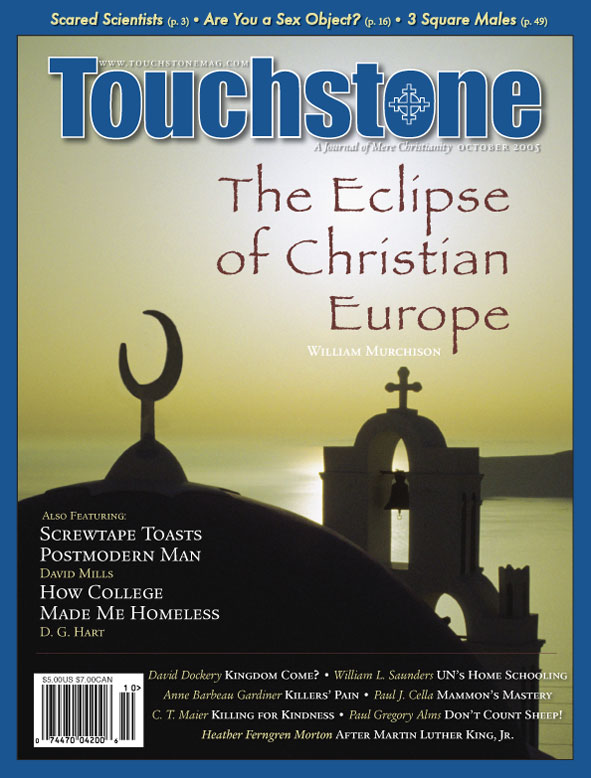
Vanishing Sea of Faith by William Murchison
Vanishing Sea of Faith
European Islam & the Doubtful Future of Christian Europe
by William Murchison
I know we know all this. We used to at least. I do confess to hearing in church
these days fewer rousing renditions of “Onward Christian Soldiers” than
during my 1950s adolescence. Well, you know, all that military stuff: soldiers,
mighty armies, not to mention “brothers” advertised as “treading” out
in front, certainly, of their sisters. Scandalous! Outmoded! In the minds of
the modern Christian establishment, anyway.
Which may be just the problem as the mighty army that once constituted Christianity
pulls up short before the awful sight of . . . indifference and apathy, or
perhaps cultivated hostility. The banners droop. Looks of puzzlement cross
earnest faces. No one . . . cares anymore?
What could that mean? Nothing good, that’s for sure.
Christianity Unwanted
The plight of Christianity in Europe, if not yet in America, has become the
topic of the moment in religious as well as secular circles, and the modern
Christian establishment professes bewilderment. What goes on? No one wants
the product the churches profess to be selling? In statistical, as well as
anecdotal terms, that would appear to be the case. Consider:
• Just 21 percent of Europeans (according to a recent European Values
Study) call religion of any kind “very important.” Only 15 percent
worship even once a week.
• On average, only 41 percent of Europeans claim belief in a personal
God. In Britain the percentage of believers has fallen from 77 percent in 1968
to 44 percent today. That’s “believers,” as opposed to the
distinctly smaller class of believer-practitioners who on Sundays put their
posteriors where their minds are. The number of Muslims at Friday prayers in
Britain reportedly exceeds the number of Anglicans at Sunday worship. A recent Wall
Street Journal article referred to Tony Blair as “the Christian
leader of a pagan country.”
• In Ireland—Ireland!—just half the population reportedly
goes to Mass now, compared with 84 percent in the early 1990s. To quote one
bored boyo, a web designer by trade, “It’s the repetition. After
you’ve heard it enough, you feel like you already know what they’re
going to say, so why do you have to go there?” Yes, why, Brendan, Brigid,
Patrick?—the whole lot of you who saw participation in Christ’s
sacrifice as the holiest of privileges.
• The European Union in 2004 notoriously declined entreaties from religious
leaders to include in its 70,000-word constitution some acknowledgement of
the continent’s Christian heritage.
• Spain’s socialist government—Spain’s!—legitimized
same-sex “marriages.”
• The papal biographer George Weigel, who has lately written a deft
little book on the subject, The Cube and the Cathedral, sees
a continent gripped by “metaphysical boredom,” its high culture
actually “Christophobic” in content. “European man,” Weigel
asserts, “has convinced himself that in order to be modern and free,
he must be radically secular.”
• The new pope, Benedict XVI, previously Joseph Cardinal Ratzinger,
who inherits the job of addressing all this confusion of purpose, would surely
agree with Weigel’s analysis. Benedict views as “total profanity” the “ideological
secularism” that is seemingly now Europe’s overarching creed.
Milton, thou shouldst be living at this hour! And maybe, for good measure,
Luther, Calvin, Augustine, Aquinas, and C. S. Lewis. Not excluding Hilaire
Belloc, who at the end of World War I saw all this coming: the “dissolution
of standards,” the “melting of the spiritual framework.”
In Europe and the Faith, Belloc wrote glumly of how “authority,
the very principle of life, loses its meaning, and this awful edifice of civilization
which we have inherited . . . trembles and threatens to crash down.” Then
the closing, well-remembered grace note: “Europe will return to the Faith,
or she will perish. The Faith is Europe. And Europe is the Faith.”
Crescent Europe
Read a certain way, Belloc’s warning calms and soothes. All this was
85 years ago—eight and a half decades. Nor did the Faith, in this time
span, really recede from view. Maybe it won’t now.
You could put the matter that way, yes. Yet spinning will not conceal European
Christianity’s undoubted perplexities and hardships. In recent decades
another perplexity has arisen: that of a large and increasingly aggressive
Muslim population, especially in France, Germany, Britain, and the Netherlands.
The July 7 outrages in London exploded literally in the face of a society
hoping, with fingers crossed, to accommodate Islamic culture, only to discover
that native-born adherents to that culture were unwilling to accommodate the
accommodationists. As the Daily Telegraph noted a week or so after
the bombings, “There is within the Muslim community in Britain a disaffected,
radicalised group of young men who listen, almost daily, to rabble-rousers
preaching the message of holy war.”
The historically minded—excluding a large number of public education’s
most recent products—will recall how relatively few years it has been
since Muslim armies and navies were trying to bring Christian Europe under
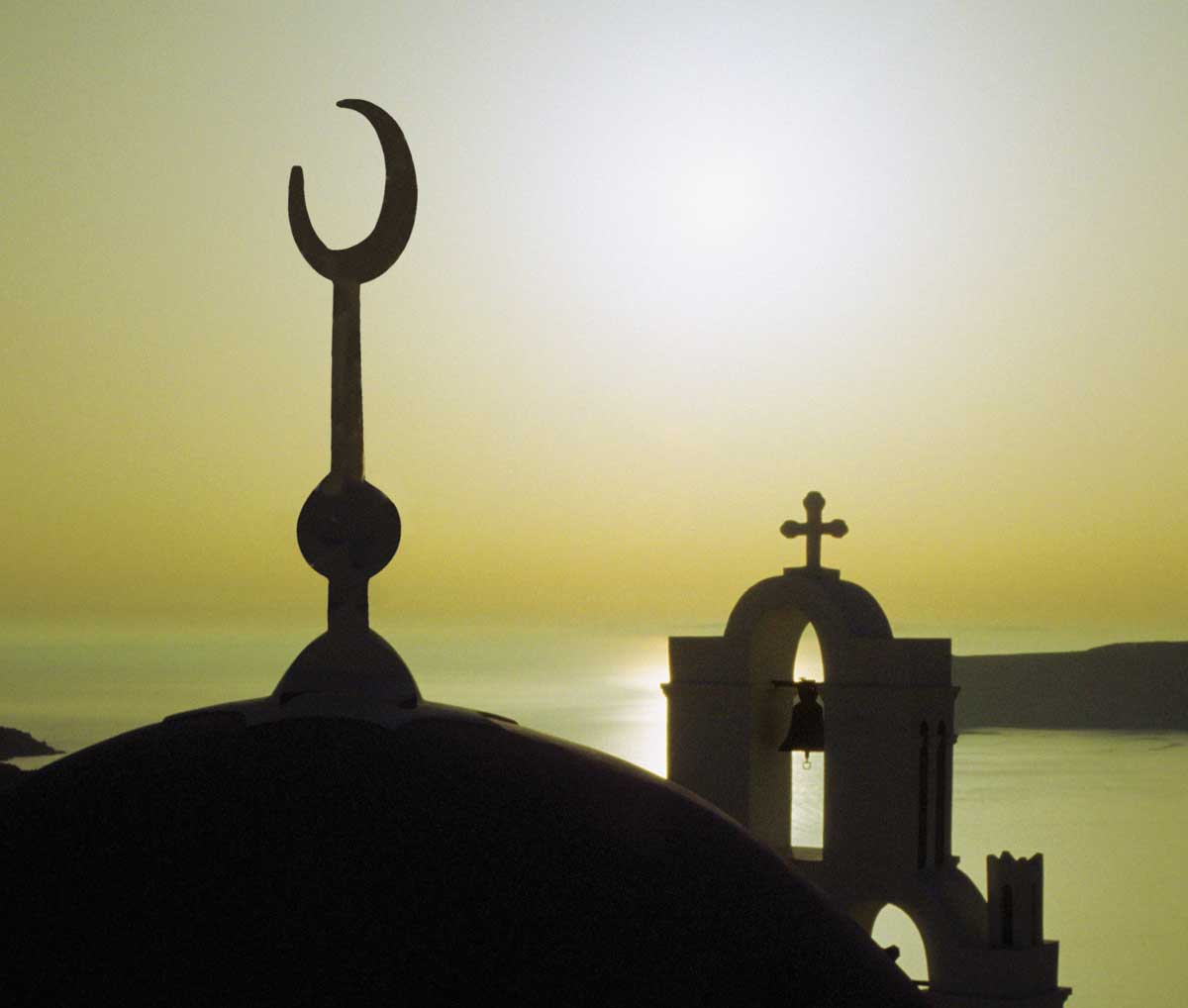
the star and crescent. What repelled them, at Lepanto and at the outskirts
of Vienna? Military might, marshaled by the conviction that Europe, being Christian,
had to remain so. There was something then to fight for.
What is there now? The European constitution, with its silence concerning
the Faith? The 35-hour workweek? Pensions? Soccer? Rock concerts? Homosexual “marriage” and
all those alternative sexual practices unavailable (at least in public) in
Islamic countries?
Yes, and what happens when Muslim immigrants refuse secular identity with
their new homelands? When, for instance, as happened recently, a Dutch Muslim
murders in broad daylight a prominent, indeed obstreperous, critic of Islam?
The Muslim who sees himself as a Muslim first and a Dutchman second or third
or fourth—to the extent he sees himself as affiliated in any urgent way
with a secular nation and people—is clearly not playing by the secular
rules of secular Europe.
Those rules specify tolerance for diverse viewpoints as crucial to modern
citizenship. The secular European easily accedes to this viewpoint. Not so
the newcomer who asserts the hard, burning faith of the desert in preference
to the kind thoughts and good wishes of the housing development.
Drawing on the fate of Byzantium nearly 700 years ago, Weigel proposes in The
Cube and the Cathedral the once-unimaginable scenario of a Europe overwhelmed
by its ancient adversaries: “The muezzin summons the faithful to prayer
from the central loggia of St. Peter’s in Rome, while Notre-Dame has
been transformed into Hagia Sophia on the Seine—a great Christian church
become an Islamic museum.”
Hmmm, that might finally get Jacques Chirac’s attention—not least
on account of the probable effects on American tourism. (How many Methodists
from Gopher Prairie want to visit a mosque?) I think, though, that what gives
Weigel’s scenario most of its power is contextual—as no doubt he
intended. What indeed would it mean for Notre-Dame to become Hagia Sophia on
the Seine? The victory of Mohammed over Christ is what it would mean; the Incarnate
Son of God displaced by the desert seer with the multiple wives.
Swept Away
That should give us pause. Centuries of Christian belief swept away in a great
cosmic sorting-out; history stood on its head. A wispy fantasy after all, these
tales of a holy man with power to transform loaves and fishes; a faith worthy
in intention but empty inside. No God-Man, then; no worshipful wise men or
empty tomb, no Holy Ghost, no forgiveness of sins, no coming again in glory;
only the wind from the desert penetrating the deepest places of consciousness,
sweeping away—never to return—the delusions and distractions of
2,000 years. Gone, all gone!
The death of the old pope and the ascent of a new one invite us to think on
these things in ways we may not have for a long time. I want, in response,
to pose two questions: (1) Why? and (2) What then?
“Why?” is the tough one. If Europe is the Faith and the Faith
is Europe, this thing—this ongoing eclipse of Christianity in Europe—shouldn’t
be possible. Except that we look the thing right in the eye and glimpse its
painful possibilities. Hagia Sophia on the Seine. Why?
“Why not?” is one way of answering. If you don’t believe
a thing is true, or vital, or relevant, in due course you quit acting as though
you did, notwithstanding any sentimental attachment you might have to the outward
forms and symbols of the old belief structure. Soon enough, when it becomes
plain that the Texas Rangers and the World Series may forever remain strangers,
you adjust your expectations. You look elsewhere for satisfaction. Europe has
long been looking elsewhere for the satisfactions Christianity once supplied.
What do we suppose has been going on there anyway these past couple of centuries—a
heart-clutching, hand-clapping revival of Wesleyan proportions? Not a bit of
it. What’s been going on is Marxism, Freudianism, and Darwinism. The
three dominant intellectual movements of the past two centuries, far from reinforcing
Christianity, have pitied, confronted, or persecuted it—in the name of
Man: his itches, his intuitions, his lusts.
Nothing—nothing whatever—happens overnight. Historical processes
take time. Don’t we recall Matthew Arnold’s mid-Victorian account
of the Sea of Faith and its “melancholy, long, withdrawing roar”?
Proper Victorianism, and the brilliance of Newman and his school, covered the
retreat for a while. On it went anyway, decade after decade: unarrestable by
the eloquence of Chesterton and Lewis or the simple piety of the royal family
(pre-Charles and Diana).
The Enlightenment of the eighteenth century, building on the disillusionments
and fractionations associated with watching Christians burn and hack apart
fellow Christians, itself declared war on l’infame (Voltaire’s
name for that which inspired Belloc). The French Revolution was one notable
consequence. Whenever the mullahs do take over Notre Dame, if they do, they
will discover there the tracks of the Goddess of Reason, to whom, in the person
of a dancer, the revolutionaries turned over symbolically the sacred old Christian
precincts. It has been that kind of era.
Dry-Rotted Europe
And it goes on. In 1871, French radicals shot or hacked to death numerous
clergy, including Paris’s archbishop.
During Spain’s civil war, 6,800 priests, monks, and nuns fell to firing
squads. The Bolsheviks and the Cheka were tougher still on the spokesmen for
Holy Russia. None of this quite qualifies as spirited affirmation of the Christian
creeds.
Weigel is right, I think, to note that the dry rot had set in before 1914—the “Nietzschean
will to power; a distorted sense of honor; intense nationalism compounded by
imperialism; the breakdown of the system of trust” on which diplomacy
relied. On and on. Then the second war, with its previously unexampled horrors,
with Christian Germany—the Germany of Bach and Luther (not to mention
the Ratzingers)—as principal perpetrator.
What does this do for Christian morale, so to call it, and for any inducements
Christianity might offer the unconverted?
Meantime, it seems necessary to advise against Americans’ giving themselves
pious airs. Ours is a culture that puts more trust in supernatural religion
than does Europe’s—but not that much more. On the way to church,
my wife and I sometimes joke about the comings and goings on the road: joggers,
bicyclists, the lounging crowds at Starbucks. Guess they’re getting a
quick refill for the ride to First Methodist, we might say with a wink, well
knowing the patrons to be occupied with latte and laptops rather than Bibles.
The legacy of the Enlightenment weighs upon us, as upon our European co-religionists:
religion as claptrap and show, churches and cathedrals as places you repair
not for physical and spiritual connection to Reality itself but for the satisfaction
of habits or social needs or goodness knows what else. Anyway, how to present
Christian realities in the context of a culture wedded to choice, change, and
the satisfaction of personal wants? The immediate satisfaction, I should add:
not deferred to some Better Time. Now. And preferably with as little pain and
inconvenience as possible.
Christianity—we should admit it—is un-modern. Or, rather, it is
modern in the sense that it encompasses all eras: past, present, and future.
What we might call the “modern spirit” is in fact detached from
the Christian spirit.
The Promise
And so we come to my second question: What then?
We don’t quite know the answer. We know the promise, nonetheless. It
is more bracing by far than anything we see around us. “The gates of
hell shall not prevail . . .”! “At the sign of triumph Satan’s
host doth flee . . .”!
All this needs looking at with vast seriousness, for two distinct yet closely
related reasons.
The first is a strong suggestion in the Lord’s words that what’s
wanted from the Church of God, in its relationship to the world, is stark clarity,
and a certain boldness. What kind of religious enterprise are a bunch of fishermen
likely to get going in the Greco-Roman world, lacking some confidence in the
ultimate triumph of Jesus Christ the Messiah over Jupiter and Apollo and Venus
and the whole marble-visaged crew positioned atop the physical and metaphysical
heights of that world?
Yes, where was this Christ business going? Couldn’t it cause trouble—such
as getting you nailed head-down to a cross or treated to other imperial inducements
to religious quietism? What was this, though? The gates of hell would not prevail
against you. You might just have a fighting chance. Indeed, given the authority
with which these memorable words were delivered—though the voice must
have been characteristically even in tone—you might have a sure thing.
Not painless—sure and certain (as the old Anglican burial service would
have it). That would make up for a great deal, it seems easy enough to say
with proper distance from all the uproar.
If anything could be said of the Church in the ensuing years and decades and
centuries, it was that the Church spoke and acted boldly—with divine
recklessness, even. Why? Because so it was commanded. The same Gospel that
relays to us the news of Peter’s commission moves the matter briskly
along, some chapters later: “Go ye therefore and teach all nations.”
What the Church said, essentially, over and over again, to whomever might
be listening, was: “You need this. Upon it depends everything.
Life, death, everything.” What came more naturally, in this event, than
invocations that have not even now lost the capacity to inspire? “Onward
Christian soldiers, marching as to war, with the Cross of Jesus, going on before.
. . .”
It is the kind of approach we have come to think of, in the twenty-first century,
as “intolerant” and “exclusivist.” Only a minor part
of the reason for Islam’s rise in Western Europe has to do with the large-scale
immigration of Algerians, Turks, and so on, and their subsequent non-amalgamation
into the general population. The larger point is that the Muslims who came
and began to populate the continent with their own kind found there a steadily
enlarging spiritual vacuum.
The cathedrals and churches were open for business, yes; but it was tourists
who more and more filled them, and not in a spirit of worship either. More
like a mood of dutiful curiosity. An increasingly secular Europe has for decades
seen Islam not as an oppositional force in cultural and spiritual terms, but,
rather, as one more mode of expression: all the more deserving of tolerance,
possibly, on account of onetime Christian proclivities for butting in with
the gospel, wherever and whenever.
Ecumenical Enemies
A Europe that saw Christianity as vital in the old terms might admit job-seeking
non-Christians to citizenship or residence. That same Europe, nonetheless,
would insist on the cultural predominance of Christianity: no heartfelt apologies
to non-Christians for the wide and intensive practice of Christianity at home.
If Christianity was true, why apologize?
To accord other faiths a status comparable to Christianity’s, you need
not only to esteem the ideal of tolerance; you need also to assume that no
religious faith makes more than ordinary sense—neither Christianity,
nor Islam, nor anything else. In this moral void, take your pick of salvational
instruments: the Way of the Cross, the Pillars of Islam, the Euro. Each to
his own: a high-minded way of saying, “Who cares, anyway?”
Not that supposedly acute European thinkers, like their American counterparts,
lack preferences of their own. These preferences normally turn out to be secular,
this-worldly, distrustful of notions rooted in long-past events in far-distant
countries: hegiras, virgin births, resurrections, and the like. Christians
and Muslims, for all their theoretical antagonism toward each other, have something
in common besides monotheism. Secularists don’t know what to do with
them.
When the Chirac government in France, seeking better integration of Muslims
into the larger community, prohibited students from wearing Islamic headscarves
to school, the government thought it necessary to prohibit at school the display
of all religious symbols, including the cross. It is worthy of remark that
on moral questions such as homosexual rights, a favorite concern of Western
secularists, Christians and non-Islamist Muslims sometimes occupy the same
moral ground, opposing secular attempts to override traditional moral understandings,
based as they are on the sovereign design of God.
A Cheering Alarm
The second, and final, point I would make regarding this gates-of-hell business
is withal more cheerful: not quite “What, me worry?”, but not particularly
distant from that sentiment either. We find in Christ’s words a rather
alarming promise—alarming to adversaries of the Faith.
It is that nothing they can do will polish off his church. Nothing. That would
include, I imagine, multi-cultural instruction in schools, prohibitions of
religious symbols, the extirpation of Christmas festivities on public property,
even the forced emptying of the churches themselves. Persecution, nakedness,
and the sword will likewise fail. Martin Luther turned the same perception
to account: “The prince of darkness grim, we tremble not for him . .
. For, lo, his doom is sure.” I think I am right in declaring this to
be the consistent witness of the Church, in all times, all places.
Now we know the impossibility of proving this expectation in terms gratifying
to secularists (as well as to some modernity-obsessed “Christians”).
But, then, no one can “prove” in secular terms any of the other
claims of the Christian faith: baptism for the remission of sins, the resurrection
of the dead, the life of the world to come.
If the pledge to Peter, the pledge of the Faith’s unconquerability,
has lost resonance, it might be time to plan one last journey to Paris, for
one last lingering look at Notre-Dame’s Rose Window, innocent yet of
Koranic curlicues.
And if, on the other hand, all is true—as promised at the start; as
lived for, fought for, died for during centuries of struggle and splendor—why,
one then might just ask, with a certain insouciance, what’s the problem
here anyway?
William Murchison , of Dallas, Texas, is a syndicated columnist and writer. His book on the tribulations of twentieth-century mainstream Christianity—with an emphasis on the Episcopal Church—will be published in late fall 2008 by Encounter Books. |