





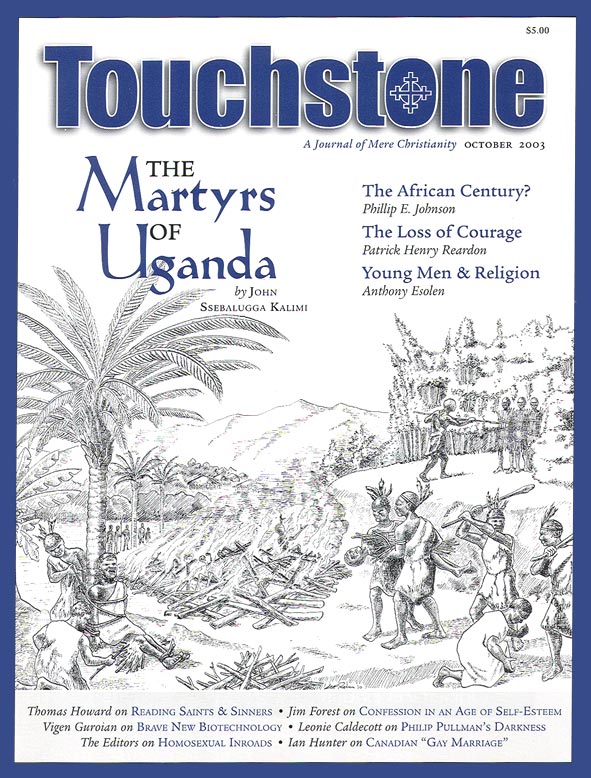
Canadian Infidelity
Ian Hunter on Courts, Churches & “Gay Marriage”
For what is probably a minority within a minority—homosexuals who want to enter a traditional marriage—the recent unanimous decision of the Ontario Court of Appeal in Halpern et al. v. A. G. of Canada is good news. The court held the existing definition of marriage as a lifelong union of a man and a woman to be contrary to the Canadian Charter of Rights and Freedoms. Henceforth, marriage means the union of any two “persons”—but why only persons and why only two is left unclear. Whether this result is good news for Canada, we shall all wait and see: The court has spoken; we, its vassals, obey.
The decision is also good news for those Canadians fed up with democracy. After all, the political process is lengthy and frustrating. It is hard to persuade one’s fellow citizens, and the resulting political compromises are maddening. How much quicker, how much nicer, to have anonymous judges answer the great existential question: How shall we then live? It saves time, debate, and especially thought.
THIS ARTICLE ONLY AVAILABLE TO SUBSCRIBERS.
FOR QUICK ACCESS:
Ian Hunter is Professor Emeritus in the Faculty of Law at the University of Western Ontario. He is the author of biographies of Robert Burns, Hesketh Pearson, and Malcolm Muggeridge.
subscription options
Order
Print/Online Subscription

Get six issues (one year) of Touchstone PLUS full online access including pdf downloads for only $39.95. That's only $3.34 per month!
Order
Online Only
Subscription

Get a one-year full-access subscription to the Touchstone online archives for only $19.95. That's only $1.66 per month!
bulk subscriptions
Order Touchstone subscriptions in bulk and save $10 per sub! Each subscription includes 6 issues of Touchstone plus full online access to touchstonemag.com—including archives, videos, and pdf downloads of recent issues for only $29.95 each! Great for churches or study groups.
Transactions will be processed on a secure server.
more on marriage from the online archives


28.1—January/February 2015
on State Impositions & Church Acquiescence by Stephen Baskerville

32.1—January/February 2019
Divine Love & the Love of Man & Woman Surpass Mere Consent by Anthony Esolen
more from the online archives

33.3—May/June 2020
on the Wisdom of the Good Doctor Edmund Pellegrino by Allen H. Roberts II

32.2—March/April 2019
Finding Him Again Through the Patriarchal Group by Anthony Esolen
31.4—July/August 2018
on the Brevity & Theology of Her Recorded Words by Judith Anderson
calling all readers
Please Donate
"There are magazines worth reading but few worth saving . . . Touchstone is just such a magazine."
—Alice von Hildebrand
"Here we do not concede one square millimeter of territory to falsehood, folly, contemporary sentimentality, or fashion. We speak the truth, and let God be our judge. . . . Touchstone is the one committedly Christian conservative journal."
—Anthony Esolen, Touchstone senior editor
