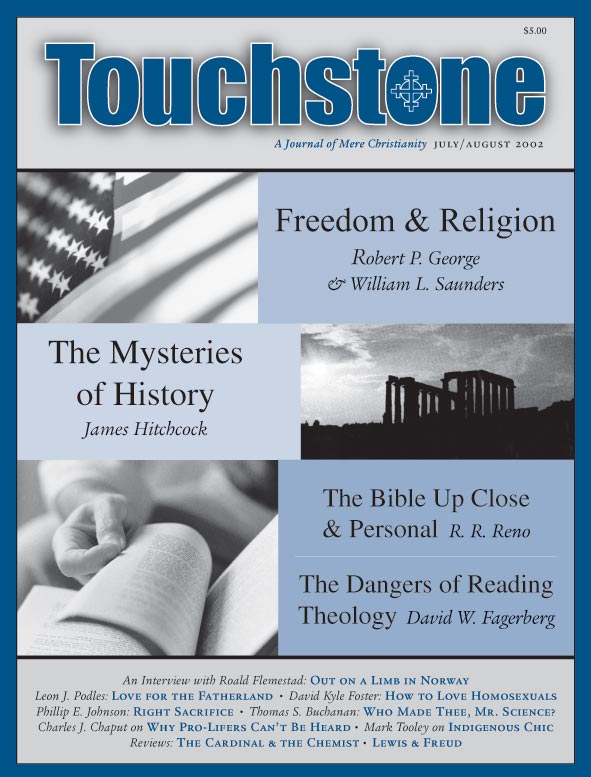
The Cardinal & the Chemist by Joseph Kroger
The Cardinal & the Chemist
Personal Catholicism: The Theological Epistemologies of John Henry Newman
and Michael Polanyi
by Martin X. Moleski, S.J.
Washington, D.C.: The Catholic University of America Press, 2000
(222 pages; $54.95, cloth)
reviewed by Joseph Kroger
Part of the cultural legacy of the scientific age in which we live is the widespread
assumption that doubt, uncertainty, and tentativeness are cognitive ideals,
whereas belief, certainty, and commitment are to be looked upon with suspicion.
Since knowledge is commonly thought to be limited to what can be clearly specified
and objectively demonstrated, it is considered intellectually irresponsible
to hold any belief or give assent to any truth without being able to provide
clear and explicit grounds for doing so. Such is the morality of knowledge in
a world governed by the ideals of critical reason.
Martin Moleski’s Personal Catholicism examines and compares
the work of two unlikely and unacquainted allies in the development of an alternative
“post-critical” view of what it means to be rational and responsible
in the world today, a view that directly challenges contemporary epistemological
assumptions of distrust, objectivity, and detachment. John Henry Newman (1801–1890),
a convert to Evangelical Christianity, then an Anglican priest, and eventually
a Roman Catholic cardinal, characterized his life’s work as a confrontation
with “religious liberalism” or the idea that there is no positive
truth in religion. Michael Polanyi (1891–1976) was born in Hungary the
year after Newman died and pursued a career in medicine, physical chemistry,
and economics before turning to philosophy to resolve issues regarding the nature
and justification of science in a free society. Polanyi converted from Judaism
to Catholicism and was later drawn to Protestant thought (specifically that
of Paul Tillich), but unlike Newman, he was not personally religious in any
traditional sense.
What Newman and Polanyi did have in common, however, as Moleski’s work
makes abundantly clear, was the countercultural conviction that the path to
reliable knowledge is not rooted in doubt or based on explicit premises, but
proceeds rather from fiduciary commitments and vague apprehensions. Both Newman
and Polanyi were unconvinced by the modern form of rationalism that seemed almost
irresistible to most of their contemporaries. For that reason, each remained
to a certain extent an “outsider” to the dominant intellectual traditions
of their day. Both men began by reacting to the damaging effects of the ideal
of technical/instrumental reason on their own specific disciplines (theology
and natural science) and ended with nothing less than a radical challenge to
the paradigm of rationality itself. They saw, in Moleski’s words, that
rationality is “greater than logic” and gave persuasive descriptions
of the informal operations of the mind that lead from tacit assumptions to true
and certain judgments.
The Illative Sense & Tacit Knowledge
Moleski’s book is divided into four major parts. The first two chapters
are basically expository and present chapter-by-chapter summaries, first of
Newman’s Grammar of Assent and then Polanyi’s Personal
Knowledge. The third chapter compares Newman’s notion of the “illative
sense” with Polanyi’s idea of “tacit knowledge,” the
key terms each use to characterize the foundation and the process of rational
thought. The fourth chapter discusses what Moleski sees as the significant implications
of these converging post-critical perspectives for understanding religion and
theology.
Newman developed his notion of the illative sense in his major epistemological
essay, Grammar of Assent. For Newman, the illative sense meant the
power by which the mind generates and evaluates inferences. (The terms illative
and inference derive from different forms of the same Latin verb that
means “to carry.”) Moleski locates Grammar of Assent in its
biographical context and clarifies its purpose and structure. He then traces
the line of argument whereby Newman accounts for the capacity and the legitimacy
of holding beliefs to be true even though they can be neither fully understood
nor explicitly proven.
While the title of Newman’s essay suggests that he will provide “rules”
for the formation of judgment, Moleski shows that his purpose was precisely
the opposite. There are no explicit methods or recipes for the mind to follow
mechanically in its pursuit of truth. Rather, intelligence is guided towards
the act of assent by an anticipatory and informal illative sense, which operates
in a deeply personal way, beyond any technical rules. Thus, Newman argues against
the attempt to formalize the conditions of legitimate assent. There can be no
higher certitude than that given by the illative sense itself, and for this
reason, all judgments are ultimately acts for which we must take personal responsibility.
In his theory of tacit knowledge, Polanyi provides a similar account of reason
and responsibility. Moleski again begins by providing a biographical context
for Polanyi’s major text and then explains its purpose and structure.
Personal Knowledge is a long and philosophically challenging work,
and Moleski’s methodical chapter-by-chapter summary is helpful in focusing
on Polanyi’s central thesis that all knowledge is personal because all
knowledge is either tacit or rooted in tacit knowledge. Polanyi sees knowing
as an art, and like Newman, he attends to the role of intellectual passions
and creative imagination in leading the mind forward in the pursuit of truth.
He argues that behind all the formal methods and specifiable procedures of scientific
inquiry lie the informal and tacit operations of the scientist’s own mind.
Explicit logical processes are effective only as tools, and the rational application
of such tools is always a personal performance, an act of ultimate self-reliance.
Polanyi’s goal is to describe and account for that personal performance.
Moleski argues that what Newman calls the illative sense and Polanyi tacit
knowledge are basically the same thing. Both are describing the irreducible
and transcendental operations of intelligence, although, according to Moleski,
Newman was focused more on the capacity of the mind and Polanyi was
more concerned with the outcome of that potency. Still, as Moleski
reveals, the similarities of their respective conceptualities and intentions
are quite remarkable despite obvious differences in context and terminology.
In addition to arguing for the basic identity of the illative sense and tacit
knowledge, Moleski notes the intersection of other aspects of these ways of
knowing: the role of conscience in the formation of judgment, the personal character
of intellectual commitment, and the idea of knowing as an act of “comprehension”
(or assembling potentially meaningful parts to form an actually meaningful whole).
Moleski also points out the similarity of Newman’s and Polanyi’s
self-reflective methodologies. Neither attempts a formal proof or explicit demonstration
of the operations of intelligence, but rather, each invites the reader to consider
his own experience and to reflect upon his own intellectual performance in order
to discover for himself the irreducibly personal character of knowledge.
Convergence & Disjunction
While Moleski’s stated aim is to show the convergence of Newman’s
and Polanyi’s fundamental insights into the tacit and personal dimension
of human judgment, he does not seek a facile harmonization of their conceptual
schemes or gloss over their differences. This becomes especially clear in the
fourth chapter, where he shows how these two authors arrive at very different
theological positions despite their similar cognitional theories. While both
Newman and Polanyi allow for an apprehension of the reality of God by an illative
sense or tacit powers of thought, for Newman, faith and revelation are directly
related to propositional truth claims in theology. For Polanyi, despite his
use of religious imagery, they are not; and the reality of God remains in the
realm of the mystical and inexpressible.
It is only in his brief conclusion that I would take issue with the author’s
view of Newman’s and Polanyi’s theological significance. Moleski
seems to emphasize the disjunction of religious faith and theological reflection,
contrasting two (almost unrelated) forms of knowledge and equating the illative
sense and tacit knowledge only with the former. The result is not only to privilege
faith as a tacit way of “knowing more than we can say,” but also
to suggest that the language of theology is incapable of expressing the reality
apprehended by faith. In Moleski’s own words, “the God that can
be put into words is not the real God” (182).
It seems to me, however, that the illative sense and tacit knowledge help
to explain not inarticulate “faith-awareness” in contrast
to articulate “theological doctrine,” but the reasoning process
that moves from the former to the latter. To put this point in classic Augustinian
terms of “fides quarens intellectum,” Newman’s illative
sense and Polanyi’s tacit knowledge account neither for the fides
(religious faith) nor for the intellectum (theological doctrine), but
rather describe the quarens, the practice of inquiry itself.
In other words, the significance of Newman and Polanyi, I believe, is found
not so much in what they tell us about implicit or inarticulate faith knowledge
in contrast to the explicit propositions of theology, but in how they
describe the practice of intelligent reasoning (not only in theology but in
any scientific field), that is, as a practice that begins with a faith commitment
and culminates in articulate propositions or truth claims. This is a minor and
somewhat technical point in light of Moleski’s overall project, however,
and does not diminish the important contribution he has made in focusing attention
on two philosophers whose cognitional theories have radically recast notions
of objectivity and subjectivity, tradition and innovation, and faith and reason
in a way that helps resolve many of the unhealthy tensions afflicting modern
forms of fideism and rationalism in Christian theology today.
Joseph Kroger is Professor of Philosophy of Religion
and Theology in the Department of Religious Studies at St. Michael’s College
in Colchester, Vermont. He is a longtime member of the Polanyi Society and has
published articles on Polanyi in Philosophy Today, The Journal of Religion,
and Tradition & Discovery (the Polanyi Society periodical).
|