




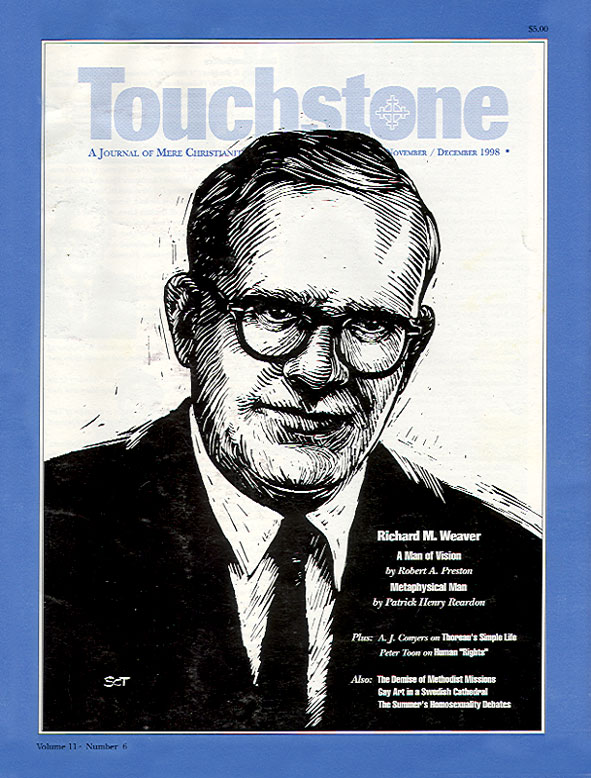
Metaphysical Man
Philosophy, Language & Richard Weaver
by Patrick Henry Reardon
In the spring of this year upwards of a hundred philosophers, jurists, literary artists, journalists, and scholars joined together at Belmont Abbey College in North Carolina to celebrate the fiftieth anniversary of Richard Weaver’s Ideas Have Consequences, the important little book that so convincingly chronicled the many moral and social evils attendant on the Western mind’s loss of metaphysics: radical materialism, the dominance of quantity over quality, greed and avarice, fragmentation and obsession, egotism in work and art, the abdication of hierarchical structure, sensuality, acquisitive violence, the quest for power, radical subjectivity and selfishness, the loss of piety and justice, the corrosion of friendship, the replacement of religion by education, and then the replacement of education by mere training. All of this in one little volume and convincingly argued.
Weaver placed the blame for the present cultural crisis of the West at the doorstep of Ockham’s nominalism at the beginning of the fourteenth century. It was to that late, indeed rather recent, season in the history of thought that he traced the modern discomfort with, and distrust of, the world of spiritual intuition and transcendence.
From Ockham on, thinkers began to conclude that thoughts of transcendence were simply the products, perhaps even by-products, of the human mind itself. Universal concepts were not, in a strict sense, real. Moreover, the nominalists’ denial that the mind was capable of knowing anything real above itself was bound to lead in due course to the dissolution of metaphysics and everything else to which metaphysics gives rise, including the prescriptive authority of inherited language, the anchoring of moral imagination, and the final validation of law.
Nominalism also produced modern materialism. Nothing so turned Western man’s thoughts back to the things of earth than this sudden persuasion of his being unable to grasp anything higher. The denial of man’s ability to perceive transcendent, intellectual realities above himself guaranteed that the Western mind would thenceforth turn ever more completely toward the only reality that remained, physical reality, the world of matter. It was to Ockham’s new movement, Weaver argued, that we correctly ascribe most of the credit for Western man’s growing determination to look at matter in a completely materialistic way. Matter comes to represent the sum total of all that can be known, and also the only means by which it can be known. Nothing, it is now concluded, is knowable except matter.
The Abdication of Intellect
Once that intuition of transcendent realities—the very essence of metaphysics—was dismissed as the root of all intelligibility, the human mind was left holding only two things, and these two things gradually became the major concerns of intellectual formation: the material data inducted through the bodily senses, and the laws of logical process by which it gave shape to this material data. Henceforth, then, empirical induction (positivism) and rational synthesis would be the proper activity of the mind. Concentration on the first would lead to the criterion of truth as purely semantic correspondence, a view associated with the name Bertrand Russell in more recent times. Concentration on logical structure would lead to the criterion of truth as internal coherence, a view associated with thinkers as diverse as Descartes and Hegel. Combined simply as the mathematical study of the material world, these two preoccupations found their champions in Thomas Hobbes and more recently in the logical positivists.
What was lost in all this development was the classical notion of intellectus, the nous, as the highest, or deepest, region of the soul and the supreme, truly defining faculty of the human being. This intellectus, if one followed the line of thought laid down by nominalism, was now illusory.
Classical Christian anthropology and ascetical doctrine always maintained that the nous or intellectus, when purified by divine grace, repentance and the ascetical life, is that faculty through which man knows God. Moreover, it is through the nous that man apprehends, by “simple cognition” (a term of Saint Isaac of Nineveh), the inner principles of created things. This direct grasp of incorruptible truth, this spiritual perception of permanent and immaterial reality, is the highest act of the human soul. By it, spiritual forms are discerned in a direct and immediate manner (immediate in the sense of not mediated by a syllogism or other inferential process). This intuitive grasp of universals, transcendent forms, is what is meant by metaphysics. Metaphysics was understood as true knowledge (jnana, gnosis) and vision (veda, visio).
Consequently, the nous is the faculty that man must use every effort to purify of all selfishness and mendacity. In doing so, he becomes the “noetic man,” the man of intellect. When Saint Diodoch of Photiki said that “we share in the image of God by virtue of the intellectual activity of the soul,” he did not mean the mental trifles that preoccupied Descartes, much less Bertrand Russell. He was referring to “the very depths of the soul—that is to say, in the intellect.”
Patrick Henry Reardon is pastor emeritus of All Saints Antiochian Orthodox Church in Chicago, Illinois, and the author of numerous books, including, most recently, Out of Step with God: Orthodox Christian Reflections on the Book of Numbers (Ancient Faith Publishing, 2019).
A Journal of Mere Christianity—Delivered to Your Door
- Essays on theology, culture, and the Church
- Contributors from across the Christian traditions

Six print issues (one year) of Touchstone, plus full online access and PDF downloads for only $39.95.

Get a one-year full-access subscription to the Touchstone online archives for only $19.95.
bulk subscriptions
Order Touchstone subscriptions in bulk and save $10 per sub! Each subscription includes 6 issues of Touchstone plus full online access to touchstonemag.com—including archives, videos, and pdf downloads of recent issues for only $29.95 each! Great for churches or study groups.
Transactions will be processed on a secure server.
more from the online archives

31.6—November/December 2018
on the Church's Response to the Anti-marriage Tide by Diane Woerner

36.4—Jul/Aug 2023
Our Political Void & the Disintegration of Truth by Michael Hanby

8.4—Fall 1995
The Demise of Biblical Preaching
Distortions of the Gospel and its Recovery by Donald G. Bloesch
calling all readers
Please Donate
"There are magazines worth reading but few worth saving . . . Touchstone is just such a magazine."
—Alice von Hildebrand
"Here we do not concede one square millimeter of territory to falsehood, folly, contemporary sentimentality, or fashion. We speak the truth, and let God be our judge. . . . Touchstone is the one committedly Christian conservative journal."
—Anthony Esolen, Touchstone senior editor
