





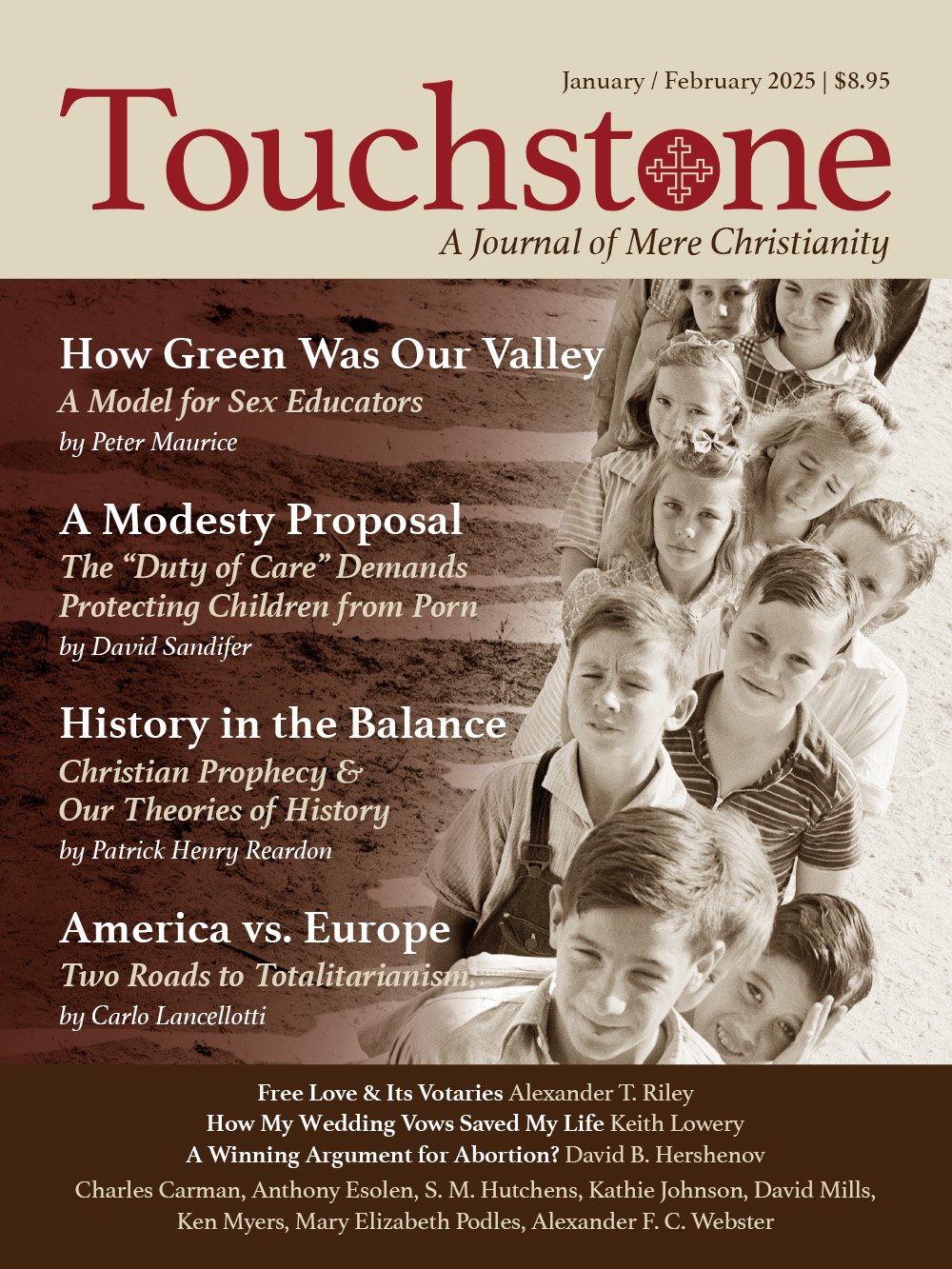
How Green Was Our Valley
A Model for Sex Educators
Adults with a penchant for talking to children about the intimate relations of man and woman, let alone man and man, used to risk ostracism if not incarceration. But such talk has become a required “subject” in public schools.
And now, in most parochial schools. Without the excuse of a government mandate, they’ve done this themselves. In New Creation, the most popular sex-ed series in parochial schools, first-graders are taught that a boy has a penis between his legs, a girl a vulva; teachers help them retain this lesson with drawings. Fourth-graders learn the mechanics of sexual intercourse, enlivened by “appropriate” illustrations. In sixth grade, they learn about “spurts” called “ejaculations.” By eighth grade, boys “chart” the times and frequency of their erections, while girls note the “wettest feelings of the day.” Unfortunately, these examples typify rather than magnify the grossness of these programs. If they differ from their public-school models, it is in pro forma references to Jesus and Mary, and “God’s plan” for sexuality.
Dietrich von Hildebrand, echoing unanimous papal encyclicals and decrees up until the dawn of the present century, condemned the perversion of non-parental sex education. Premature knowledge would damage “the holy bashfulness of children.” How mystifying such a phrase would be to a modern sex educationist. Perhaps the philosopher was ignorant of Freud’s discovery: even from infancy, it’s all about sex.
Before woke psychology invented the child’s right to know everything, various myths were deployed in deference to what the folk perceived—like von Hildebrand—as childhood innocence. In Germany, “Der Kindlbringer,” a merry old gentleman much like Santa, transported the new baby in a sack. Water sprites, in some Nordic lands, carried the newborn to expectant parents (invariably a man and a woman). Across much of Europe, a variety of furry or feathered creatures performed this service. In America, despite some local variations, the stork was the deliverer par excellence.
A Model of Delicacy
There comes a time, however, when a child will no longer be put off with charming fables. Christian societies, until yesterday, then entrusted the transmission of the mystery of birth and sex to those who knew and loved the child best—the parents, or their designee.
Richard Llewellyn’s How Green Was My Valley offers a fine model (definition for sex educators: something to copy, to imitate) of the delicacy with which this could be done. Huw, the novel’s first-person narrator, is the youngest son in a family of Welsh miners. One evening, after overhearing the men use a bawdy reference, the boy asks his older brother to elucidate. Elder brother is brusquely evasive. Huw is too young to be asking such questions. Huw’s sister-in-law, Bronwen, likewise refuses to satisfy his curiosity, but sensing the burgeoning sexuality in the boy and the urgency of his need, she assigns the task to a trusted minister and family intimate, Mr. Gruffydd.
When Huw turns to him, the minister isn’t, in the mode of the modern sexpert, avid. He performs dutifully, abjuring the “wares peddled in the thoroughfares” of the co-ed classroom. He tailors his “lesson” for the unique soul of one sensitive young boy, a future husband and father, a transmitter in his turn, of this God-ordained role so vital to a Christian civilization. His approach might be called—in the cant phrase of the professional educator—“individualized instruction.”
Mr. Gruffydd leads the boy from what he already knows—the Genesis story of Adam and Eve—to what he might infer, mainly through Socratic questioning. The dialogue takes a subtly developed eight pages in Llewellyn’s novel. Though worth quoting in its entirety, we’ll make do with a sample:
“Now as to the union,” Mr. Gruffydd said, in another voice, as he would point the difference between two pieces of wood. “You have heard of the seed of man, Huw?”
“Yes, sir,” I said.
Peter Maurice is a retired teacher of French, English, and humanities, at all levels from elementary through university. He is the recipient of several fellowships from the National Endowment for the Humanities. His writing has appeared in The Wanderer, Chronicles, Touchstone, Crisis, New Oxford Review, and Gilbert magazines.
A Journal of Mere Christianity—Delivered to Your Door
- Essays on theology, culture, and the Church
- Contributors from across the Christian traditions
Subscribe (Print + Online) 
Six print issues (one year) of Touchstone, plus full online access and PDF downloads for only $39.95.
Subscribe (Online Only) 
Get a one-year full-access subscription to the Touchstone online archives for only $19.95.
bulk subscriptions
Order Touchstone subscriptions in bulk and save $10 per sub! Each subscription includes 6 issues of Touchstone plus full online access to touchstonemag.com—including archives, videos, and pdf downloads of recent issues for only $29.95 each! Great for churches or study groups.
Transactions will be processed on a secure server.
more on education from the online archives

20.8—October 2007
The Deep & Abiding Biblical Roots of Western Liberal Education by David Lyle Jeffrey

more from the online archives

17.6—July/August 2004
Old Science Confronts a Formidable Challenge in the Scientific ID Movement by Jay W. Richards
32.2—March/April 2019
on Preserving Physical & Spiritual Nourishment by Nathanael Devlin
calling all readers
Please Donate
"There are magazines worth reading but few worth saving . . . Touchstone is just such a magazine."
—Alice von Hildebrand"Here we do not concede one square millimeter of territory to falsehood, folly, contemporary sentimentality, or fashion. We speak the truth, and let God be our judge. . . . Touchstone is the one committedly Christian conservative journal."
Support Touchstone
—Anthony Esolen, Touchstone senior editor
