





J. S. Bach’s Accompanists
The Church Culture That Made His Musical Genius Flourish
It is now three hundred years since J. S. Bach composed his church cantatas, and despite the secularization of the West, their cultural influence still lingers. Even non-Christians with only a modest interest in classical music are likely to recognize the tunes of “Jesu, Joy of Man’s Desiring”(Jesus bleibet meine Freude), “Sleepers, Awake!” (Wachet auf!), and “Sheep May Safely Graze” (Schafe können sicher weiden). Movements from his cantatas (or adaptations thereof) continue to furnish churches of many denominations with instrumental voluntaries, choral anthems, and vocal solos. The St. Matthew Passion and the St. John Passion, crown jewels of Bach’s cantata cycle, are among the greatest masterpieces of the Baroque era, and they enjoy hundreds of performances a year in cities across the globe. The chorales (hymns) from his cantatas remain the preeminent teaching model for harmony and counterpoint, and they still appear in many Christian hymnals today.
Because we breathe postmodern air, we are prone to assume that these exceptional pieces sprang solely from Bach’s genius and from no other source. Now there is no question that Bach was a singular genius, and his extraordinary intelligence and unparalleled musical talent were certainly prerequisites for the sacred music that he wrote. But we need to realize that Bach could never have written his cantatas—indeed, would never have thought to write them—without being born into a particular society and inheriting its worldview, its traditions, and its infrastructure. The cantatas, therefore, emerged from something that was much bigger than just one individual life or one set of savant abilities; they emerged from an entire culture. That culture was the soil in which Bach’s genius blossomed, the foundation upon which he erected an exceptional spire.
If the cantatas were merely the fruit of solitary genius, if they were a radical, individual project that ran contrary to the spirit of the times, then we might expect them to have been received with an intense reaction from Bach’s contemporaries: wild accolades, perhaps, or denunciations, or even bewilderment. But so far as the written record goes, Bach’s church music did not produce much comment at all. This is all the more striking when we consider that the cantatas are now classed among the greatest church music of all time, and that they were written by the composer now hailed as the cornerstone of Western classical music. As the conductor John Eliot Gardiner puts it, “One senses that a lot of the music that he performed here [in Leipzig] was pearls cast before swine, in the sense that there’s no record of anybody other than his students saying, ‘This was some of the most extraordinary music that we ever, ever have heard.’”
Pearls before swine . . . or pearls before other oysters, perhaps? Maybe Bach’s music did not attract attention because he was one of many church composers—a long tradition of composers, in fact—who were all working along similar lines and with similar creative goals. Whereas Bach wrote about 300 cantatas (of which 200 are extant), his colleague, Georg Philipp Telemann, wrote more than 1,000. Another contemporary, Christoph Graupner, produced over 1,400. Perhaps the Lutherans of Leipzig overlooked Bach, not because they were indifferent to church music, but because they took excellent church music for granted. His ambitions for a “well-regulated church music,” lofty by our standards, were not so salient in his own day.
Those of us who are keen to improve the state of church music in our own time, then, would do well to ask: what formed this culture in which Bach blossomed? If it was his soil, what were its ingredients? And how might we nurture a similarly vibrant culture for sacred music?
The Cantata in Its Setting
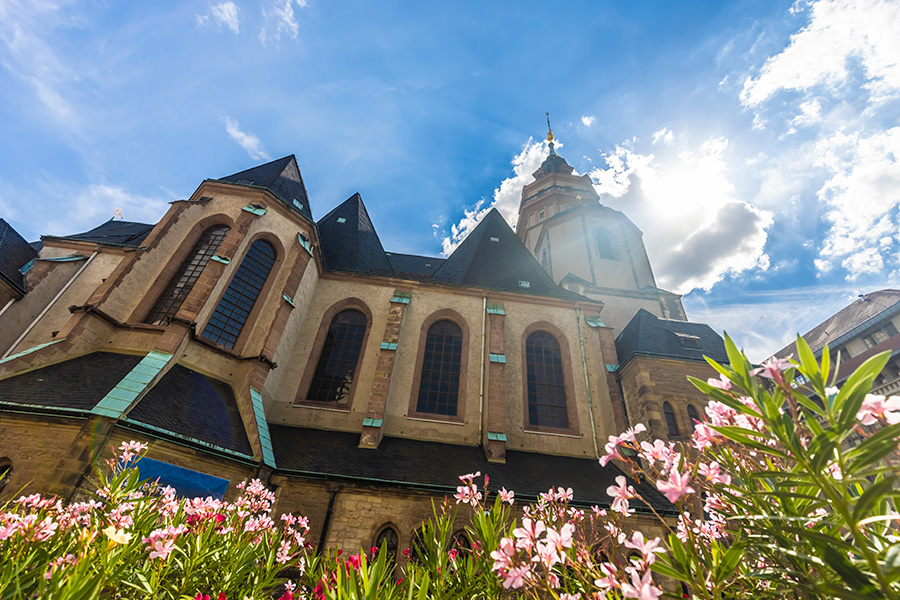
Before getting to that question, let’s review just what Bach’s cantatas were and how they functioned in their original setting. Bach wrote the bulk of his cantatas in the town of Leipzig, where they were a part of the regular Sunday Mass. From Sunday to Sunday, the performance of the cantata alternated between the town’s two main churches: the St. Thomas Church and the St. Nicholas Church. Each could seat 2,500 congregants, and on Sunday mornings, most pews were filled.
Even apart from the cantata, the service was replete with singing: the congregation sang at least five congregational hymns appointed for the day, and the choir sang all the musical ordinary of the service as well (the Kyrie, Gloria, Credo, Sanctus, and Agnus Dei). Just before the sermon (which was about an hour long) came the cantata, a special piece of music generally performed by a choir of (ideally) sixteen trained singers and a small orchestra of about twenty players. The congregation followed the performance by reading the words in a printed booklet.
The cantata was 20–30 minutes long, divided into several movements, and it elaborated upon the themes of that particular Sunday. The opening movement was usually an ornate, expansive setting of one of the hymns (or chorales, as they were called) for the day; it would employ the full musical forces of choir and orchestra. The middle movements, generally for solo singers and smaller instrumental accompaniment, might quote further stanzas from the chorale, or comment upon the text of the chorale in some way, or quote the appointed Scripture readings for that Sunday. For the closing movement, the choir sang one more stanza of the chorale, this time in a more straightforward musical setting.
That is an imposing amount of new music to perform on a weekly basis. And even without it, the church service in Leipzig could last three hours. So how did the German Lutherans in the early eighteenth century come to have such an enormous appetite for singing and hearing music in church?
Luther’s Zeal for Music
Well, for one thing, they inherited that enthusiasm from Martin Luther himself, who had lived two centuries earlier. Many readers will already know about Luther’s zeal for music-making: that he loved to sing, that he played several instruments, and that he authored both the words and the music of many hymns.
And Luther was no mere dilettante; beneath his music-making was a robust, multi-faceted understanding of music’s place in God’s creation. In 1538, he wrote a preface to the Symphoniae iucundae, a collection of motets compiled by Georg Rhau, and that preface gives us a good look at Luther’s conception of music. As his writing shows, he had inherited the rich medieval view of music; he does not describe music narrowly, as a mere human activity, but rather as a cosmic phenomenon that every one of God’s creatures—living or not—participates in:
First then, looking at music itself, you will find that from the beginning of the world it has been instilled and implanted in all creatures, individually and collectively. For nothing is without sound or sounding number. Even the air, which of itself is invisible and imperceptible to all our senses, and which, since it lacks both voice and speech, is the least musical of all things, becomes sonorous, audible, and comprehensible when it is set in motion.
From that sweeping cosmic panorama, Luther then moves in closer, discussing, first, the particular music-making of living creatures like birds and, finally, the music-making of mankind. His delight in this divine gift could hardly be exaggerated; “enthusiasm” is too mild a word for it. In his eyes, music is not merely pleasurable, but full of spiritual virtue:
[N]ext to the Word of God, music deserves the highest praise. . . . The Holy Ghost himself honors her as an instrument for his proper work when in his Holy Scriptures he asserts that through her his gifts (namely, the inclination to all virtues) were instilled in the prophets, as can be seen in Elisha [2 Kings 3:15]. On the other hand, she serves to cast out Satan, the instigator of all sins, as is shown in Saul, the king of Israel [1 Sam. 16:23].
In marked contrast to John Calvin’s practice in Geneva (which permitted only unison singing, unaccompanied by instruments), Luther exulted to hear harmony, polyphony, instruments, and intricate musical counterpoint in church. He exuberantly praised the polyphony of Josquin des Prez, and one wonders what raptures he might have reached if he had heard music of Bach, perhaps the greatest composer of counterpoint who ever lived. In that same preface to Symphoniae iucundae, Luther almost sounds as though he were anticipating the music of Bach:
Here it is most remarkable that one single voice continues to sing the tenor [melody], while at the same time many other voices play around it, exulting and adorning it in exuberant strains and, as it were, leading it forth in a divine dance, so that those who are the least bit moved know nothing more amazing in this world.
Fostering Musical Literacy
Luther matched his zeal for music with action. He tried to put the music of the church back into the mouths of the laypeople. Many of the German chorales which he wrote for congregational singing are, in fact, adaptations of ancient plainchant. Luther took the existing church chants, translated them from Latin into the German vernacular, and adapted the melodies to be more tuneful. He transformed the entire musical ordinary of the Mass into liturgical songs which the “man in the pew” could sing. To take but one example from among many, he adapted the Easter plainchant, Victimae paschali laudes, into the German chorale Christ lag in Todesbanden (“Christ Jesus Lay in Death’s Strong Bands”), which Bach would later use as the basis of one of his most ingenious cantatas.
In passing, we should lay to rest the notion that Luther pilfered from the tavern music of his day when writing hymns. I am not arguing categorically against baptizing secular music for church use; I merely note that Luther did no such thing. As Jeremy Begbie has observed:
Despite die-hard folklore, the well-known saying, “Why should the devil have all the best tunes?” cannot be traced to Luther. Of all the hymns we can attribute safely to him, only one is secular in origin, “Vom Himmel hoch,” an alteration of a popular song. But he wrote this for a children’s pageant, not church worship, and for church use he changed its original tune to one of his own. (Resounding Truth, 105)
Luther brought a great deal of music into the school curriculum of his day. Even students who were not musicians-in-training could expect to learn basic music literacy. As he said, “A schoolmaster must be able to sing; otherwise I won’t acknowledge him.” John Eliot Gardiner writes:
School staff were often expected to be proficient in music. In an updated version of the medieval trivium, music in Lutheran schools was considered an adjunct to the study of grammar, logic and rhetoric, while singing was valued as a proven way of helping pupils to commit things to memory. They were taught the practical rudiments of music—rules for clefs, rests and intervals, sight-reading and part-singing—mostly by singing in canon. (Music in the Castle of Heaven, 40)
Excellence Expected
As the musical topsoil of Lutheran Germany grew richer, its churches sprouted new musical forms, many of them imported from Italy: passions, oratorios, madrigals, organ voluntaries of every conceivable shape, and, of course, cantatas. Cantata-like pieces took root in Germany as early as the days of Hans Leo Hassler (1564–1612) and Heinrich Schütz (1585–1672), and these pieces grew more ornate and elaborate with each passing generation. Erdmann Neumeister (1671–1756), one of Bach’s contemporaries, was one of the first Germans to apply the term “cantata” (literally “sung”) to the sacred pieces he was writing in 1700. Because this musical form varied so much from one composer to the next, the only reliable common denominator among the many pieces called “cantatas” was that they all involved singing.
In contrast with our own times, the people of eighteenth-century Lutheran Germany took musical excellence for granted, both in church and out of it. Of the many ingredients in Bach’s cultural soil, this one may be the hardest for us to grasp, because we are so thoroughly steeped in our postmodern marinade. Every day we soak in assumptions that stifle the very possibility of excellence: the assumption that musical judgments are entirely a matter of subjective taste; that the ultimate benchmark for music is whether it gratifies us (regardless of how immature our musical perceptions may be); that music ought to resonate with us quickly and without much effort on our part; that music should tell us what we already know and already want to hear; that the individual, not the community or the artisan, is the more important judge of aesthetics.
This does not mean that every layperson in Leipzig was a musical expert. For instance, the members of the Leipzig town council who hired Bach do not seem to have realized what an exceptional candidate they had on their hands. Bach was not their first choice. They first wanted Georg Philipp Telemann, who had already distinguished himself as a composer in Leipzig while still a student. When they could not get Telemann, the council next tried for Christoph Graupner. When they had to settle for Bach, Mayor Abraham Platz remarked that “since the best could not be obtained, mediocre ones would have to be accepted.” In their discussion, the council did not remark on Bach’s trial performance at all, instead spending most of their deliberations on the question of whether Bach would be willing to teach certain classes at the St. Thomas School as part of his duties. Twenty-seven years later, when Bach died, the town council regarded its creation of the Kapellmeister position as a failed experiment and reverted to employing a mere Cantor with a smaller scope of musical duties.
Yet this is not so surprising. Few of us who are not trained sommeliers would be able to distinguish between a $30 bottle of wine and a $300 bottle. And J. S. Bach was surrounded by $30 bottles—a whole generation of composers who were talented, trained, hard-working, and prolific. This would explain why only a handful of students and professional musicians recognized Johann Sebastian for the genius that he was. Excellent composers abounded because the entire society assumed that music was a rigorous science, not a playground for self-expression. Even laypeople not trained as professional musicians would have been bemused by our prevailing assumption that there is no objective basis for evaluating music, only individual likes and dislikes.
More Key Ingredients
The people of Leipzig oriented their whole life around the Church and its calendar—not just Sundays, but weekday, “secular” life as well. The city closed its gates to wheeled traffic not only on Sundays but on holy days like the Feast of the Circumcision or the Feast of the Ascension as well. Festival bell peals announced such holidays to the whole city. No weddings or social banquets were permitted during the penitential seasons of Advent and Lent. Individual businesses conformed their schedules to the rhythm of Christ’s life: for instance, butchers in Leipzig closed their shops for half the day on Maundy Thursday. This alignment to Christ-time—society-wide and taken almost for granted—is undoubtedly another key ingredient in Bach’s soil.
Another was liturgical stability. Bach wrote five annual cycles of cantatas; that is, a cantata for every Sunday and every major feast day of the year for five years. The vast majority of them center around a chorale appointed for the day. Bach could only undertake such a project if he could assume that the church liturgy would not change drastically: that the lectionary readings, the chorale selections, the calendar observations, and the length of time permitted for the cantata would all remain consistent. Indeed, when one of the subdeacons at St. Nicholas Church tried to select different chorales from the ones Bach had scheduled—an innovation that threatened to wreck the whole cantata project—Bach appealed to the town council to uphold his prerogative of choosing the chorales.
The culture of eighteenth-century Lutheran Germany had another trait that made Bach’s corpus possible, and that was its financial commitment to church music. As many readers may already be aware, the funds in Leipzig never quite matched Bach’s own ambitions for his musical forces. He had trouble finding enough capable musicians to fill the places in his choir and orchestra, and this predicament grew steadily worse as the money for musical stipends dried up. Consequently, much of his correspondence with his superiors in Leipzig is taken up with money matters, fostering our impression that he was an impoverished, beleaguered artist, unappreciated and oppressed by his hierarchy.
But this is only partly true. Even though the funds never matched Bach’s aspirations, the musical forces of the Leipzig churches still represented a major investment of resources, particularly by our standards. His choir (of sixteen, ideally) consisted principally of boy singers from the St. Thomas School, whose tuition was funded with the expectation that they be trained to sing regularly for the city’s churches. The orchestra (of twenty, give or take a few) was an assortment of professional city musicians who, in more plentiful years, received honorariums for their performances. Bach would supplement both choir and orchestra by hiring student musicians from the local university as he had need. Even in its waning years, the city’s church cantatas were supported by a considerable flow of money.
Lessons for Our Churches
Now, I am not advocating that churches today revive the Bach cantata cycle per se. Nor do I think that the cantata as a musical-liturgical form is ideal for every ecclesiastical setting. But if we Christians would like to revitalize sacred music in our own time and in our own churches, then, whatever our liturgical context, we can draw some important lessons from this survey of Bach’s environment. I have discussed a few of the crucial ingredients in his soil: (1) a robust philosophy of music, (2) a congregation that loved to sing, (3) a cornucopia of musical forms, (4) belief in objective standards for music and an expectation of musical excellence, (5) orientation around Christ-time, (6) liturgical stability, and (7) financial commitment.
I hope it is evident from this list that cultivating church music is more than the work of professional musicians. It is more, even, than the work of individual pastors. It is the work of a whole Christian community. Every family that sings during its devotions contributes to it. Every Christian child who learns to play an instrument contributes to it. Every adult who learns how to sing in harmony, or tries to learn a little music theory, contributes to it. And by loving good music outside of church, we all contribute to it.
To be sure, we must beware of idolatry in this. Church music is not the final end; the offering of ourselves to God in worship is the final end. But to that end, church music is not merely one optional means among many; rather, it is a means that God has specifically and explicitly commanded. “Sing praise to the Lord, you saints of his!” (Ps. 30:4) is an exhortation that is echoed in more than fifty places in Scripture. In his letter to Marcellinus, Athanasius wrote:
When, therefore, the Psalms are chanted, it is not from any mere desire for sweet music, but as the outward expression of the inward harmony obtaining in the soul, because such harmonious recitation is in itself the index of a peaceful and well-ordered heart. To praise God tunefully upon an instrument, such as well-tuned cymbals, cithara, or ten-stringed psaltery is, as we know, an outward token that the members of the body and the thoughts of the heart are, like the instruments themselves, in proper order and control, all of them together living and moving by the Spirit’s cry and breath.
Could not the same principle apply to the whole community as to the individual believer? If excellent music-making can be an outward manifestation of an individual’s worshipful spirit, might the music-making of a whole congregation also serve as a token of its spiritual orientation? True, a church may be dead in heart and still make a beautiful outward song, just as a man may partake of the Lord’s Supper with a faithless heart. But we would not abandon or disparage the administration of Holy Communion just because some receive it without faith. Similarly, we ought not to abandon or disparage God’s music just because music can be made into an idol. Rather, let us continually examine ourselves and reorient ourselves towards God in the sanctuary, so that the vehicle of our worship does not become the object of it.
Sowing in Hope
Reviving church music could be a potent witness to a generation that has no remaining vestige of community singing. My grandparents’ generation—the “Greatest Generation”—knew hundreds of religious songs, folksongs, and patriotic songs by heart. At 93 years old, my grandmother would get together with others in her retirement community and sing old favorites like “The Man on the Flying Trapeze,” “Home Sweet Home,” and “I Dream of Jeanie with the Light Brown Hair.” But the devil is a cruel taskmaster, and as he has devoured our society, he has robbed us of many simple pleasures: singing, dancing, storytelling, and more. Just the sight of a Christian community singing old, beloved tunes, and enjoying themselves in doing so, may be an oasis to the desperate souls around us.
The fruit of such cultural revival, of course, is entirely in God’s providence. We may not live to see new blossoms comparable to J. S. Bach. We merely sow in hope; perhaps others will reap. The future yield is not our ultimate goal. Our zeal is not for the tally of sheaves, but for the Lord of the harvest, and hence our motto is not Ars Gratia Artis, but Soli Deo Gloriam.
Christopher Hoyt is the organist/choirmaster at Good Shepherd Church in Tyler, Texas, and teaches Sacred Music at Cranmer Theological House (Reformed Episcopal) in Dallas. He was general editor of the hymnal, The Book of Common Praise/Magnify the Lord (2017) and is a composer of hymns and other church music (hoytcomposer.com).
Share this article with non-subscribers:
https://www.touchstonemag.com/archives/article.php?id=37-06-037-f&readcode=11170
A Journal of Mere Christianity—Delivered to Your Door
- Essays on theology, culture, and the Church
- Contributors from across the Christian traditions

Six print issues (one year) of Touchstone, plus full online access and PDF downloads for only $39.95.

Get a one-year full-access subscription to the Touchstone online archives for only $19.95.
bulk subscriptions
Order Touchstone subscriptions in bulk and save $10 per sub! Each subscription includes 6 issues of Touchstone plus full online access to touchstonemag.com—including archives, videos, and pdf downloads of recent issues for only $29.95 each! Great for churches or study groups.
Transactions will be processed on a secure server.
more on music from the online archives
33.3—May/June 2020
Bach's Cantata BWV 106, Gottes Zeit ist die allerbesteZeit (God's time is the very best time) by Ken Myers
more from the online archives
14.1—January/February 2001
The Christian Heart of Fatherhood
The Place of Marriage, Authority & Service in the Recovery of Fatherhood by John M. Haas

33.4—July/August 2020
Our Views on the President Are Not Crucial by S. M. Hutchens
calling all readers
Please Donate
"There are magazines worth reading but few worth saving . . . Touchstone is just such a magazine."
—Alice von Hildebrand
"Here we do not concede one square millimeter of territory to falsehood, folly, contemporary sentimentality, or fashion. We speak the truth, and let God be our judge. . . . Touchstone is the one committedly Christian conservative journal."
—Anthony Esolen, Touchstone senior editor
