





J. S. Bach’s Accompanists
The Church Culture That Made His Musical Genius Flourish
It is now three hundred years since J. S. Bach composed his church cantatas, and despite the secularization of the West, their cultural influence still lingers. Even non-Christians with only a modest interest in classical music are likely to recognize the tunes of “Jesu, Joy of Man’s Desiring”(Jesus bleibet meine Freude), “Sleepers, Awake!” (Wachet auf!), and “Sheep May Safely Graze” (Schafe können sicher weiden). Movements from his cantatas (or adaptations thereof) continue to furnish churches of many denominations with instrumental voluntaries, choral anthems, and vocal solos. The St. Matthew Passion and the St. John Passion, crown jewels of Bach’s cantata cycle, are among the greatest masterpieces of the Baroque era, and they enjoy hundreds of performances a year in cities across the globe. The chorales (hymns) from his cantatas remain the preeminent teaching model for harmony and counterpoint, and they still appear in many Christian hymnals today.
Because we breathe postmodern air, we are prone to assume that these exceptional pieces sprang solely from Bach’s genius and from no other source. Now there is no question that Bach was a singular genius, and his extraordinary intelligence and unparalleled musical talent were certainly prerequisites for the sacred music that he wrote. But we need to realize that Bach could never have written his cantatas—indeed, would never have thought to write them—without being born into a particular society and inheriting its worldview, its traditions, and its infrastructure. The cantatas, therefore, emerged from something that was much bigger than just one individual life or one set of savant abilities; they emerged from an entire culture. That culture was the soil in which Bach’s genius blossomed, the foundation upon which he erected an exceptional spire.
If the cantatas were merely the fruit of solitary genius, if they were a radical, individual project that ran contrary to the spirit of the times, then we might expect them to have been received with an intense reaction from Bach’s contemporaries: wild accolades, perhaps, or denunciations, or even bewilderment. But so far as the written record goes, Bach’s church music did not produce much comment at all. This is all the more striking when we consider that the cantatas are now classed among the greatest church music of all time, and that they were written by the composer now hailed as the cornerstone of Western classical music. As the conductor John Eliot Gardiner puts it, “One senses that a lot of the music that he performed here [in Leipzig] was pearls cast before swine, in the sense that there’s no record of anybody other than his students saying, ‘This was some of the most extraordinary music that we ever, ever have heard.’”
Pearls before swine . . . or pearls before other oysters, perhaps? Maybe Bach’s music did not attract attention because he was one of many church composers—a long tradition of composers, in fact—who were all working along similar lines and with similar creative goals. Whereas Bach wrote about 300 cantatas (of which 200 are extant), his colleague, Georg Philipp Telemann, wrote more than 1,000. Another contemporary, Christoph Graupner, produced over 1,400. Perhaps the Lutherans of Leipzig overlooked Bach, not because they were indifferent to church music, but because they took excellent church music for granted. His ambitions for a “well-regulated church music,” lofty by our standards, were not so salient in his own day.
Those of us who are keen to improve the state of church music in our own time, then, would do well to ask: what formed this culture in which Bach blossomed? If it was his soil, what were its ingredients? And how might we nurture a similarly vibrant culture for sacred music?
The Cantata in Its Setting
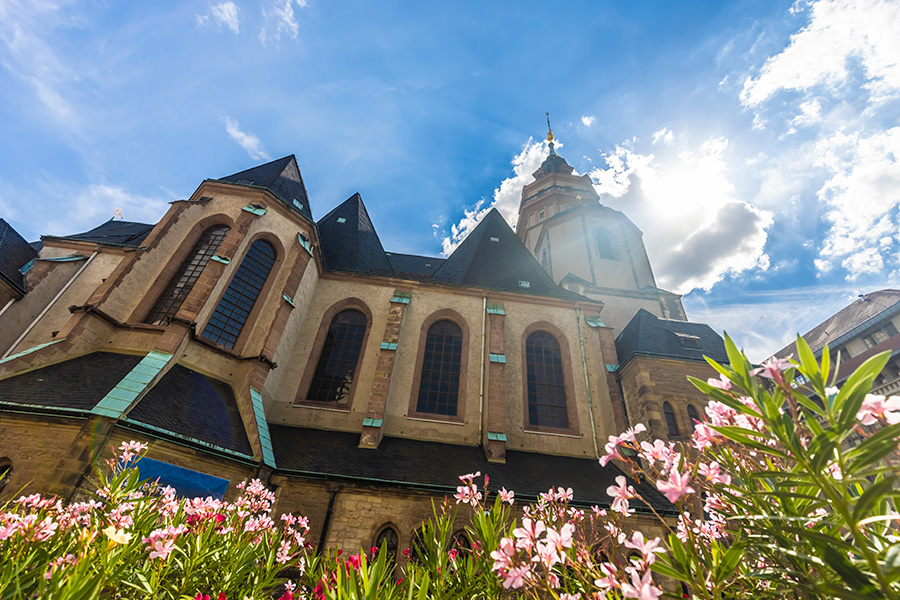
Before getting to that question, let’s review just what Bach’s cantatas were and how they functioned in their original setting. Bach wrote the bulk of his cantatas in the town of Leipzig, where they were a part of the regular Sunday Mass. From Sunday to Sunday, the performance of the cantata alternated between the town’s two main churches: the St. Thomas Church and the St. Nicholas Church. Each could seat 2,500 congregants, and on Sunday mornings, most pews were filled.
Even apart from the cantata, the service was replete with singing: the congregation sang at least five congregational hymns appointed for the day, and the choir sang all the musical ordinary of the service as well (the Kyrie, Gloria, Credo, Sanctus, and Agnus Dei). Just before the sermon (which was about an hour long) came the cantata, a special piece of music generally performed by a choir of (ideally) sixteen trained singers and a small orchestra of about twenty players. The congregation followed the performance by reading the words in a printed booklet.
The cantata was 20–30 minutes long, divided into several movements, and it elaborated upon the themes of that particular Sunday. The opening movement was usually an ornate, expansive setting of one of the hymns (or chorales, as they were called) for the day; it would employ the full musical forces of choir and orchestra. The middle movements, generally for solo singers and smaller instrumental accompaniment, might quote further stanzas from the chorale, or comment upon the text of the chorale in some way, or quote the appointed Scripture readings for that Sunday. For the closing movement, the choir sang one more stanza of the chorale, this time in a more straightforward musical setting.
That is an imposing amount of new music to perform on a weekly basis. And even without it, the church service in Leipzig could last three hours. So how did the German Lutherans in the early eighteenth century come to have such an enormous appetite for singing and hearing music in church?
Luther’s Zeal for Music
Well, for one thing, they inherited that enthusiasm from Martin Luther himself, who had lived two centuries earlier. Many readers will already know about Luther’s zeal for music-making: that he loved to sing, that he played several instruments, and that he authored both the words and the music of many hymns.
Christopher Hoyt is the organist/choirmaster at Good Shepherd Church in Tyler, Texas, and teaches Sacred Music at Cranmer Theological House (Reformed Episcopal) in Dallas. He was general editor of the hymnal, The Book of Common Praise/Magnify the Lord (2017) and is a composer of hymns and other church music (hoytcomposer.com).
Share this article with non-subscribers:
https://www.touchstonemag.com/archives/article.php?id=37-06-037-f&readcode=11170
A Journal of Mere Christianity—Delivered to Your Door
- Essays on theology, culture, and the Church
- Contributors from across the Christian traditions

Six print issues (one year) of Touchstone, plus full online access and PDF downloads for only $39.95.

Get a one-year full-access subscription to the Touchstone online archives for only $19.95.
bulk subscriptions
Order Touchstone subscriptions in bulk and save $10 per sub! Each subscription includes 6 issues of Touchstone plus full online access to touchstonemag.com—including archives, videos, and pdf downloads of recent issues for only $29.95 each! Great for churches or study groups.
Transactions will be processed on a secure server.
more on music from the online archives
33.3—May/June 2020
Bach's Cantata BWV 106, Gottes Zeit ist die allerbesteZeit (God's time is the very best time) by Ken Myers
more from the online archives
30.2—March/April 2017
Our Path to Holiness Runs Straight Through Calvary by Robin Phillips

30.6—Nov/Dec 2017
on C. S. Lewis, Brideshead Revisited & the Middle Things by Ben Reinhard
14.6—July/August 2001
The Transformed Relics of the Fall
on the Fulfillment of History in Christ by Patrick Henry Reardon
calling all readers
Please Donate
"There are magazines worth reading but few worth saving . . . Touchstone is just such a magazine."
—Alice von Hildebrand
"Here we do not concede one square millimeter of territory to falsehood, folly, contemporary sentimentality, or fashion. We speak the truth, and let God be our judge. . . . Touchstone is the one committedly Christian conservative journal."
—Anthony Esolen, Touchstone senior editor
