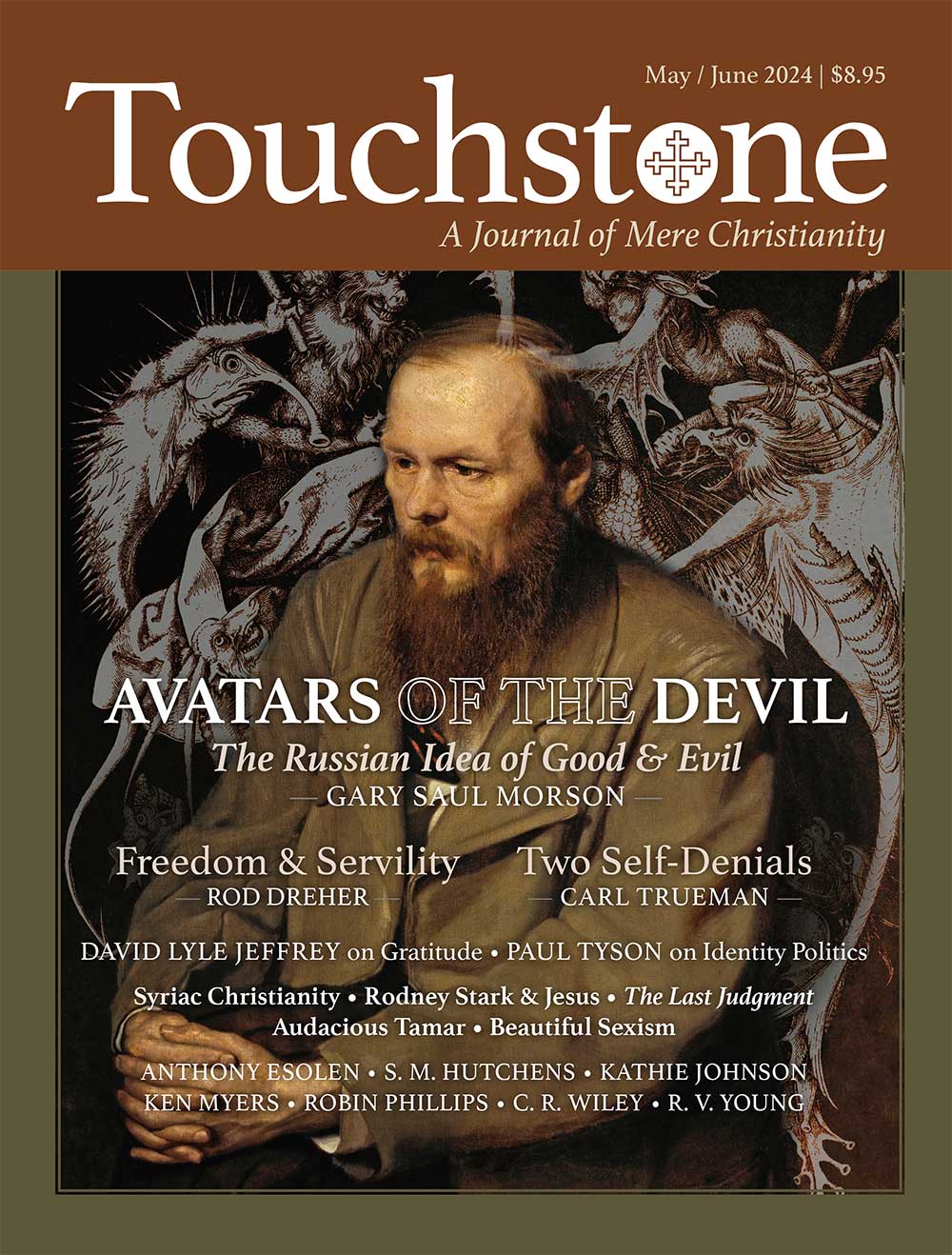
The Two Self-Denials

Why the Christian Life Threatens Modern “Progress”

The modern conflict between Christianity and the values of our contemporary culture can be understood in a number of ways. There is the obvious moral conflict between biblical sexual morality and that of our permissive and pornified age. There is the religious conflict between a faith predicated on a belief in divine revelation and a world that denies the existence of anything transcendent or immaterial. And there is the struggle between those who think of truth in terms of that which is objectively real and those who think of it in utilitarian terms. On each point, Christian orthodoxy finds itself in direct confrontation with this present age.

And yet I want to suggest that there is a further and more basic point of conflict between the two, which serves as a backdrop to these particular points of contention and which needs to be grasped in order to understand the nature of the problems that the Church faces. It is the issue of the nature and status of self-denial.

Modern Priorities & Destabilization

Numerous thinkers have characterized the present age as one in which personal satisfaction—understood as psychological contentment or well-being—is the central concern. Philip Rieff dubbed it the “Therapeutic Society,” but I’m shifting my language slightly, moving towards Leszek Kolakowski’s preferred term, the “Analgesic Society.” Both terms depict a society characterized by an increasing intolerance of suffering, on the grounds that suffering can fulfill no useful positive function. As Kolakowski expressed it:

[A]mong the outstandingly distinguishable aspects of our civilization is a belief, practiced rather than expressed, that security from suffering is worth any price, and specifically, that those goods whose values it is impossible to measure but which are unavailable without pain, are the inventions of maniacs or a residual superstition.

In short, pain—which has, among other things, generally been a necessary concomitant of personal growth and which marks the most important of human phenomena, love, as a matter of self-giving to another—is intolerable in the Analgesic Society. Far from enhancing self-development, it actually harms that development by inhibiting it.

In a similar vein, Rieff also commented that the rise of this type of society would be marked by the decline of two institutions and the rise to prominence of two others. Those declining would be the church and the nation. Those ascending would be the hospital and the theater. The reasons are simple: church and nation demand a sacrifice of the individual for something greater; hospital and theater provide the palliatives necessary to keep the individual feeling good in a world that is somewhat less than perfect. In other words, society’s institutional hierarchy would be reconfigured based on its priorities, and those priorities would increasingly focus on the comfort of the individual.

To Rieff’s list of declining and rising institutions, I would add two more. On the decline side, I would list the family, and on the ascendant, social media. The same rationale is in play with the family as with church and nation. It is an institution that demands a sacrifice of the individual for something greater. As to social media, all the evidence suggests that, far from making people feel better, it generally has the opposite effect, feeding anxieties and insecurities. But it does enable one further aspect of the modern world that is important: the need to make life a public performance in order to be truly authentic.

There are many reasons for this dramatic shift in society’s priorities, encompassing both an intellectual genealogy and the story of how the institutions of family, church, and nation have been destabilized by internal corruption and external cultural pressure. The internal corruptions of these institutions are relatively easy to delineate. For example, cheap and easy divorce has meant that the tensions and difficulties that have always marked marriages and family life are now easy to escape. Churches have been racked for decades with scandals involving leaders who use their positions to abuse the vulnerable and fleece the flock. And what nation on earth is there whose reality lives up to the myths that sustain the acts of corporate imagination necessary to maintain its existence?

Of course, these institutions have always been corrupt at some level. What is different today is the means by which that corruption is displayed for all to see, and the way it is parlayed into an influential cultural narrative that serves to eviscerate the institutions of any credibility. Social media has demolished the possibility of private space and made all news into local news. Hence, American police actions in Minneapolis can provoke protests in England and Australia. The hypocrisy of the church is on constant display in living rooms across the world through news reports of scandals. And the foibles of the family are made the plotlines of countless movies and sitcoms.

Yet it is not simply the capacity to reach a wider audience with such narratives that marks off our day from the past. It is also the appetite of the public to see such things. The scandals of the priesthood, the breakdown of the family, the collapse of narratives of patriotism are not, on the whole, greeted with sadness and lamentation. And they are certainly not presented in such a manner. Rather, they are proposed more in terms of “We told you so. Look at how you were duped into thinking these things were goods, when all along they have been tools of oppression, abuse, and lies.” And they are received in like spirit. And that indicates that there is something within our culture that facilitates precisely such a reception.


Carl R. Trueman is Professor of Biblical and Religious Studies at Grove City College in Grove City, Pennsylvania. He earned an MA in Classics from the University of Cambridge and a Ph.D. in Church History from the University of Aberdeen. He is the author or editor of over a dozen books, and is the co-host of the Mortification of Spin podcast.

A Journal of Mere Christianity—Delivered to Your Door

  • Essays on theology, culture, and the Church
  • Contributors from across the Christian traditions

Subscribe (Print + Online)

Six print issues (one year) of Touchstone, plus full online access and PDF downloads for only $39.95.

Subscribe (Online Only)

Get a one-year full-access subscription to the Touchstone online archives for only $19.95.


bulk subscriptions

Order Touchstone subscriptions in bulk and save $10 per sub! Each subscription includes 6 issues of Touchstone plus full online access to touchstonemag.com—including archives, videos, and pdf downloads of recent issues for only $29.95 each! Great for churches or study groups.

Transactions will be processed on a secure server.


more on culture from the online archives

34.1—January/February 2021

Fighting for Love

What the World Needs Now It Hardly Knows by Anthony Esolen

6.1—Winter 1993

Civilization Without Religion?

by Russell Kirk

32.5—September/October 2019

Must Say No

on When Christians Can't Compromise by Joshua Steely


more from the online archives

21.10—December 2008

Savior in a Manger

Early Christian Teaching on the Incarnation & Redemption by Patrick Henry Reardon

22.6—July/August 2009

Samurai Bioethics

on a Noble Defense Doomed by Darwinian Materialism by John G. West

22.3—April 2009

Wasted by Watching

Neil Postman's Amusing Ourselves to Death: Public Discourse in the Age of Show Business by J. Daryl Charles

calling all readers

Please Donate

"There are magazines worth reading but few worth saving . . . Touchstone is just such a magazine."
—Alice von Hildebrand

"Here we do not concede one square millimeter of territory to falsehood, folly, contemporary sentimentality, or fashion. We speak the truth, and let God be our judge. . . . Touchstone is the one committedly Christian conservative journal."
—Anthony Esolen, Touchstone senior editor

Support Touchstone

00