


Mining Middle-Earth
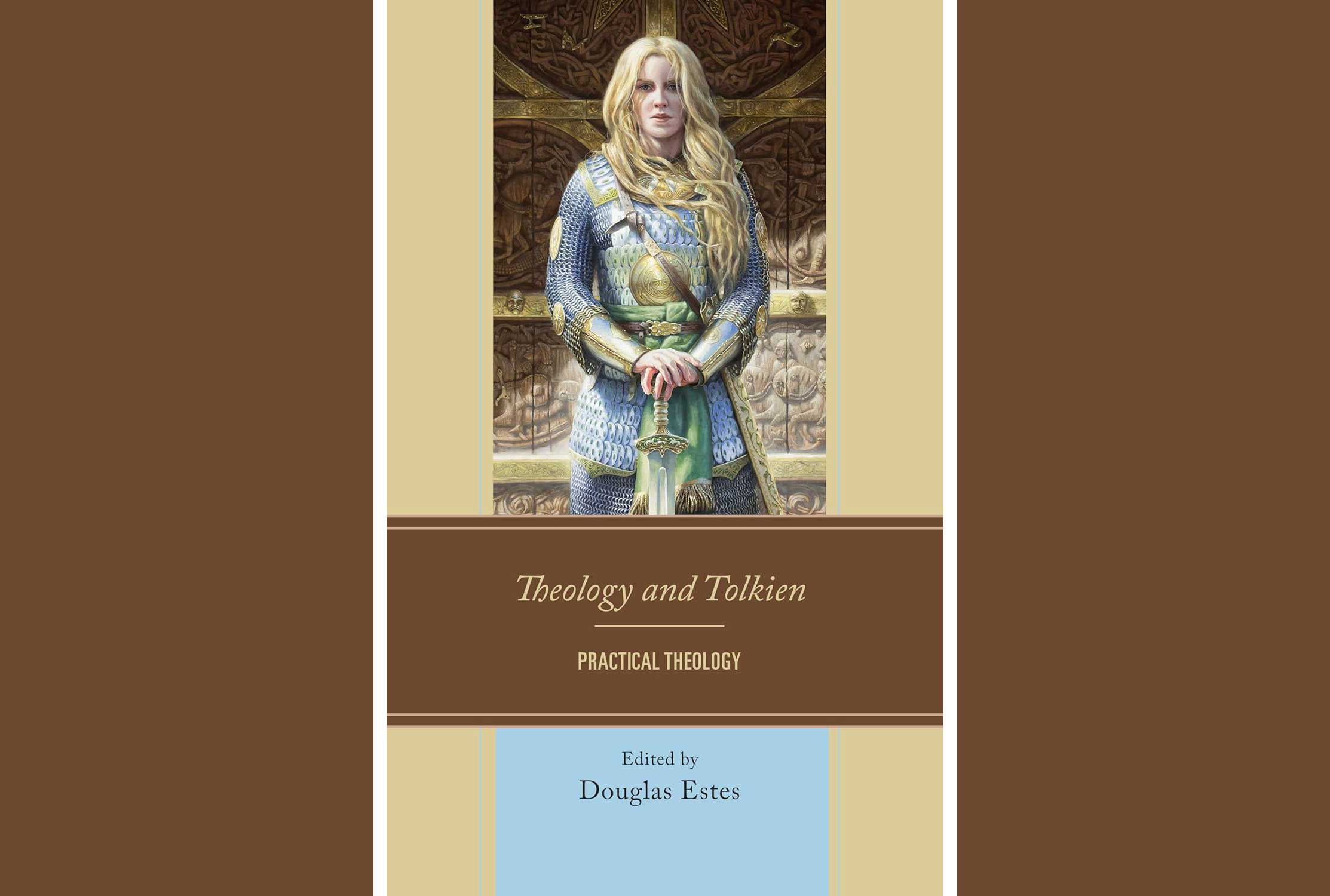
Theology and Tolkien: Practical Theology
edited by Douglas Estes
Lexington Books, 2023
(292 pages, $95.00, hardcover)
Had The Lord of the Rings never been written and the Peter Jackson film trilogy never produced, I would not be the person I am. My relationship with my children would be slightly different as well, for we communicate often through Tolkien’s words and Jackson’s images. So much of what I think about life and death, adventure and danger, choice and fate, joy and sorrow, justice and mercy—and what I’ve shared about those topics with my children—goes back to Tolkien’s epic and its incarnation on film.
For The Lord of the Rings is as much a theoretical epic as it is a practical one. It speaks in broad, sweeping strokes about the immortality of Elves and the mortality of Men, but it also forces me to ask myself what it would mean to live forever on a fallen earth. Would that be a blessing or a curse? Would I not become like Gollum or the Ringwraiths? Is that really what I want? Is death not, in some ways, a gift?
It is exciting to follow Frodo and Sam on their quest to destroy the Ring. But would I have the same courage and endurance that they had? How would I bear up under such a burden? What kind of story will my life turn out to be? I will never be asked to take a journey quite like Frodo’s, but it is nevertheless a dangerous thing to walk out my door and put my feet on the Road. The old cliché that says that life is like a road is a true one.
Douglas Estes, editor of Theology and Tolkien: Practical Theology, understands well this dimension of The Lord of the Rings: its ability to explore themes of philosophical, theological, and aesthetic profundity while simultaneously prodding its readers to apply those themes to themselves. To help clarify that dimension, Estes, who teaches at Friends University in Wichita, Kansas, has compiled fourteen essays that take up issues that are as central to the lives of Tolkien’s characters, who fight and suffer and grieve at the end of the Third Age, as they are to us, who fight and suffer and grieve at the end of the Fifth.
Fellowship
The collection begins, as it should, with a celebration of fellowship (koinonia in Greek) and the role it plays in the plot and the lives of the characters. Philip Ryken, president of Wheaton College, finds a connection between the Christian communion of the saints and the fellowship that unites the four hobbits. When Sam bears Frodo, and thus the Ring as well, on his back, he practices quite literally the biblical call for brothers in Christ to bear one another’s burdens (see Gal. 6:2). Merry’s and Pippin’s ability to remain connected in spirit to each other and to Frodo and Sam when physical distance separates them points to the way the Body of Christ extends across space and time.
The fellowship that drives the plot and makes possible the defeat of Sauron does not, however, confine itself to the hobbits. “The uncommon bond of friendship and fidelity” that unites the Nine Walkers brings
into special focus the global, multiethnic scope of Christian koinonia. The bonds of fellowship at the heart of The Lord of the Rings transcend kinship, such as the hobbits enjoy. Because of these bonds there is neither Wizard nor Warrior, neither Human nor Halfling, neither Dwarf nor Elf in the Fellowship of the Ring, but all are one in their quest to triumph over evil. (21)
Between Gimli and Legolas, in particular, we experience something akin to the breaking down of the wall between Jew and Gentile that was effected in Christ (see Eph. 2:14). If Gimli and Legolas can shatter the old ancestral wall of bitterness and distrust that have separated Dwarf from Elf since the First Age, then surely we can reconcile with the people in the next pew who think or pray or vote in a different way.
Place
As Ryken discerns a theological truth and a practical application in the fellowship that unites Hobbits with Men and Dwarf with Elf, so J. Collin Huber, senior editor at Fathom magazine, unpacks a yearning that lies within the hearts of Tolkien’s characters and readers alike. Unlike empty, abstract space, place, Huber explains after Walter Brueggemann, is a special kind of space that we endow with meaning and value. We call one of those places home, a place we both define and are defined by. We are, Huber argues, “implaced creatures” (31) who were dis-placed by the Fall and yearn to be re-placed.
Louis Markos , Professor in English and Scholar in Residence at Houston Baptist University, holds the Robert H. Ray Chair in Humanities. His 19 books include Lewis Agonistes; Restoring Beauty: The Good, the True, and the Beautiful in the Writings of C. S. Lewis; On the Shoulders of Hobbits: The Road to Virtue with Tolkien and Lewis; and From A to Z to Narnia with C. S. Lewis.
A Journal of Mere Christianity—Delivered to Your Door
- Essays on theology, culture, and the Church
- Contributors from across the Christian traditions
Six print issues (one year) of Touchstone, plus full online access and PDF downloads for only $39.95.
Get a one-year full-access subscription to the Touchstone online archives for only $19.95.
bulk subscriptions
Order Touchstone subscriptions in bulk and save $10 per sub! Each subscription includes 6 issues of Touchstone plus full online access to touchstonemag.com—including archives, videos, and pdf downloads of recent issues for only $29.95 each! Great for churches or study groups.
Transactions will be processed on a secure server.
more from the online archives
24.1—January/February 2011
Marriage Thrives in Reality, Not in Our Dreams by Nathan Schlueter
calling all readers
Please Donate
"There are magazines worth reading but few worth saving . . . Touchstone is just such a magazine."
—Alice von Hildebrand
"Here we do not concede one square millimeter of territory to falsehood, folly, contemporary sentimentality, or fashion. We speak the truth, and let God be our judge. . . . Touchstone is the one committedly Christian conservative journal."
—Anthony Esolen, Touchstone senior editor