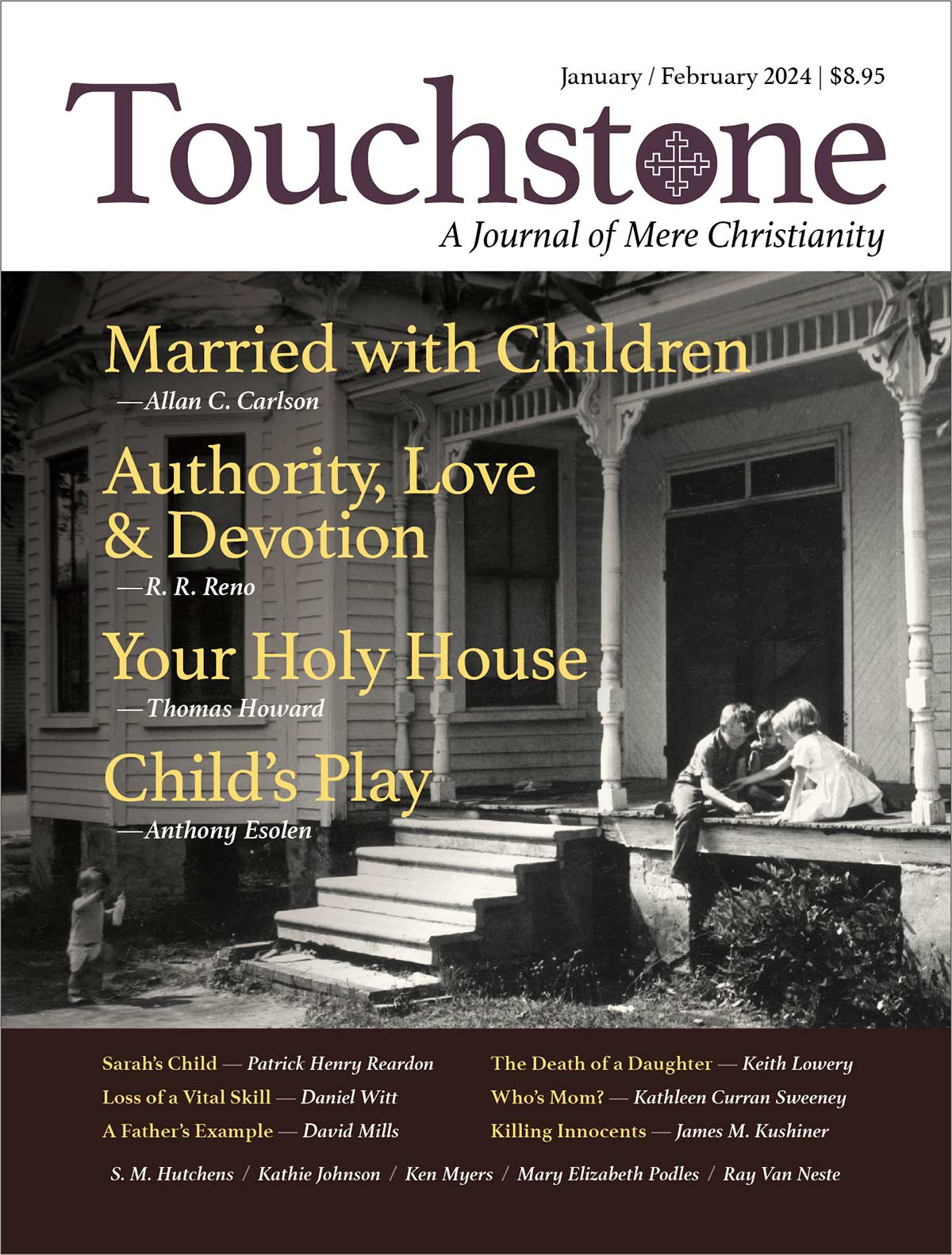
Your House as a Holy Place
Recognizing Signs of Heaven in Your Home
I have made a minuscule alteration in the title which the sponsors of this conference assigned to me for my speech. I think that in your brochures you will see this speech listed as “Your Home as a Holy Place.” I have no difficulty at all with that title; it is a good one. But for a particular (and very minor) reason, I am changing that word “home” to “house.” “Your House as a Holy Place.”
This will seem to be a quibble. But what I want to achieve by this change is simply a matter of pace, we might say. That is, I would like to move slightly more slowly into our topic. If we start with “home,” we have taken a leap, so to speak, since, as we all know, “it takes a heap o’ livin’ to make a house a home.” I am aware that that quotation from Edgar A. Guest invites only catcalls and snorts from English departments, but I am so old that this sort of thing no longer bothers me. I know it is an insupportably sentimental sentiment; nevertheless, it has a point that serves my purpose.
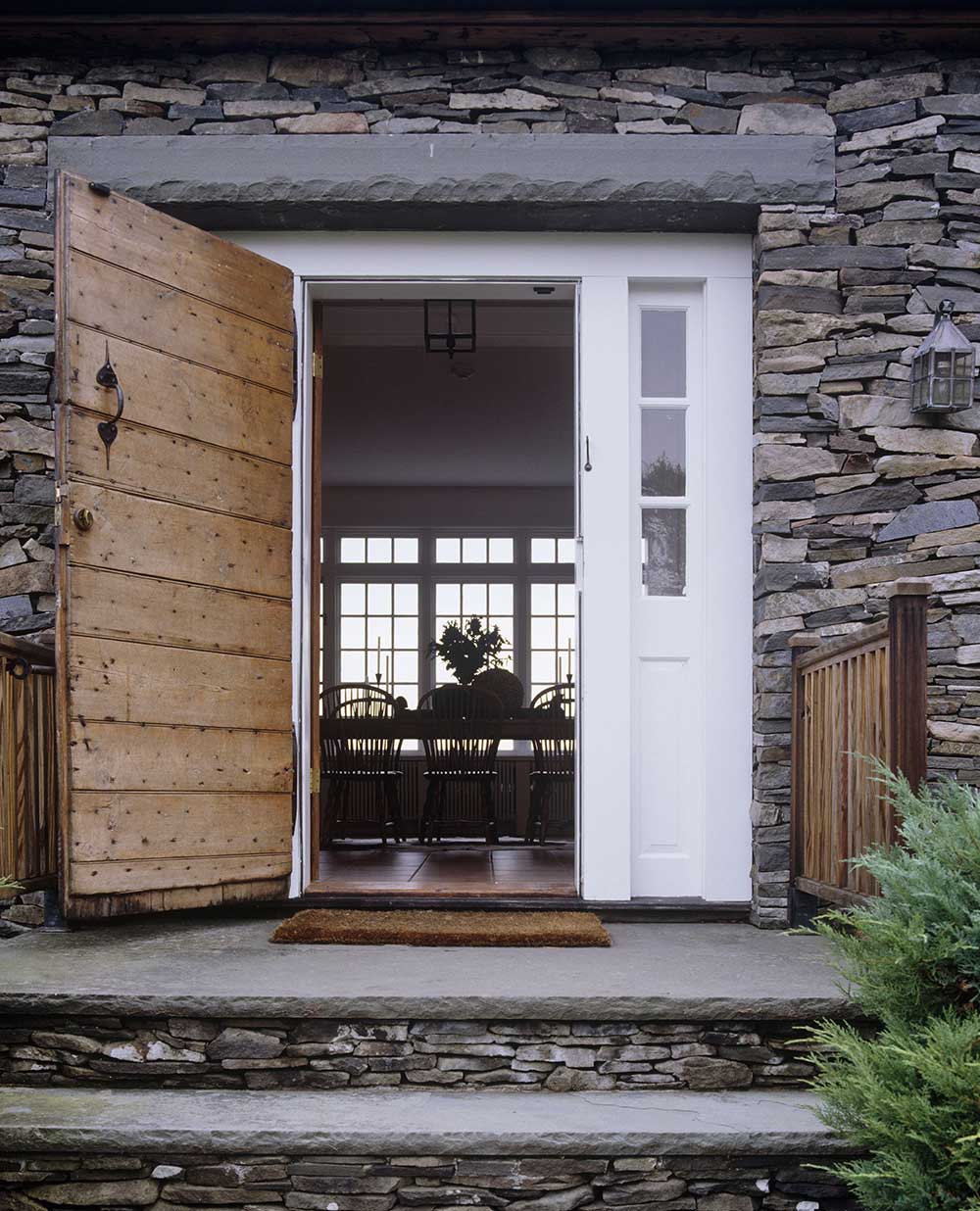
We need to begin with the house—the physical structure made of wood, brick, stone, tarpaper, mud and wattle, or whatever. The structure becomes holy by the intention with which it is brought into use. We are all familiar with this notion in any case, since most of the audience gathered here, if you are readers of Touchstone, will likely be sacramentalists; and sacramentalists know, for example, that there is water and there is holy water. Of course, we could urge that all water is holy in some ultimate sense, since it comes from God and returns to God and is his no matter what it is doing. But that would be a somewhat loose usage of the word “holy.” Waterfalls, ponds, oceans, and water flowing through municipal pipes and into our kitchen sinks, is not ordinarily called “holy,” whereas this very same water, blessed by a priest with the specific intention of bringing it into use as a sacramental, is holy, in a sense in which your ponds and waterfalls aren’t.
Or bread: what we see in the bakery window—all those crusty loaves and croissants and scones—thank God for them all, but we do not commonly regard them as holy. But when the priest takes bread and blesses it with an exact intention, then we have holy bread—the sacrament. (I am aware that the whole question of yeast is arising in the minds of many of you; but I do not wish to belabor my example here. Being a Roman Catholic myself, of course I cannot applaud the notion of croissants, say, being brought into service for the Eucharist. But my only point is that wheat, shall we say, can be made into any old bread product, or it can be the substance which is trans-substantiated into something holy.)
Can a Place Be Holy?
It is thus with houses. With holy things, we begin with something common: wheat, water, or a structure of wood, brick, or stone. Something that exists out there in the physical world. Everyone at this conference is no doubt keenly aware that we have believing Christian brethren who deny that any thing can be made holy. Holiness is a quality that can only apply to the inner man, say these good folks. You can have holy people, but there is no such thing as a holy place or a holy object. God doesn’t bless things; he blesses people. On this view, the notion that you can have holy objects—medals, relics, cloths, places, and so forth, is pagan mumbo-jumbo. But again, I am making the (I hope safe) assumption that this audience will long since have gotten that matter settled.
When it comes to houses, something has to happen to, or happen in, the house for it to become a holy place. The great clutter of activities that go on in here must be of a certain nature. They must be holy.
Oh, you mean prayer and so forth. Altars in every room. Smoke and bells. Icons. Holy hours. The rosary. Everyone whispering and tiptoeing about. Is that it?
No. Or rather, yes and no. Yes, in the sense that, if the particular house in question has been set aside as a shrine, housing, say, a relic of the True Cross, like the monastery of Heiligenkreuz outside of Vienna, then we say it is a holy place, and indeed, we do see everyone on his knees, or tiptoeing, or speaking quietly, if at all. But at this conference we are considering the hallowing of ordinary family households. And in those establishments we have shouts and laughter and sneakers lying about and leftover crusts of pizza and the TV Guide and jackets thrown down all higgledy-piggledy. Nothing that says very obviously, “holy.”
(I suppose I should add here that the Victorian household in which I grew up, not to mention the household that my wife and I ran as our children were growing, did not have all that clutter: we were all punctiliously tidy—but of course that quality didn’t guarantee holiness.)
What Is the Holy?
Which immediately raises the next big question: what, then, is the holy? As we know, the word refers in its ordinary usage to “that which belongs to God.” But of course God himself is “holy.” What does that mean? This is very difficult to chase down, mainly because God and all of his attributes are so far beyond our bravest efforts to grasp, that insofar as we speak of him at all, we know that we scarcely know what we are saying.
Thomas Howard taught for many years at St. John's Seminary College, the Roman Catholic seminary of the archdiocese of Boston. Among his many works are the books Christ the Tiger, Evangelical Is Not Enough, Lead Kindly Light, On Being Catholic, and The Secret of New York Revealed, and a videotape series of 13 lectures on "The Treasures of Catholicism" (all from Ignatius Press).
A Journal of Mere Christianity—Delivered to Your Door
- Essays on theology, culture, and the Church
- Contributors from across the Christian traditions

Six print issues (one year) of Touchstone, plus full online access and PDF downloads for only $39.95.

Get a one-year full-access subscription to the Touchstone online archives for only $19.95.
bulk subscriptions
Order Touchstone subscriptions in bulk and save $10 per sub! Each subscription includes 6 issues of Touchstone plus full online access to touchstonemag.com—including archives, videos, and pdf downloads of recent issues for only $29.95 each! Great for churches or study groups.
Transactions will be processed on a secure server.
more on conference talk from the online archives
more from the online archives
35.4—Jul/Aug 2022
The Death Rattle of a Tradition
Contemporary Catholic Thinking on the Question of War by Andrew Latham
calling all readers
Please Donate
"There are magazines worth reading but few worth saving . . . Touchstone is just such a magazine."
—Alice von Hildebrand
"Here we do not concede one square millimeter of territory to falsehood, folly, contemporary sentimentality, or fashion. We speak the truth, and let God be our judge. . . . Touchstone is the one committedly Christian conservative journal."
—Anthony Esolen, Touchstone senior editor