





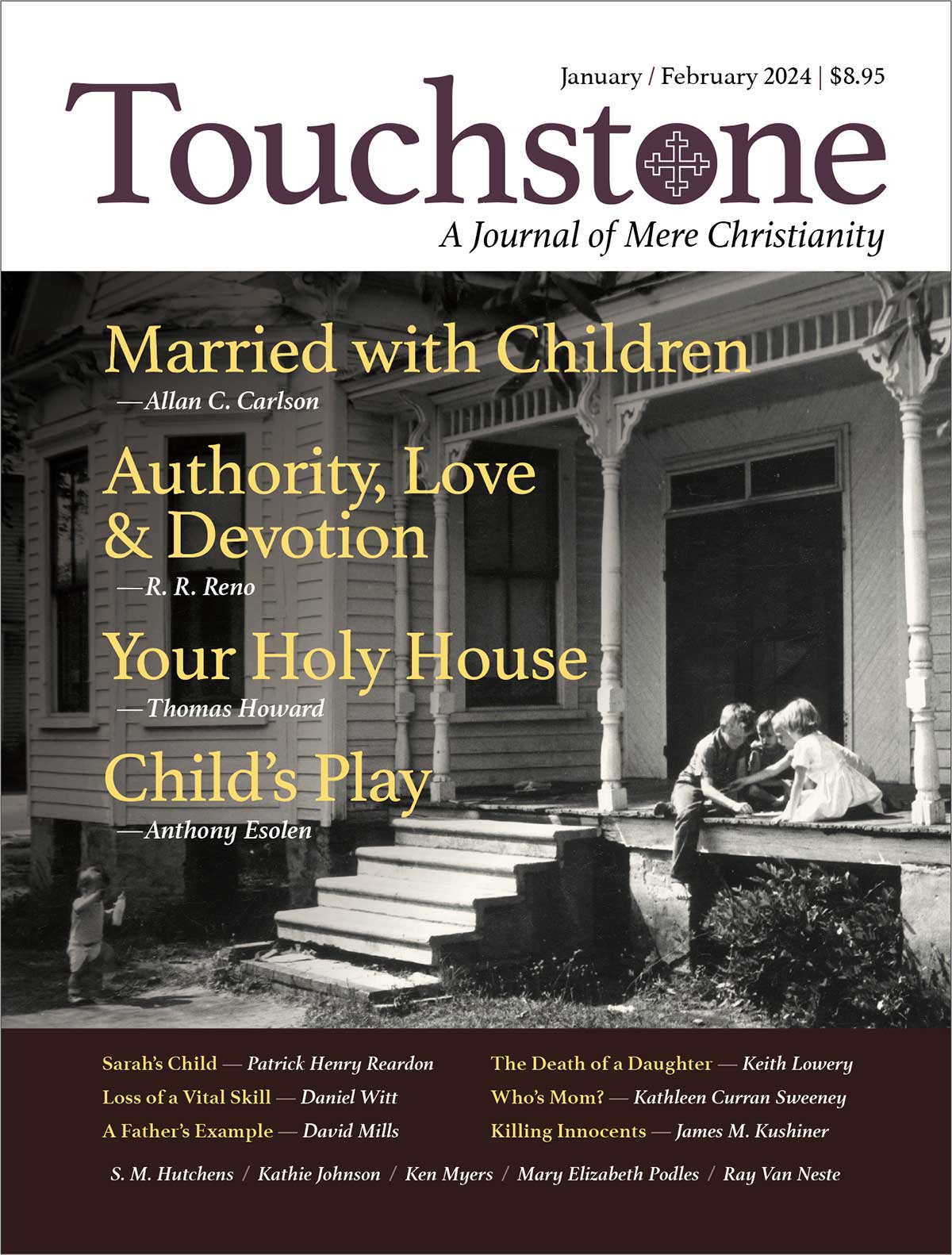
What Good Is Marriage?
The Deliberate Demise of Augustine-Christian Marriage
by
Allan C. Carlson
It is surely unhealthy to become depressed over statistics. As the modern proverb has it, there are lies, damn lies, and then come statistics. Still, I went into a funk six months ago after reading the results of a survey on parenting by the reliable Pew Research Center. The researchers asked two thousand active parents if it was important to them whether their children did certain things once they became adults. A stunning 88 percent said it was extremely or very important that they “be financially independent” and “have jobs or careers they enjoy.” In contrast, only 21 percent said it was extremely/very important that their grown children marry, and a mere 20 percent that they have children of their own.
One response is that perhaps the parents being queried will come to appreciate the merits of grandchildren a little later on (for as another modern proverb puts it, the only reason to endure parenthood is to gain grandkids). Or, on a perhaps more troubling note, we see here clear evidence of the triumph of capitalism over familism, of mammon over posterity. However, I prefer to see such numbers as signs of the repudiation of good St. Augustine.
These thoughts came back to me over the past weekend as I attended an extended-family wedding. The bride was lovely and glowing, the groom overflowed with joy, and the wedding was properly conducted, even in a “mainline” church dedicated, according to its pew cards, first and foremost to Diversity. Still, the event was, in a way, post-Augustinian. To begin with, and as is now normal, the couple had already been living together for several years. The post-Augustinian status could also be seen in the ages of the bride and groom: she was 35; he near 40. Today, that is only somewhat above the average for all first marriages. While I was told that they hope to have children, they probably know that for first-timers the biological deck is now stacked against them. In contrast, a half-century ago, when my wife and I were married, in the very last year of the Augustinian dispensation in America, I was 23 and she was 22; even then, we were on the old side for newlyweds. Children, moreover, were a reasonable expectation.
The Augustinian Tradition
Why drag Augustine into this? As in just about everything else of importance, Christian marriage owes its operational definition to his “mental universe” (a phrase borrowed from the legal scholar Charles J. Reid, Jr.). Writing at the end of the fourth century A.D., Augustine faced two challenges: the Manichaeans, a heretical sect which so focused on the spirit that they fully rejected reproductive intercourse; and the pagan Romans, among whom concubinage, adultery, prostitution, homosexuality, and easy divorce were common. Citing the innate “sociability” of humankind and “a natural companionship between the sexes,” the church father defined the “goods” of marriage as procreation, fidelity, and sacramental permanence. Rejecting both extreme asceticism and hedonism, Augustine affirmed that “the marriage of man and woman is something good.”
These principles flowed into the sixth century’s Code of Justinian, which inaugurated the formal influence of Christianity on family law. In 1140, the canonist Gratian compiled a vast legal treatise, the Decretum. Concerning marriage, he emphasized its procreative purpose, condemning those who used the “poisons of sterility” to prevent conception. A century later, Thomas Aquinas stressed that marriage rested on the natural law and was designed for both the spiritual and emotional communion of the spouses and the procreation and education of children. While the Augustinian monk and reformer Martin Luther tossed out the sacramental nature of marriage, he recast the marital bond as the highest order and calling on earth, adding: “We were all created to do as our parents have done, to beget and rear children.” Even among the Anglicans, a church body that could be described (albeit without charity) as the offshoot of a nasty divorce, Augustine’s three “goods” remained definitive. Early eighteenth-century canonist John Ayliffe, for example, embraced the “three-fold matrimonial Good” in his description of marriage.
The Augustinian tradition forcefully entered American law through the writings of the New York justice, Chancellor James Kent (1763–1847). He emphasized how marriage was grounded in the “law of nature,” which he understood as “those fit and just rules of conduct which the Creator has prescribed to man.” As Kent wrote in his influential Commentaries on American Law: “The . . . most important of the domestic relations is that of husband and wife. It has its foundation in nature, and is the only relation by which Providence has permitted the continuance of the human race.”
Augustine’s affirmation of marriage as a natural institution with its own claims and protections lasted well into the twentieth century. In a 1942 decision striking down a eugenic sterilization law, for example, the U.S. Supreme Court declared, “Marriage and procreation are fundamental to the very existence and survival of the race.” And as late as 1971, the Minnesota Supreme Court could opine that the “institution of marriage as a union of man and woman, uniquely involving the procreation and rearing of children within a family, is as old as the book of Genesis.”
Marriage Denuded
The U.S. Supreme Court put an end to this in 1972. As Gratian, perhaps, had foreseen, the immediate issue was birth control. Seven years earlier, in its Griswold v. Connecticut decision, the Court—citing a newly discovered “right of privacy” in the “penumbra” of the Constitution—had struck down a law banning the use of contraceptives within marriage. In doing so, it did give a final, cynical nod to Augustine, citing the “sacred precincts of marital bedrooms.” In its new decision in the case of Eisenstadt v. Baird, the Court extended the same right of contraception to the unmarried. In so doing, it used an argument that in effect abolished legal marriage as a natural institution with divinely ordained claims of its own. As the key sentence put it: “the marital couple is not an independent entity with a mind and heart of its own, but an association of two individuals each with a separate intellectual and emotional make-up.” By intent and effect, this repudiated not only the “one flesh” physical union highlighted in the Old Testament. The logic of the decision also rejected the equally if not more important union of purpose, spirit, and identity emphasized in the New Testament.
And that was it. Subsequent court decisions, supplemented by legislative acts such as no-fault divorce, have left marriage denuded of status. Back in 1888, the Supreme Court had described marriage as “something more than a mere contract”; rather, it was “an institution, in the maintenance of which in its purity the public is deeply interested, for it is the foundation of the family and of society.” Today, legal marriage is weaker than any contract and—except by coincidence—has no relation whatsoever to procreation and the rearing of children. Accordingly, relatively early marriage—designed to accommodate natural and healthy human fertility patterns—is no longer relevant. Indeed, judged against the Augustinian framework, legal marriage in America today means nothing . . . which may be why “same-sex marriage” crept in so effectively.
I disagree with those who argue that this change was the result of a cultural shift, with the Court simply giving to a post-Christian, contracepting, fornicating majority what they wanted. No; this was the result of elites in control of legal institutions deliberately wrecking an Augustinian-Christian marriage system, for their own ideological ends. In so doing, they successfully turned the law into a teaching tool that has served Eros unleashed and devastated tens of millions of lives.
Survival & Encouragement
Allan C. Carlson is the author of numerous books, including Family Questions: Reflections on the American Social Crisis and The American Way: Family and Community in the Shaping of the American Identity. He attends St. Paul Lutheran Church in Rockford, Illinois. He is a senior editor of Touchstone.
A Journal of Mere Christianity—Delivered to Your Door
- Essays on theology, culture, and the Church
- Contributors from across the Christian traditions

Six print issues (one year) of Touchstone, plus full online access and PDF downloads for only $39.95.

Get a one-year full-access subscription to the Touchstone online archives for only $19.95.
bulk subscriptions
Order Touchstone subscriptions in bulk and save $10 per sub! Each subscription includes 6 issues of Touchstone plus full online access to touchstonemag.com—including archives, videos, and pdf downloads of recent issues for only $29.95 each! Great for churches or study groups.
Transactions will be processed on a secure server.
more on Marriage from the online archives

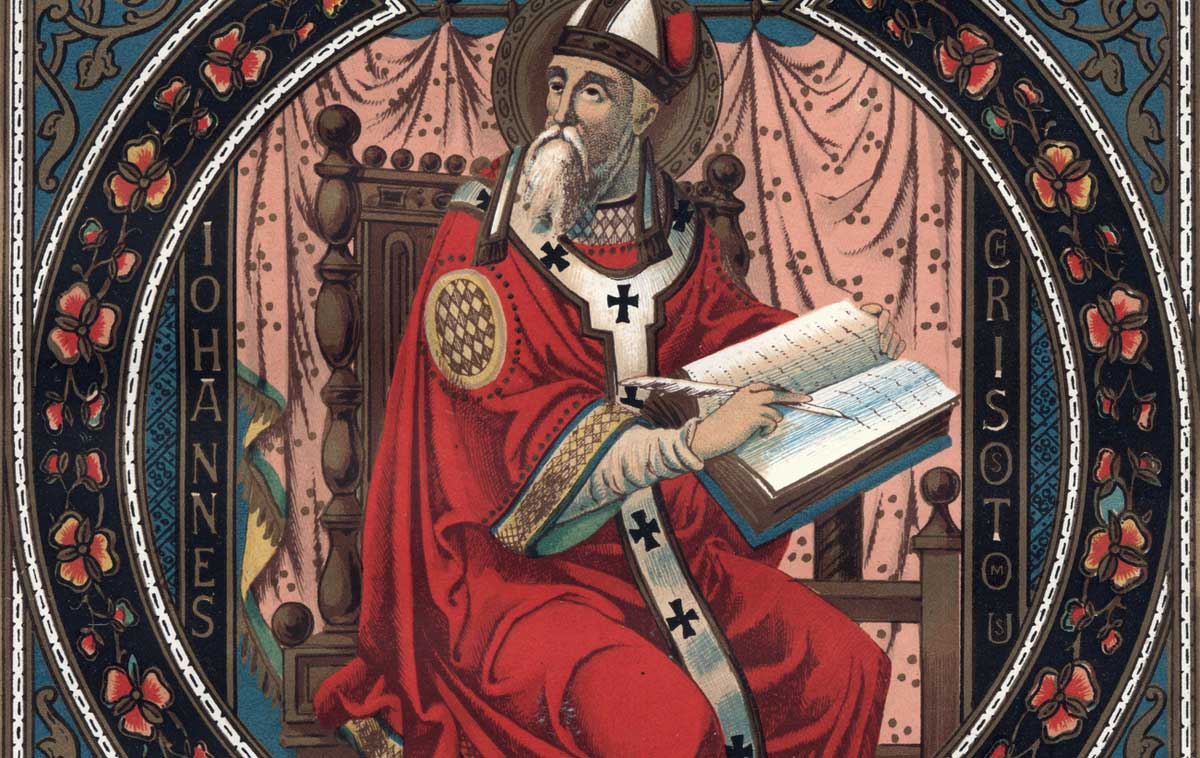
21.1—January/February 2008
John Chrysostom’s Discovery of the Blessings & Mysteries of Marriage by Mike Aquilina

28.1—January/February 2015
on State Impositions & Church Acquiescence by Stephen Baskerville
more from the online archives

16.5—June 2003
on the Importance of Fathers to Churchgoing by Robbie Low


calling all readers
Please Donate
"There are magazines worth reading but few worth saving . . . Touchstone is just such a magazine."
—Alice von Hildebrand
"Here we do not concede one square millimeter of territory to falsehood, folly, contemporary sentimentality, or fashion. We speak the truth, and let God be our judge. . . . Touchstone is the one committedly Christian conservative journal."
—Anthony Esolen, Touchstone senior editor
