




Frogs & Friendship
One consolation of spotty education is the opportunity to read texts later in life that you wish you had read much earlier but that fell through the cracks until you were mature enough to appreciate them more fully. Such was the case for me reading Gregory of Nyssa’s charming, instructive The Life of Moses, an account of the Christian life read into the Exodus story through the actions of its chief protagonist, Moses.
A bishop of Cappadocia (in modern-day Turkey), Gregory was the younger brother of Basil of Caesarea; together with their friend Gregory of Nazianzus, they are collectively referred to as the “Cappadocian Fathers,” key shapers of and advocates for Nicene Christianity at a crucial time (the 300s) in the Church’s doctrinal formation and highly revered in most traditional strands of Christianity, not least among the Eastern Orthodox.
As those steeped in early-Church studies well know, allegorical or figural interpretation of the Old Testament is the coin of the realm for the Church Fathers, that is, the ability to read these Scriptures for how they anticipate or prefigure New Testament motifs and stories and/or how they might speak directly to the joys and travails of Christian discipleship. Gregory calls this the “spiritual interpretation” or “loftier interpretation,” requiring “some subtlety of understanding and keenness of vision.”
Sometimes the “loftier” associations are apparent—say, the sacrifice of Isaac as prefiguring Christ’s atonement, or Abraham and Sarah’s three visitors as an initial anticipation of the Trinity—but sometimes they are not, or they at least require an insightfully creative theological imagination.
Shunning Evil & Pursuing Virtue
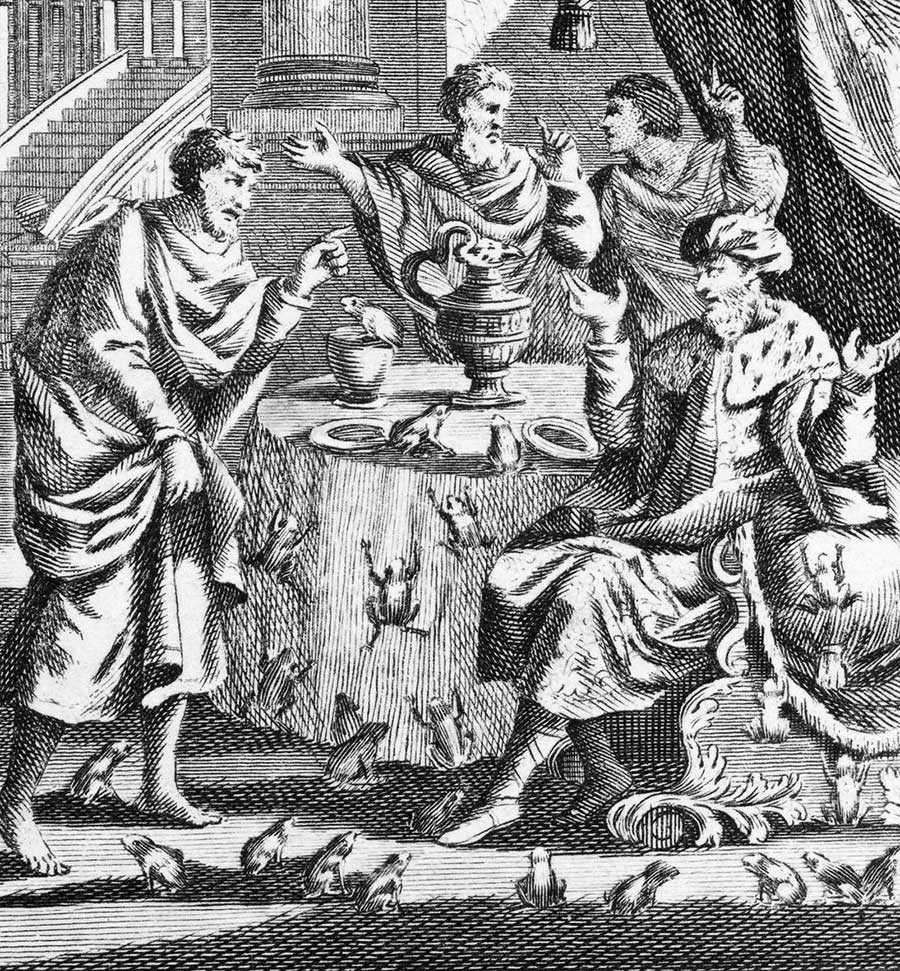
Take, for instance, the frogs among the plagues that God visits upon Egypt prior to the Jews’ departure. These “ugly and noisy amphibians” with “foul-smelling skin” represent, in Gregory’s eyes, nothing less than the evil from which we all should flee. “The breed of frogs is obviously the destructive offspring of the evil which is brought forth from the sordid heart of man,” he writes, adding that “being a man by nature and becoming a beast by passion, this kind of person [given to evil] exhibits an amphibious form of life [that is] ambiguous in nature.” The mature Christian should thus shun evil, fleeing from anyone who is ostensibly upstanding but really “froglike and fleshy.” “And if you search the storeroom, that is to say, the secret and unmentionable things of his life,” Gregory continues, “you will discern there in his licentiousness a much greater pile of frogs.”
Gregory espies a very different allegorical meaning in the priestly vestment made for Aaron as indicated in Exodus 28:33: “On its skirts you shall make pomegranates of blue and purple and scarlet stuff, around its skirts, with bells of gold between them” (RSV).
What do the bells and pomegranates represent? Faith and conscience, of course. “The golden bells alternating with pomegranates represent the brilliance of good works,” Gregory writes. “They are the two pursuits through which virtue is acquired, namely through faith toward the Divine and conscience toward life. . . . So let faith sound forth pure and loud in the preaching of the holy Trinity, and let life imitate the nature of a pomegranate’s fruit.”
How might one accomplish the latter?, it merits asking. Gregory pounces with an answer, connecting conscience to the philosophical life devoted to truth-seeking and virtuous action:
Because it is covered with a hard and sour rind, its [the pomegranate’s] outside is inedible, but the inside is a pleasant sight with its many neatly ordered seeds, and it becomes even sweeter when it is tasted. The philosophical life, although outwardly austere and unpleasant, is yet full of good hopes when it ripens. For when our Gardener opens the pomegranate of life at the proper time and manifests the hidden beauty, then . . . [all] will enjoy the sweetness.
Becoming God’s Friend
Additional arresting features of Gregory’s thought include his attitude toward classical learning—his insistence that, while some sure things can be known of the Divine Being, God’s ultimate nature remains unfathomable from a human standpoint; yet, even so, friendship with God is superlatively desirable.
Thomas Albert Howard is Professor of Humanities and holder of the Phyllis and Richard Duesenberg Chair in Christian Ethics at Valparaiso University.
A Journal of Mere Christianity—Delivered to Your Door
- Essays on theology, culture, and the Church
- Contributors from across the Christian traditions

Six print issues (one year) of Touchstone, plus full online access and PDF downloads for only $39.95.

Get a one-year full-access subscription to the Touchstone online archives for only $19.95.
bulk subscriptions
Order Touchstone subscriptions in bulk and save $10 per sub! Each subscription includes 6 issues of Touchstone plus full online access to touchstonemag.com—including archives, videos, and pdf downloads of recent issues for only $29.95 each! Great for churches or study groups.
Transactions will be processed on a secure server.
more on Theology from the online archives
31.6—November/December 2018
on Futility & the Open Door to Deliverance by Patrick Henry Reardon
31.4—July/August 2018
Life & Love Are Real Despite Theatrical Illusions by Anthony Esolen

33.2—March/April 2020
on How Bodily Resurrection Informs Social Justice by W. Ross Blackburn
more from the online archives

33.2—March/April 2020
Lewis, Chesterton, et al. Against the Frauds, Experts & Revisionists by Vigen Guroian

23.1—January/February 2010
It’s Bent on Bringing Down the House on the Family & the Church by Douglas Farrow
calling all readers
Please Donate
"There are magazines worth reading but few worth saving . . . Touchstone is just such a magazine."
—Alice von Hildebrand
"Here we do not concede one square millimeter of territory to falsehood, folly, contemporary sentimentality, or fashion. We speak the truth, and let God be our judge. . . . Touchstone is the one committedly Christian conservative journal."
—Anthony Esolen, Touchstone senior editor
